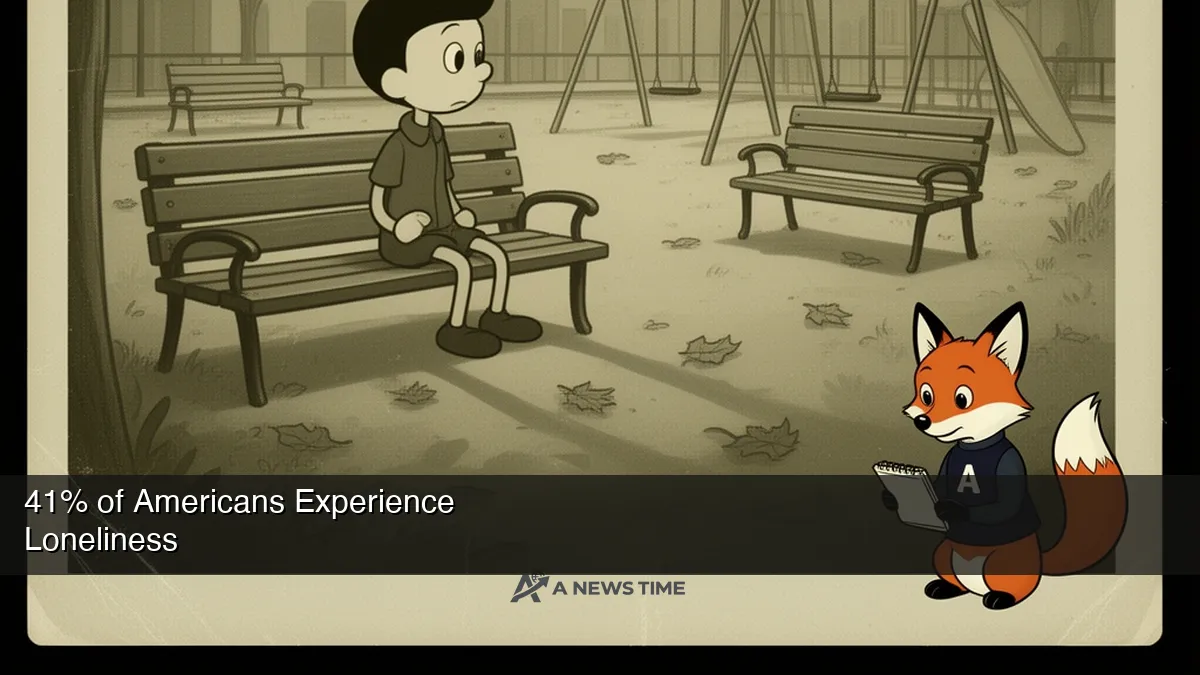
The numbers arrived quietly, as many disturbing statistics do: in a national survey released in January 2026, 41 percent of Americans reported experiencing loneliness. That figure, drawn from research commissioned by the Barnes Family Foundation and conducted in partnership with Dr. Julianne Holt-Lunstad, one of the world's leading researchers on social isolation, was not entirely surprising to those who have been tracking this issue. But the granular data beneath that headline number tells a story that goes beyond a simple survey statistic and into something more structurally significant about how Americans are living now.
The Architecture of American Isolation
Loneliness, as researchers like Holt-Lunstad define it, is the subjective experience of having fewer meaningful social connections than you want or need. It is distinct from solitude (voluntary aloneness) and from objective social isolation (literally being without contact with other people), though these states can overlap and reinforce one another. The distinction matters because you can be surrounded by people and feel profoundly lonely, or you can spend significant time alone and feel well-connected. The survey's findings illuminate both dimensions.
The 41 percent figure represents subjective loneliness, but the behavioral data paints a picture of objective social impoverishment as well. Seventy-two percent of respondents reported that they rarely or never get together with people they care about. Two-thirds said they never participate in clubs, organizations, or community groups. More than half never volunteer. These are not marginal behaviors that a small subset of people engages in; they are civic and social practices that previous generations treated as normal features of community life, now largely absent from most Americans' routines.
Dr. Holt-Lunstad, whose research over the past two decades has established the health consequences of social isolation with a precision that rivals the data on smoking and obesity, was unambiguous in her interpretation. "It's not just that we're feeling alone," she said. "We are objectively alone." That dual framing, subjective experience confirmed by behavioral data, is what makes the survey results particularly significant. It is not a story about perception or anxiety; it is a story about how Americans are actually spending their time and organizing their social lives.
Who Is Affected and How
The survey's economic breakdown reveals a structural dimension to loneliness that gets less attention than the age and gender narratives that dominate coverage of this topic. Americans earning under $75,000 annually are faring considerably worse on nearly every measure of social connection than those earning more. This threshold is significant: approximately 100 million Americans fall below it. The mechanisms connecting income to social isolation are multiple and mutually reinforcing. Lower-income Americans are more likely to work multiple jobs with irregular schedules that make social planning difficult. They are more likely to live in communities where the civic infrastructure, the libraries, community centers, parks, and third places that facilitate spontaneous social connection, has been defunded or allowed to deteriorate. They are more likely to rely on cars rather than public transit, which eliminates the incidental social contact that walking and transit commuting provide. And they are less likely to have the financial buffer that makes discretionary social spending, attending events, eating out with friends, hosting gatherings, possible.
The gender and age data adds another layer. Research published by AARP has found that Generation X men are lonelier than women over 50, a reversal of the pattern observed in older generations where widowed women faced greater isolation risk than men. Fifteen percent of men report having no close friends at all, a figure that has increased substantially over the past two decades. This male isolation pattern is connected to a broader cultural shift: the peer-based friendships that men in previous generations maintained through workplaces, religious institutions, and civic organizations are no longer being reliably replaced as those institutions thin out. Men in their 40s and 50s, who are past the life stages (school, early career, young children) that most naturally generate social connection, often find themselves without the structural scaffolding for friendship and struggling to build it deliberately.
For younger adults, a separate research thread offers a different but related picture. A study from the University of Zurich, led by psychologist Michael Krämer, tracked social connection and life satisfaction in adults between the ages of 16 and 29. The research found that prolonged singlehood in this age group, defined not just as the absence of a romantic partner but as the cumulative experience of extended periods without one, is associated with declining life satisfaction and increasing loneliness over time. The effect was not instantaneous but accumulated: young adults who spent years in singlehood, even when they were otherwise socially active, showed a gradual erosion of the subjective sense of being well-connected.
The Health Stakes
The reason that public health researchers like Holt-Lunstad care so deeply about social connection data is that the health consequences are not abstract or speculative. More than two decades of research have established that chronic loneliness and social isolation are associated with a significantly elevated risk of premature death, with effect sizes comparable to smoking 15 cigarettes a day. The mechanisms are multiple: loneliness activates chronic low-grade inflammatory responses, disrupts sleep architecture, impairs immune function, elevates cortisol over the long term, and increases the risk of cardiovascular disease, cognitive decline, and clinical depression.
The cognitive dimension is particularly salient in 2026, as the population ages and dementia prevention becomes a public health priority. Research has consistently found that social engagement is one of the most robust modifiable risk factors for cognitive decline, more protective than many pharmaceutical interventions that have been tested. The mechanisms involve both the cognitive stimulation that social interaction provides and the stress-buffering effects of feeling connected and supported. Isolation removes both. The evidence connecting social isolation to brain health and Alzheimer's risk is increasingly robust, as examined in work on how chronic inflammatory states affect long-term health outcomes.
The Barnes Family Foundation's decision to fund the survey through 2050 reflects an understanding of the long-term nature of this problem. Dan Barnes, who leads the foundation, framed the issue in terms that go beyond individual health: "Social connection is the bedrock for creating a prosperous and thriving future." That framing connects individual loneliness to collective capacity, the idea that a society of disconnected individuals is less resilient, less innovative, less capable of collective action in response to shared challenges. The public health case and the civic case for social connection turn out to be the same case.
The Digital Paradox
Any honest examination of American loneliness has to grapple with the paradox at the center of our current social reality: we have never been more digitally connected and never, by some measures, more genuinely alone. The average American spends several hours daily on social media and messaging platforms. They are in near-constant communication with acquaintances, colleagues, and the parasocial presences of content creators and celebrities. Yet 41 percent report loneliness, and 72 percent rarely gather with people they care about.
The resolution of this paradox lies in the distinction between the kinds of social contact that digital platforms provide and the kinds that human nervous systems actually need. Research on social connection and health consistently finds that the protective effects come primarily from in-person contact, from shared physical presence, touch, eye contact, the full bandwidth of human social communication. Digital communication is not without value: it can maintain connections across distances, provide a sense of ambient social presence, and facilitate the planning of in-person gatherings. But it does not deliver the physiological effects of genuine co-presence, the cardiovascular synchrony, the oxytocin release, the vagal tone regulation that in-person social contact produces.
There is also evidence that passive social media consumption, scrolling through others' highlight reels without engaging, can actively worsen the subjective experience of loneliness by activating social comparison mechanisms that heighten the felt sense of exclusion. The platforms that promised to connect us have, in significant ways, substituted a low-nutrient form of social contact for the high-nutrient form, and the health consequences of that substitution are beginning to register in population-level data.
The neuroscience of this dynamic connects to broader research on how the nervous system processes social signals. The emerging field of neurowellness is beginning to examine how social isolation affects autonomic nervous system regulation, the finding that chronic loneliness keeps the sympathetic nervous system in a state of elevated vigilance that is physiologically indistinguishable from threat detection. Being alone, in an evolutionary context, meant being vulnerable to predators and exclusion from protective group resources. The nervous system has not had time to update for the modern context in which aloneness is a lifestyle choice rather than an existential threat.
What Structural Solutions Look Like
The scale of the loneliness problem, affecting 41 percent of Americans, makes it clear that individual-level solutions, though valuable, are insufficient. A problem of this magnitude has structural causes and will require structural responses. Researchers and policy advocates are beginning to articulate what those might look like.
The investment in civic infrastructure is one clear area. The decline of libraries, community centers, parks with amenities, and other publicly funded "third places" (spaces that are neither home nor work) has removed the environments in which incidental social connection most naturally occurs. When people have nowhere to go that facilitates low-stakes interaction with neighbors and fellow community members, they default to private spaces and digital environments, both of which provide less of the spontaneous social contact that builds the weak ties that research has shown to be important for both wellbeing and social mobility.
Workplace policy is another lever. The shift to remote and hybrid work has delivered genuine benefits for flexibility and autonomy, but it has also eliminated the ambient social contact that offices provided, contact that was often undervalued precisely because it required no deliberate effort. Organizations that are thoughtful about this are designing intentional connection practices into their remote work cultures, not as a substitute for in-person connection but as an acknowledgment that connection in distributed workplaces requires active cultivation rather than passive reliance on proximity.
The healthcare system is increasingly recognizing social isolation as a clinical risk factor that belongs in medical records alongside blood pressure and BMI. Several health systems have begun "social prescribing" programs that allow clinicians to refer patients experiencing loneliness to community programs, volunteer opportunities, and social groups as part of their care plan. The evidence base for social prescribing is still developing, but early results from programs in the UK and parts of the US are promising.
The Long View: A Survey Built for 2050
The Barnes Family Foundation's decision to fund longitudinal tracking of social connection data through 2050 is itself a signal worth noting. Most wellness surveys are one-time snapshots; this one is designed to track change over a generation. That framing reflects a recognition that the forces driving American loneliness, the thinning of civic institutions, the economic pressures on lower-income households, the structural inadequacy of digital substitutes for in-person connection, are not problems that will resolve quickly or without deliberate effort.
Holt-Lunstad's framing of the issue suggests that the stakes are high enough to warrant that long-term investment. The public health infrastructure that eventually addressed tobacco use, air pollution, and physical inactivity took decades to build and required sustained research, public communication, and policy change. Social connection, Holt-Lunstad and others argue, deserves the same level of sustained institutional attention.
For individuals navigating this landscape in 2026, the research points toward a few consistent findings. Quality matters more than quantity: having three or four relationships characterized by genuine mutual support and regular in-person contact confers more health benefit than having dozens of superficial connections. Structural commitments, joining an organization, committing to a regular gathering, building connection into the architecture of daily life rather than relying on spontaneous motivation, are more reliable generators of social contact than intention alone. And the health benefits of social connection are not reserved for the young or the extroverted; they accrue across the lifespan, with evidence suggesting that the protective effects are actually strongest for middle-aged and older adults.
The AARP's finding that Gen X men are experiencing particularly high rates of loneliness, combined with the 15 percent of men who report no close friends at all, suggests that the coming years will see growing cultural attention to male social connection as a specific public health challenge. The silence around men's loneliness, rooted in cultural norms that discourage men from expressing emotional needs or actively seeking friendship, is itself part of the problem. Research has found that men, once they do have close friendships, report similar health benefits to women but face higher structural and cultural barriers to forming and maintaining those friendships in the first place.
The Barnes Family Foundation survey will track whether any of these patterns change over the coming decades. The measurement itself is an act of intention: a society that systematically tracks its own social health is at least beginning to treat it as the public health priority that the evidence suggests it should be.
Sources
- Barnes Family Foundation / Holt-Lunstad, Julianne. "State of Social Connection in America Survey 2026." WITF / Barnes Family Foundation, January 2026. witf.org
- Krämer, Michael D., et al. "Prolonged Singlehood and Life Satisfaction Trajectories in Young Adults." Phys.org / University of Zurich, 2026. phys.org
- AARP Research. "Loneliness and Social Connection Among Men 50+." AARP, 2025. aarp.org
- National Organization for Women. "Economic Factors in Social Isolation: Women and Low-Income Americans." NOW.org, 2025. now.org