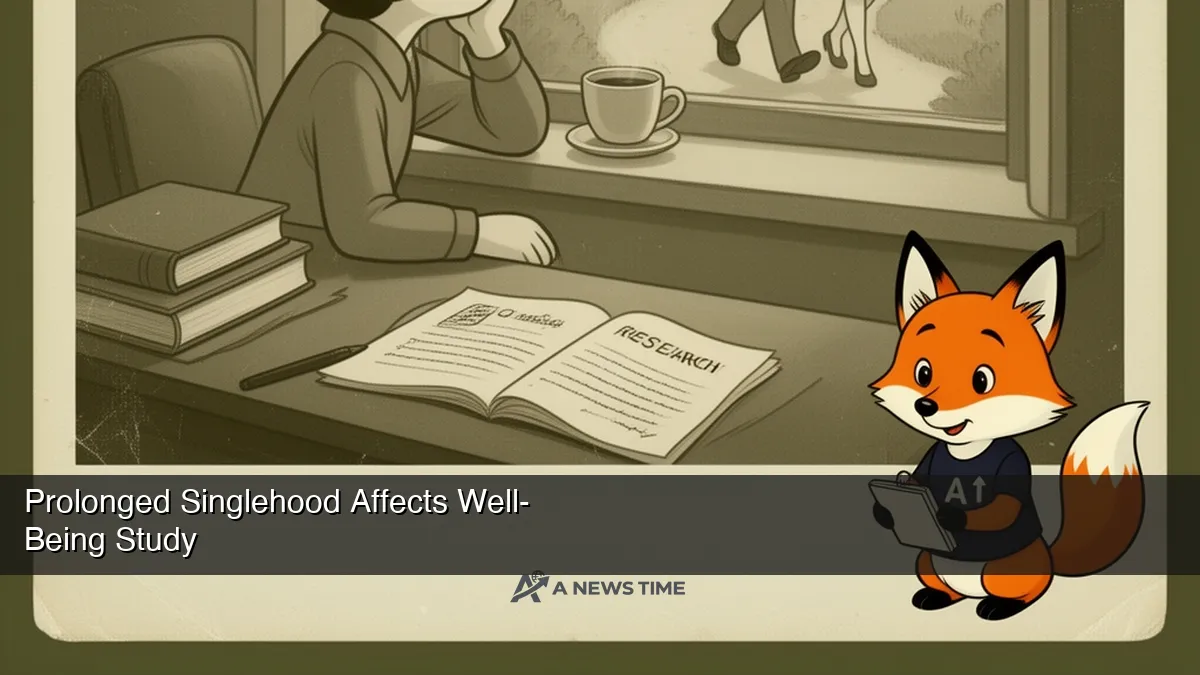
A study from the University of Zurich tracked more than 17,000 young people in Germany and the United Kingdom between the ages of 16 and 29 and arrived at a finding that cuts against much of what popular culture has been saying about being single: prolonged singlehood is associated with measurable declines in life satisfaction, increasing loneliness, and, in the late twenties, rising symptoms of depression. The study, published in the Journal of Personality and Social Psychology, is one of the most comprehensive longitudinal examinations of this question to date.
Michael Krämer, a senior researcher at the University of Zurich and one of the study's lead authors, noted that the research identified a specific profile among those who remained single longest. Men, highly educated individuals, those living alone, and those currently reporting lower well-being were statistically more likely to have no romantic relationship history through their late twenties. But the well-being effects themselves were not gendered: both men and women who remained single longer experienced the same pattern of declining life satisfaction and increasing loneliness over time.
What the Data Actually Shows
The study design followed participants longitudinally, meaning researchers could track changes within individuals over time rather than comparing different people at a single point in time. That methodological distinction matters considerably. Cross-sectional snapshots of singlehood often cannot distinguish between people who are contentedly single and those who are involuntarily so. Longitudinal data captures the trajectory, and the trajectory the Zurich researchers found was not flat.
Among those who remained single throughout the study period, life satisfaction declined progressively, while loneliness increased. The effect was particularly pronounced in the late twenties, a period the researchers describe as a social inflection point. By the time participants entered their late twenties, first romantic relationships became, in Krämer's words, "more difficult to initiate," which the researchers interpreted as a compound effect: the longer someone has been single, the more entrenched the social patterns that reinforce continued singlehood.
The data on first relationships tells a parallel story. Participants who entered a first romantic relationship during the study period showed improvements in both life satisfaction and loneliness, and those gains held over time, not just in the immediate aftermath of the relationship beginning. This finding is important because it distinguishes the data from a simple "new relationship euphoria" effect. Something more durable appears to be happening.
"Entering a first relationship may become more difficult when people are in their late twenties. The social pathways that typically lead to romantic connection are less available, and the well-being costs of continued singlehood accumulate."
Michael Krämer, Senior Researcher, University of Zurich
The Cultural Narrative and What Research Complicates
None of this unfolds in a cultural vacuum. Over the past decade, a substantial body of media, social media content, and popular psychology has reframed prolonged singlehood as an act of self-determination. Terms like "self-partnership" and the practice of "sologamy" (symbolic ceremonies in which individuals marry themselves) have moved from niche curiosity to something approaching mainstream conversation. The wellness industry has embraced solo living as a framework for radical self-sufficiency. Dating app discourse frequently celebrates periods of deliberate singlehood as necessary for personal growth.
The Zurich researchers are not dismissing any of this outright. Their paper acknowledges the genuine social changes driving later partnership formation, including later marriage norms, greater educational and career demands in early adulthood, and a cultural shift that has reduced stigma around singlehood. But their data raises a quieter concern: the gap between cultural framing and psychological reality.
Zoom out from the individual anecdotes that tend to dominate wellness media, and a more ambiguous pattern emerges. The research does not characterize singlehood as universally harmful. The effect sizes the Zurich team found are what they describe as "moderate," and there is clearly substantial variation among individuals. But the consistent directional trend across a sample this size is harder to dismiss than a single study with a few hundred participants. Long-term singlehood, at the population level, carries measurable well-being costs for many young adults, and those costs are not distributed evenly across the developmental arc.
For related insight into how social connection shapes health more broadly, the science on immune system vulnerability and chronic conditions provides useful context on how psychological and physiological health intersect over time.
Why Late Twenties Matter More Than Earlier Years
The late twenties finding deserves particular attention. The study period ran from age 16 to 29, which means researchers had a full picture of romantic relationship initiation across what developmental psychologists often call "emerging adulthood." In the earlier years of this window, singlehood showed weaker associations with declining well-being. The costs intensified as participants moved toward 30.
Several mechanisms might explain this pattern. Social networks in adolescence and early adulthood are naturally structured around group activities that provide incidental proximity to potential partners: school settings, university, early workplace environments, shared housing situations. As people move into established adult routines, those incidental social structures often shrink. Social circles stabilize and become less porous to new entrants. The infrastructure for meeting new people changes fundamentally, which is part of why the researchers interpret late-twenties singlehood as not merely a preference state but a structural situation that can become increasingly self-reinforcing.
There is also the developmental context of what researchers often call "social timing." Many people enter their late twenties watching peers form partnerships, cohabitate, and move into life phases organized around coupledom. Social comparison is a well-documented driver of well-being outcomes, and the late twenties tend to be a period of heightened social comparison around relationship milestones in ways that the early twenties typically are not.
Depression Symptoms in the Late Twenties
The depression finding adds another layer to the picture. The Zurich study found that by the late twenties, long-term singles were reporting not just declining life satisfaction and greater loneliness but elevated symptoms of depression. This does not mean singlehood causes depression, and the researchers are careful not to frame it that way. What it does suggest is that the factors associated with prolonged singlehood, including sustained loneliness and the erosion of positive mood that comes with declining life satisfaction, are correlated with the kinds of cognitive and emotional patterns that depression measurement scales capture.
Loneliness itself has a well-established relationship with depression in the psychological literature. Chronic physiological stress, whether from isolation or ongoing illness, activates overlapping biological pathways. The distinction between loneliness and depression can blur over time, particularly when the social conditions generating loneliness are stable rather than temporary. A person who is lonely for months because of a geographic move is in a qualitatively different situation from someone who has been chronically lonely for years during a formative developmental period.
What the Zurich data contributes to this conversation is the developmental specificity: the effect is not uniform across the entire age range studied, but concentrates in the late twenties. That specificity is useful because it points toward the mechanisms rather than just cataloguing the correlation.
Who Stays Single Longest, and Why It Matters
The profile of those who remained single longest in the study is worth examining carefully, because it complicates any simple narrative about singlehood as a choice by the most capable and independent adults. Men, highly educated individuals, those living alone rather than with others, and those already reporting lower well-being at the study's outset were all statistically more likely to have no relationship history by their late twenties.
The gender finding is striking. Men reporting long-term singlehood outnumbered women in this category, which aligns with other recent social research suggesting that young men are experiencing particular difficulties with social connection. Broader data on social isolation in 2026 shows that men, particularly those without college degrees, report the highest rates of social disconnection across multiple measures. The Zurich study's finding that highly educated men are also overrepresented among long-term singles adds nuance: this is not purely a socioeconomic story.
The finding that those with already-lower well-being are more likely to remain single is also potentially important, and raises genuine questions about causation direction. Does lower well-being make relationship formation more difficult? Or does the anticipation of continued singlehood suppress well-being prospectively? Almost certainly the relationship runs in both directions, which is precisely the kind of compounding dynamic that makes longitudinal data more informative than a single snapshot.
What the Research Does Not Claim
It would be easy to read a study like this as a morality tale, but that reading would misrepresent what the researchers are actually arguing. The paper does not claim that romantic relationships are the only path to well-being, or that people who are contentedly single are somehow wrong about their own experience, or that the cultural shift toward accepting singlehood has been net negative. The effect sizes are moderate, meaning they describe population-level tendencies, not individual destinies.
The study also does not address the quality of the relationships that improved well-being for participants. Entering any first relationship is not necessarily the same as entering a good one. There is a substantial body of research on the well-being costs of high-conflict, controlling, or otherwise distressing relationships, and the Zurich study does not grapple with that dimension in detail. The researchers' own language is careful: first romantic relationships, in general, were associated with improved well-being in this sample, but "in general" always contains a distribution.
What the research does claim, and what the data appears to support reasonably well, is that the popular cultural framing of prolonged singlehood as a uniformly positive or neutral experience does not match the psychological reality for a meaningful proportion of young adults. That is a different claim from saying singlehood is bad, or relationships are mandatory, or individuals should feel pressured to couple up by a certain age.
For young adults navigating these questions, understanding the broader landscape of social connection matters. Research on how structured environments like universities shape social networks helps explain why post-education life often involves a significant contraction in the organic social infrastructure that supports relationship formation.
The Cultural Conversation From Here
The University of Zurich findings land at an interesting cultural moment. Social media platforms are simultaneously the venues where singlehood-as-empowerment narratives circulate most forcefully and the environments researchers identify as contributors to the social isolation that makes meaningful connection harder to form. The wellness industry's embrace of solo living intersects awkwardly with a growing body of social science suggesting that isolation, voluntary or otherwise, carries real costs over time.
The researchers are not calling for a return to earlier social norms that stigmatized singlehood. What the data does suggest is that the conversation could be more honest about the distinction between choosing to be single for a period and experiencing prolonged singlehood as a structural condition shaped by social, psychological, and circumstantial factors beyond pure preference. Those are different experiences, and they may carry different well-being implications.
As the cohort studied here ages further, longitudinal follow-up will likely clarify whether the well-being effects seen in the late twenties moderate in the thirties, whether they compound further, or whether relationship formation later in life reverses the pattern. The Zurich team's ongoing tracking of this population will add important data to what is, so far, one of the most rigorously constructed examinations of an experience that touches the lives of a very large number of young people.
Frequently Asked Questions
What did the University of Zurich study on singlehood find?
The study tracked more than 17,000 young people aged 16 to 29 in Germany and the United Kingdom and found that prolonged singlehood was associated with declining life satisfaction, increasing loneliness, and rising depression symptoms, particularly in the late twenties. Entering a first romantic relationship was associated with improvements in both life satisfaction and loneliness that held over time.
Does this study prove that being single is bad for well-being?
No. The researchers found moderate effect sizes at the population level, meaning the finding describes a statistical tendency, not an individual outcome. Considerable variation exists among individuals, and the study does not address relationship quality or characterize singlehood as universally harmful. The researchers explicitly avoid prescriptive conclusions.
Why are the late twenties particularly significant in this research?
The data showed that well-being costs of prolonged singlehood intensified in the late twenties compared to earlier in emerging adulthood. The researchers suggest this reflects both a structural shift in social environments as people leave school settings and a social comparison dynamic as peers increasingly form partnerships, making first relationship initiation feel more difficult.
Were there gender differences in the findings?
Men were more likely than women to remain single longest in the study sample, but the well-being effects of prolonged singlehood, including declining life satisfaction and increasing loneliness, showed no significant gender difference. Both men and women who remained single longer experienced the same pattern of outcomes.