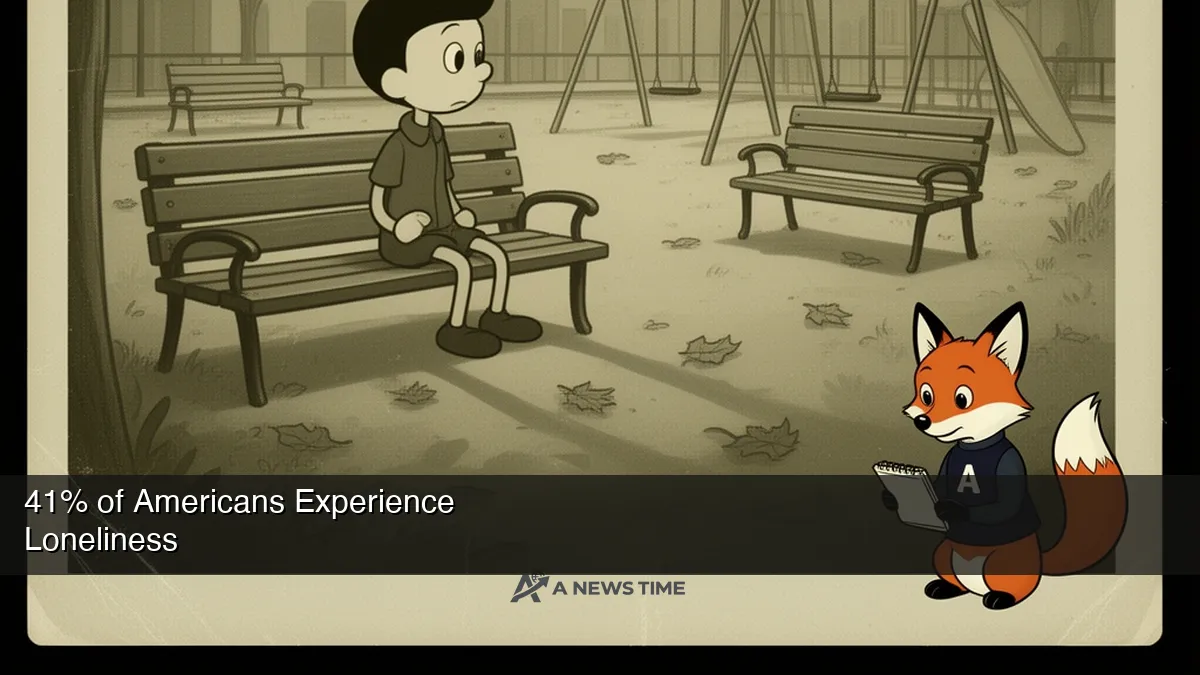
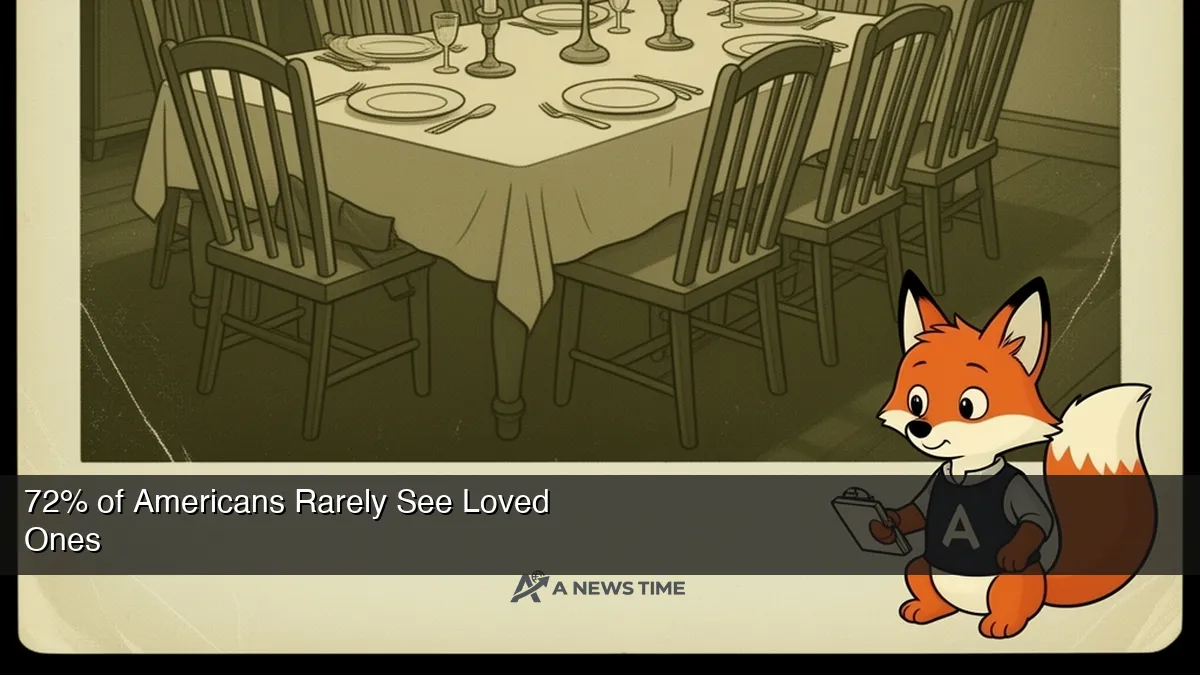
A survey funded by the Barnes Family Foundation, conducted in partnership with Dr. Julianne Holt-Lunstad, one of the world's leading researchers on loneliness and health, found that 72 percent of Americans rarely get together with people they care about. The number lands not as a headline abstraction but as a description of daily life: nearly three out of four American adults moving through their weeks with infrequent face-to-face time with the people who matter most to them. A separate finding from the same survey showed that 41 percent of respondents experience loneliness, a figure that varies considerably by income, with those earning under $75,000 per year faring measurably worse.
The survey is designed to run through 2050, an unusually long funding horizon that reflects a recognition that social disconnection is not a temporary crisis to be solved but an ongoing structural feature of American life that requires sustained documentation. Holt-Lunstad, a professor at Brigham Young University whose research has shaped how public health frameworks think about loneliness, brought to the project decades of work establishing that weak social ties are not merely a quality-of-life concern but a mortality risk.
The Scale of American Social Disconnection
The survey data maps a landscape of remarkable social thinness. Two-thirds of respondents reported never participating in clubs or organized social groups. More than half never volunteer. These are not peripheral activities: clubs, community organizations, and volunteer settings are among the most reliable environments for forming and sustaining adult friendships outside of workplace relationships, which themselves have become more attenuated in the era of hybrid and remote work.
The income dimension is significant and often underreported in coverage of the "loneliness epidemic." The approximately 100 million Americans who earn under $75,000 per year report worse outcomes across nearly every measure of social connection in the Barnes Foundation survey. This is not surprising to researchers who study social isolation, because the structural conditions that make connection difficult, including time poverty, irregular work schedules, lack of reliable transportation, limited access to third places like cafes or libraries with extended hours, and housing instability, are all more prevalent at lower income levels.
"We have decades of data showing that social connection is not just a nice-to-have. People with strong social connections are 50 percent more likely to survive over a given time period than those with weak or insufficient connections. This is a public health issue, not a personal failing."
Dr. Julianne Holt-Lunstad, Professor of Psychology and Neuroscience, Brigham Young University
That 50 percent survival statistic comes from a landmark meta-analysis Holt-Lunstad and colleagues published in PLOS Medicine, which synthesized data from 148 studies covering more than 300,000 participants. Social connection, the analysis found, was a stronger predictor of survival than factors like obesity, physical inactivity, and air pollution. The finding has been influential in shifting how some public health researchers and policymakers think about the social determinants of health, though it has not yet translated into the kind of systemic policy response that more familiar health risks tend to generate.
Male Loneliness: A Pattern Hiding in Plain Sight
One of the more striking dimensions of the current social disconnection data involves men, and specifically Gen X men in the 40 to 60 age range. Data from AARP shows that Gen X men report higher rates of loneliness than women in the same demographic, a finding that inverts what many people assume about gender and social connection. The popular image of lonely older adults tends to center on women, particularly widows, but the data is increasingly suggesting that men across multiple age cohorts are struggling with connection in ways that are less visible and less culturally legible.
The statistic that draws the most attention in this discussion is simple: 15 percent of American men report having no close friends, according to research cited by the National Organization for Women and other advocacy groups tracking what some researchers are calling a male friendship crisis. That figure represents a significant increase from data collected in the 1990s, when roughly 3 percent of men reported having no close friends. The shift over roughly three decades is substantial enough that researchers who study friendship and social bonding have treated it as a meaningful cultural and structural change rather than measurement noise.
The causes are debated, but several converging factors appear in the literature. The structure of male friendship has historically relied heavily on shared activities and institutions: team sports, military service, fraternal organizations, neighborhood proximity. Many of those structures have weakened or shifted. Workplace friendships, which served as a primary source of male social connection for much of the twentieth century, have been complicated by remote and hybrid work. The cultural expectation that men maintain emotional self-sufficiency continues to discourage the kinds of vulnerability and reciprocal sharing that researchers identify as constitutive of close friendship.
For more on how workplace and social structures shape adult development, our reporting on how hybrid work is reshaping social norms for young workers explores the structural dimensions of connection in professional environments.
Making Friends Without Social Media in 2026
Against this backdrop of documented disconnection, a counter-trend has been gaining momentum: deliberate analog social infrastructure building. Research and reporting from the Institute for Family Studies and the social data firm Spokeo identified eight primary ways Americans were forming new friendships in 2026 without social media platforms as the primary mechanism. The list reflects a growing recognition that the platforms that were supposed to connect us have, for many users, delivered a simulacrum of connection rather than the real thing.
The eight approaches documented by the research include recurring activity groups (running clubs, hiking groups, recreational sports leagues), community classes (cooking, pottery, language learning), faith communities, volunteer organizations, neighborhood associations, co-working spaces, community sports facilities, and what the researchers call "purpose-driven micro-communities." That last category is worth dwelling on. Justin Gurland, founder of the community design organization The Maze, has been among the practitioners most vocal about this concept, arguing that people form their strongest adult bonds around shared purpose rather than shared demographic identity.
The data on club participation from the Barnes Foundation survey tells the other side of this story: two-thirds of Americans currently participate in no organized social group at all. The infrastructure for organic social connection exists, but participation rates suggest significant barriers to entry, whether those are time, cost, social anxiety, lack of awareness, or simple inertia.
Why Connection Is the Real Health Revolution
The phrase "real health revolution" has been used by researchers and commentators reflecting on the cumulative evidence on social connection, and it captures something genuine about the current state of the science. The mainstream wellness industry in 2026 continues to direct enormous attention and commerce toward individual biological optimization: sleep tracking, metabolic health, nutritional precision, hormonal tuning. These are not trivial concerns, but the PLOS Medicine meta-analysis data suggests they may be secondary to something far simpler and far harder to monetize: consistent, meaningful contact with other people who care about you.
The mechanisms connecting social connection to health outcomes are multiple and reinforcing. Socially connected people show lower baseline levels of cortisol and inflammatory biomarkers. They tend to engage in better health-seeking behaviors, partly because social networks transmit health norms and partly because people with close relationships are more likely to have someone who notices when something is wrong. They sleep better. They recover from illness more quickly. These are not hypothesized effects; they are documented across hundreds of studies in multiple populations.
For comparison, Holt-Lunstad's work has found that inadequate social connection is associated with a risk increase comparable to smoking 15 cigarettes per day and greater than the risks associated with obesity and physical inactivity. The public health response to those latter two risks involves significant institutional infrastructure, public awareness campaigns, and medical protocols. The response to social disconnection has been, by comparison, minimal.
This gap between evidence and response is partly a function of how difficult social connection is to intervene on at scale. Prescribing a medication is logistically tractable in ways that restructuring adult social life is not. But researchers like Holt-Lunstad have been arguing for years that the absence of systematic intervention does not reflect an absence of evidence; it reflects an absence of institutional will to treat connection as a health infrastructure problem rather than a personal lifestyle preference.
Analog Solutions in a Digital Moment
The trends data for 2026 shows something that would have seemed counterintuitive a decade ago: analog social solutions are attracting serious cultural attention precisely because digital connection has failed to deliver on its implicit promise. Writing in Medium, cultural commentators and sociologists have pointed to what they describe as the emergence of a "digital hangover" sensibility among younger adults, particularly those in their mid-twenties, who grew up with social media as their primary framework for social life and are finding it insufficient.
Shared living arrangements, which had been declining as a share of young adult housing choices for most of the twentieth century, have stabilized and in some markets begun to grow, driven partly by housing costs but also by a reassessment of what adult life can look like. Activity-based travel, which pairs tourism with structured social interaction through shared physical challenge, has seen significant booking growth. Local community organizations that had been struggling with declining membership for two decades are reporting upticks in interest.
None of this constitutes a structural reversal of the social disconnection data. A 41 percent loneliness rate does not improve overnight because some people start joining running clubs. But the cultural moment may be more receptive than it has been in some time to rethinking the conditions under which American adults form and sustain meaningful social bonds. The Barnes Foundation survey's commitment to tracking these patterns through 2050 will provide one of the most important longitudinal data sets on social connection ever assembled, at a moment when the question of how people actually relate to each other has never been more urgently in need of sustained, honest examination.
Understanding what shapes our social lives also requires attention to the cultural norms governing how young people approach relationships. Our reporting on how Gen Z is reframing romance and connection explores the generational dimensions of these shifts.
Frequently Asked Questions
What percentage of Americans rarely see people they care about?
A 2026 Barnes Family Foundation survey conducted in partnership with researcher Dr. Julianne Holt-Lunstad found that 72 percent of Americans rarely get together with people they care about. Forty-one percent of respondents reported experiencing loneliness, with those earning under $75,000 per year reporting worse outcomes across connection measures.
What are the health consequences of social isolation?
A landmark meta-analysis published in PLOS Medicine, analyzing data from over 300,000 participants across 148 studies, found that people with strong social connections are 50 percent more likely to survive over a given period than those with weak connections. Social isolation carries health risks comparable to smoking 15 cigarettes per day and greater than the risks associated with obesity.
Why are Gen X men specifically highlighted in loneliness research?
AARP data shows that Gen X men report higher rates of loneliness than women in the same age group, reversing the common assumption that older women are the primary population affected. Additionally, 15 percent of American men report having no close friends, up significantly from 3 percent in the 1990s, suggesting a structural change in how men form and maintain friendships.
How are Americans forming friendships without social media in 2026?
Research from the Institute for Family Studies and Spokeo identifies eight primary methods: recurring activity groups, community classes, faith communities, volunteer organizations, neighborhood associations, co-working spaces, sports facilities, and purpose-driven micro-communities organized around shared goals rather than demographics alone.