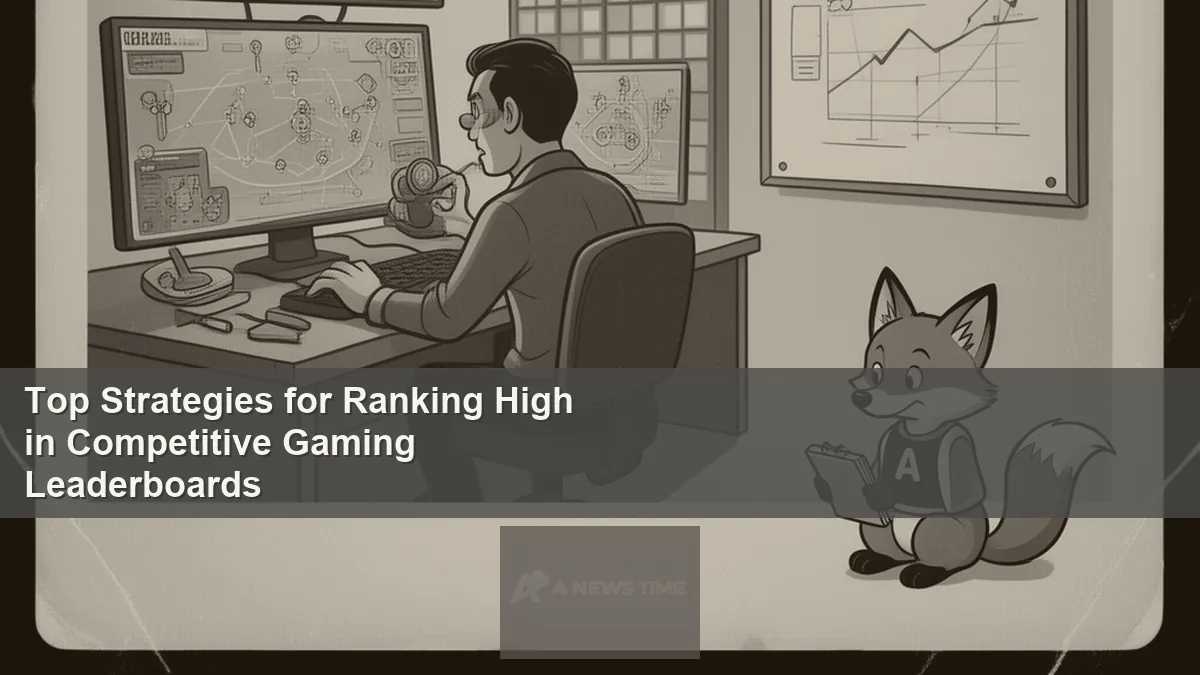
The LoL 2024 World Championship drew a peak viewership of 6.86 million, according to Statista. That number represents people watching competitive games played at a level that took years to develop, not weeks. But watching those players and understanding how they got there are two different things. Every Challenger, Immortal, or Radiant-ranked player reached that tier through a process that is more teachable than most assume, and more demanding than most expect.
The competitive gaming industry has matured enough that the gap between professional methodology and what casual ranked players do is now well documented. Research from institutions studying esports performance, team analysis from organizations like Team Liquid and Team Vitality, and the observable patterns across millions of ranked games have produced a reasonably clear picture of what separates consistent leaderboard climbers from players who plateau. The short version: grinding more games is not the answer. Grinding better games is.
Understand the Ranked System Before You Play It
Ranked systems vary significantly between titles, and most players engage with them without fully understanding how they work. That is roughly equivalent to playing chess without understanding how points are counted in competitive formats.
Most modern ranked systems use some variation of MMR, an invisible score that reflects your actual performance and determines who you are matched against, alongside a visible rank tier (Bronze, Plat, Diamond) that lags behind your hidden MMR during winning or losing streaks. Riot Games' titles, Valve's Dota 2, and Activision's Call of Duty all use MMR-adjacent systems. Blizzard's Overwatch 2 shows a visible skill rating that moves after every match.
The tactical implication is this: in most systems, you cannot lose your rank simply by playing. You lose it by losing matches. But the MMR update happens immediately after each game, which means the system is tracking your skill in real time even when your visible rank has not moved. A player in a "rank protection" period may not be dropping in visible tier, but their hidden MMR is falling, and the matches will get easier to compensate. This is not generosity. It is the system queuing you against weaker opponents to bring your win rate back toward 50 percent.
Understanding this means understanding that your goal is not to maintain a 50 percent win rate. Your goal is to perform above the skill level of your current rank consistently enough that the system is forced to push your MMR higher. Every game you play is providing data. Playing intentionally is the only way to make that data useful.
Purposeful Practice Beats Volume
An NCBI study on esports coaching and talent development found a finding that cuts against the "just play more games" mentality that dominates ranked culture: simply grinding more matches does not correlate strongly with top-tier results. Instead, players at higher tiers benefited most from three specific practice habits: clear session intentions, immediate feedback loops, and repeated skill drills.
Clear session intentions means knowing what you are trying to improve before you queue. Not "get better at the game," but something specific: "practice last-hitting under pressure in the laning phase" or "practice rotating before the objective timer, not after it." Vague intentions produce vague improvement. Players who sit down without a specific focus tend to autopilot through familiar patterns, which reinforces existing habits, including bad ones.
Immediate feedback loops means reviewing your performance while the game is still fresh. Replay tools exist in virtually every major competitive title. Valorant, CS2, League of Legends, Dota 2, and Apex Legends all provide match replay or post-match statistics. The players who use them after losses, looking specifically for the moment a match turned against them, compress learning cycles dramatically. A player who reviews five replays understands their mistakes in context. A player who plays five more games without review is likely making the same mistakes again.
Aim trainers like Kovaaks and Aimlabs represent one form of isolated skill drill. But aim is only one dimension of competitive performance. Game sense, positioning, resource management, and communication are all drillable in custom lobbies, scrimmages, and structured review sessions with teammates or coaches.
Meta Literacy: Playing the Game the Patch Is Rewarding
Every live service game has a meta: the set of champions, weapons, compositions, or strategies that are performing above average in the current patch. Players who play against the meta because of personal preference are fighting a second opponent beyond their actual opponents. The game's balance is working against their choices.
Meta literacy does not mean only playing whatever the spreadsheet says is statistically optimal. That approach produces a player who can only win when their preferred picks are strong, and collapses when the patch changes. It means understanding why certain strategies are dominant, what their weaknesses are, and which counters are available when opponents try to exploit the meta themselves.
Professional teams spend considerable resources on meta analysis. Sebastian Weishaar, President of Esports at ESL FACEIT Group, has noted the increasing sophistication of how top-tier teams approach preparation: understanding not just what is winning in tournaments, but what is winning in their specific regional meta, which often diverges from global trends due to playstyle differences and regional counter-meta development.
For ranked players, meta literacy translates to two habits: following patch notes for the specific mechanics that have changed (not just the numbers), and watching a small number of high-level streamers or tournament matches in your role or category. The goal is not to copy pro builds mechanically but to understand the decision-making framework that makes those strategies effective.
The Mental Game: Tilt, Variance, and Long-Run Thinking
Competitive performance psychology is increasingly part of how esports organizations train players. Team Vitality employs dedicated performance coaches. Team Liquid has invested in mental performance staff for years. The industry-wide recognition that mechanical skill is not the only determinant of ranked success is not new, but it is more actionable now than it has ever been.
"Looking ahead, the primary challenge for the next 24 months will be navigating the shift from rapid expansion to operational resilience and financial maturity. Organizations with diversified strengths, strong management, and clear strategic positioning will be best equipped to thrive."
Danny Engels, Corporate Director of Global Operations, Team Vitality
Tilt, the state of impaired decision-making caused by frustration or emotional arousal, is the most consistently destructive force in ranked play. The mechanism is well understood: when a player experiences a loss or a frustrating interaction, cortisol and adrenaline increase, which narrows attention, shortens decision horizons, and increases risk tolerance. A tilted player plays faster, takes more fights they should avoid, communicates worse with teammates, and blames external factors rather than adjusting their approach. They also queue immediately into the next game rather than recovering.
The tactical countermeasure is not complicated, but it requires deliberate practice: stop playing when you lose two games in a row. Not because two losses mean anything statistically, but because consecutive losses are a reliable signal that you are either fatigued, mentally degraded, or encountering a hard counter in the current meta. Each additional loss in that state provides negative practice, reinforcing suboptimal patterns and deepening frustration.
Variance is the other mental challenge that ranked players routinely mishandle. In any competitive system with randomized elements (draft order, map selection, teammate assignment), short-term results reflect both skill and luck. A 55 percent win rate, which is considered very strong in most ranked systems, means you are still losing nearly half your games. Over 100 games, the variance in outcomes for a player at that win rate is large enough that a 15-game losing streak is statistically possible. Treating any single session or week as diagnostic of your skill is a cognitive error. The sample size is too small.
Equipment, Setup, and the Physical Side
The equipment ceiling in competitive gaming is real, but most players are well within the range where hardware improvements produce diminishing returns. A 240Hz monitor provides a measurable advantage over a 60Hz monitor in fast-paced shooters. The difference between a 240Hz and 360Hz monitor is smaller and depends heavily on your ability to process that information. At the level of play where that difference is meaningful, players are already near the top of their server's ranked distribution.
More practically, equipment consistency matters more than equipment quality above a reasonable threshold. Playing on the same setup, with the same sensitivity, the same keybindings, and the same audio configuration, builds muscle memory that degrades when variables change. Tournament players who switch between home and LAN setups go through explicit recalibration processes for exactly this reason.
| Equipment Factor | Practical Impact | Diminishing Returns Threshold |
|---|---|---|
| Monitor refresh rate | High in fast-paced games | 240Hz (above 360Hz marginal) |
| Input lag | High | Less than 1ms (most gaming mice) |
| Audio setup | High for positional sound | Open-back headphones > $100 |
| Internet stability | Critical, wired > wireless | Less than 20ms consistent ping |
| Peripheral consistency | High (muscle memory) | Does not diminish |
Physical preparation is consistently underestimated outside professional environments. Sleep deprivation measurably slows reaction time, reduces working memory, and increases emotional reactivity. A player who consistently games from midnight to 3 a.m. and then plays ranked for another two hours is competing at a cognitive disadvantage that no amount of mechanical skill compensates for. Most high-level players report that their best ranked sessions happen in the early to midday, after adequate sleep, rather than in late-night sessions when overall play volume is highest.
Team Play and Communication in Ranked Queues
In team-based games, solo-queue ranked play presents a specific challenge: you cannot control your teammates, but you can influence them. The research on team performance in esports consistently identifies communication quality as a significant differentiator at higher ranks, where mechanical differences between players on a given team narrow significantly.
Effective in-game communication in ranked queues has a specific character: it is brief, forward-looking, and non-critical. Calling information ("mid pushing," "jungler top side," "rotating now") is high value. Calling out teammate mistakes in the moment ("why did you go there," "terrible rotation") is negative value regardless of whether it is accurate, because it produces defensive responses and reduces the team's willingness to communicate further. The player who wins communication in ranked is the one whose calls teammates actually respond to, not the one who is most technically correct about what went wrong.
"An always-on model addresses fan disengagement by expanding the experience from isolated moments to a continuous journey. The same principle applies to individual skill development: consistency between sessions compounds far more than occasional intense bursts."
Minseo Choi, Esports Management Team Lead, PUBG Esports / KRAFTON
Playing with a consistent duo or small group compounds the communication advantage further. Two players who know each other's tendencies, have shared callout vocabulary, and have practiced coordinating specific plays remove a significant layer of uncertainty from the team dynamic. The win rate increase from a coordinated duo versus two solo-queue strangers is substantial across every ranked game that has been studied at this level of detail.
Frequently Asked Questions
How many games per day should I play to climb ranked?
Quality over quantity is the consistent finding across esports performance research. Two or three focused games with post-match review tend to produce more rank progress than eight games played on autopilot. Setting a hard stop at two consecutive losses per session prevents the negative practice loop that comes from playing tilted.
Does my rank reset at the start of a new season affect my strategy?
Seasonal resets typically place players one or two rank tiers below their end-of-season rank. The ranked system then recalibrates through placement matches. The optimal approach is to treat the first 20 to 30 games of a new season as calibration data: play your strongest champion or role, avoid experimenting, and focus on win rate rather than trying new strategies until your rank stabilizes near your actual skill level.
Is playing multiple roles or characters better for rank climbing?
Most ranked players climb faster by narrowing their champion or role pool to two or three options they understand deeply rather than playing a wide variety. Depth produces better decision-making and muscle memory in high-pressure situations. Breadth is valuable at the professional level where counter-picking and meta flexibility matter more. For most ranked players, the opposite trade-off applies.
How important is team communication versus individual skill?
This depends heavily on rank tier. At lower ranks, individual mechanical decisions (avoiding avoidable deaths, completing basic objectives) have a larger impact on game outcomes than communication because coordination errors are ubiquitous at that level. At higher ranks, where individual mistake rates converge, communication and teamwork quality increasingly determine outcomes. Developing both in parallel is the correct approach.
What is the most common mistake that prevents players from climbing?
Across competitive titles, the most common barrier is what coaches call "autopilot queuing": playing matches without specific improvement intentions and without reviewing mistakes afterward. The result is consolidating existing habits, including the bad ones, rather than replacing them. Players who play 500 ranked games without intentional practice often reach a hard plateau that does not reflect their potential skill ceiling.