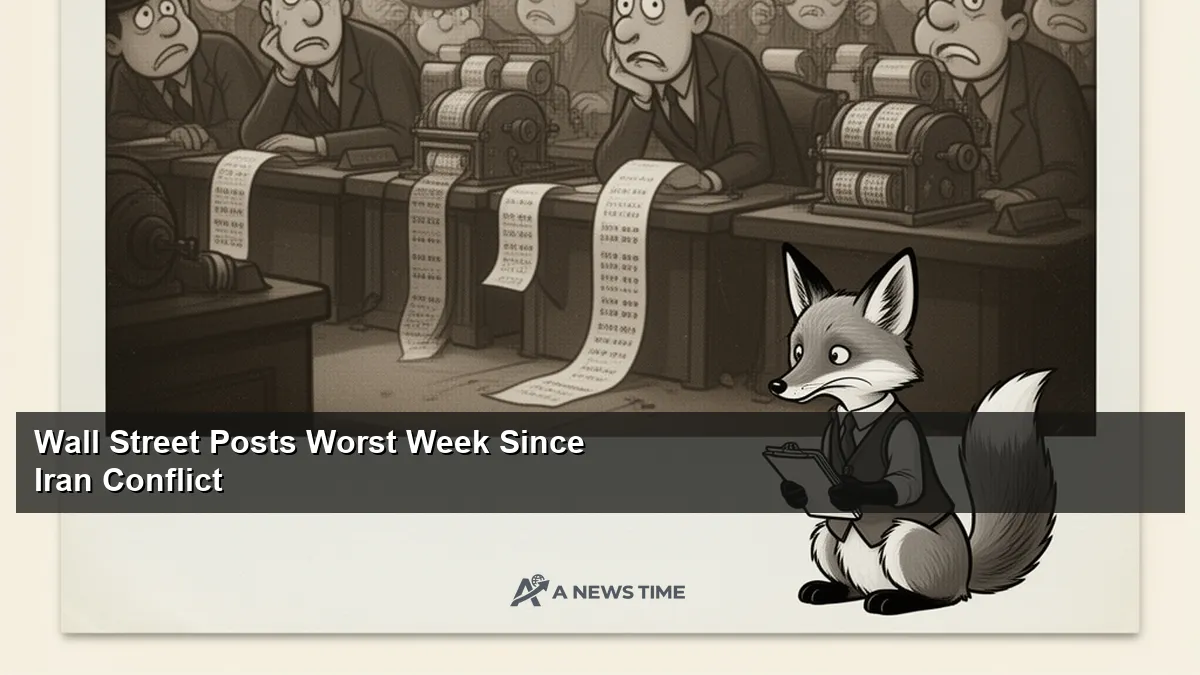
Wall Street closed out the final trading day of March 2026 with a grim tally that investors have not seen since the early weeks of the U.S.-Iran military confrontation. The S&P 500 fell 2.4% on Friday, the Nasdaq Composite dropped 3.1%, and the Dow Jones Industrial Average shed 1.9%, capping a fifth consecutive week of losses that has erased approximately $4.2 trillion in market capitalization from U.S. equities since late February. The scale of the decline, the persistence of the selling, and the catalysts driving it all point to a market that has moved decisively from pricing in hope to pricing in doubt.
The immediate trigger for Friday's selloff was a combination of rising oil prices (Brent crude surged past $112 per barrel in early Asian trading before settling at $109.60) and a Pentagon briefing that described ongoing naval engagements near the Strait of Hormuz as "consistent with sustained operational posture." Traders interpreted that language, correctly or not, as confirmation that the U.S. military expects the conflict to extend well beyond initial timelines. For a market that had spent the first two weeks of March rallying on cease-fire speculation, the reversal was swift and unforgiving.
The Numbers Tell a Clear Story
Let the data speak first. The S&P 500 ended the week at 4,687, its lowest close since August 2025 and a decline of 11.3% from its January peak of 5,285. The Nasdaq Composite, more sensitive to growth expectations because of its heavy weighting toward technology stocks, finished at 14,412, down 14.1% from its high. The Dow Jones Industrial Average, which tilts toward industrials, financials, and consumer staples, closed at 37,890, placing it firmly in correction territory (defined as a decline of 10% or more from a recent high).
The week's losses broke down unevenly across sectors. Energy stocks, represented by the XLE exchange-traded fund, rose 3.7% for the week, the only sector posting gains, as oil and natural gas producers benefited from elevated commodity prices. Defense contractors including Lockheed Martin, RTX Corporation, and Northrop Grumman also outperformed. Every other sector declined, with technology (down 4.2%), consumer discretionary (down 3.8%), and industrials (down 3.1%) absorbing the heaviest selling.
The VIX, Wall Street's preferred measure of expected market volatility, closed the week at 31.4, its highest sustained reading since the regional banking crisis of March 2023. A VIX above 30 generally signals that professional options traders expect daily swings of 2% or more in the S&P 500, the kind of environment that makes institutional portfolio managers reduce risk exposures and retail investors check their brokerage accounts with a mixture of anxiety and morbid curiosity.
Thursday's Selloff Set the Tone
While Friday grabbed the headlines, Thursday's session was arguably the more consequential trading day. The S&P 500 fell 2.8% on Thursday alone after Reuters reported that Iranian military forces had test-fired a medium-range ballistic missile in the Persian Gulf region, a move U.S. Central Command described as "provocative but not unexpected." Oil prices jumped $6 per barrel in the hour following the report, and equity futures, which had been roughly flat ahead of the open, cratered.
The Thursday session also featured heavy volume in put options on the major indexes, with the put-to-call ratio on the CBOE reaching 1.42, its highest reading since early February. Put options give their holders the right to sell at a predetermined price, so elevated put buying indicates that large investors are paying for downside protection rather than betting on a recovery. When the people who manage pension funds and endowments start buying insurance policies on their portfolios, it tells you something about the prevailing mood in the institutional investor community.
Trading volume on Thursday exceeded 14.2 billion shares across U.S. exchanges, the highest single-day total since the January session that followed the initial U.S. military strikes against Iranian nuclear facilities. High volume on down days is a technical signal that selling is broad-based and conviction-driven, not the kind of light, drift-lower action that markets sometimes experience during slow news periods.
Oil Is the Transmission Mechanism
Understanding this market decline requires understanding oil. Crude prices function as the transmission mechanism through which geopolitical conflict in the Middle East reaches the balance sheets of American companies and the wallets of American consumers. CBC News reported that Brent crude has averaged $105 per barrel throughout March, compared with $82 per barrel in December 2025. That $23 per barrel increase, spread across the roughly 20 million barrels per day that the U.S. economy consumes, translates to approximately $460 million in additional daily energy costs for American businesses and households.
The price increase has not occurred in a vacuum. The Strait of Hormuz, through which approximately 20% of the world's oil supply passes daily, has been subject to intermittent disruptions since Iranian naval forces began conducting what Tehran describes as "defensive patrols" in the waterway in late February. Insurance rates for tankers transiting the strait have tripled since the conflict began, according to Lloyd's of London data. Those insurance costs get passed through to refiners, then to distributors, then to the gas station price board that American drivers see every morning on their commute.
Goldman Sachs chief commodity strategist Jeff Currie wrote in a client note on Wednesday that the firm now expects Brent crude to average $115 per barrel in April if Hormuz disruptions continue at their current pace. That forecast, if realized, would push the national average gasoline price above $4.30 per gallon, a level that historically correlates with measurable declines in consumer spending on discretionary goods. For context, the national average stood at $3.42 per gallon in December.
From Hope to Doubt in Two Weeks
The market's trajectory over the past month illustrates how quickly sentiment can reverse when geopolitical narratives shift. In the first two weeks of March, stocks rallied on reports that Swiss intermediaries were facilitating back-channel communications between Washington and Tehran. The S&P 500 gained 3.4% during that period, with technology stocks leading the advance as investors rotated back into growth names. Meta Platforms rose 8.2% in a single week on strong advertising revenue data and optimism that a de-escalation in the Middle East would reduce the inflation pressures weighing on consumer spending.
That narrative collapsed on March 17, when Iranian Supreme Leader Ayatollah Ali Khamenei delivered a nationally televised address rejecting what he called "American preconditions for surrender disguised as diplomacy." The following day, the U.S. State Department confirmed that diplomatic channels had been "paused" pending a reassessment of Iranian intentions. Stocks have fallen in nine of the eleven trading sessions since.
The speed of the reversal underscores a structural vulnerability in the current market: there is very little fundamental cushion beneath stock prices. Corporate earnings growth has slowed to approximately 4% year over year for the S&P 500, down from 12% in the second half of 2025. Valuations, measured by the forward price-to-earnings ratio, remain above their 10-year average even after the recent decline. That means stocks were priced for a reasonably optimistic economic outcome before the conflict began, and the conflict has made a reasonably optimistic outcome less likely.
The Federal Reserve Is Trapped
The Federal Reserve's predicament adds another layer of complexity. Under normal circumstances, a sustained equity market decline of this magnitude would prompt expectations of interest rate cuts to cushion the economic impact. But the Fed cannot cut rates easily when oil-driven inflation is running hot. The PCE price index, the Fed's preferred inflation measure, showed headline inflation at 2.9% and core inflation at 3.1% in January data. Both figures are moving in the wrong direction, and the oil price surge since then has almost certainly pushed them higher.
Fed Chair Jerome Powell, speaking at a press conference in mid-March, described the situation as presenting "competing pressures that require careful calibration." Translation: the Fed sees both growth risk and inflation risk simultaneously, and its standard toolkit (raising rates to fight inflation, cutting rates to support growth) cannot address both at the same time. The FOMC dot plot, released at the March meeting, showed a median expectation of one rate cut in 2026, down from three cuts projected in December. Several committee members indicated they would support zero cuts this year if inflation does not moderate.
Bond markets have responded accordingly. The 10-year Treasury yield has risen to 4.58%, reflecting expectations that the Fed will keep rates higher for longer. The 2-year yield, which more directly tracks expectations for short-term Fed policy, sits at 4.41%, maintaining a modest positive slope to the yield curve but not enough of one to suggest that bond traders see rate cuts as imminent.
What the Strategists Are Saying
Wall Street's major investment banks have scrambled to update their market outlooks over the past two weeks, and the resulting forecasts reveal a profession that is genuinely uncertain about what comes next.
"The geopolitical risk premium embedded in equity markets is currently between 150 and 200 basis points of compression on the forward P/E multiple. In plain terms, stocks are trading 8 to 10% below where they would be if the Iran conflict were resolved tomorrow."
David Kostin, Chief U.S. Equity Strategist, Goldman Sachs
Morgan Stanley's Mike Wilson, who has oscillated between bearish and cautiously optimistic over the past two years, moved his year-end S&P 500 target down to 4,900 from 5,400, citing "a combination of margin compression from energy costs, multiple contraction from geopolitical uncertainty, and earnings growth deceleration that was already underway before the conflict." JPMorgan's Marko Kolanovic maintained a more constructive view, arguing that markets have historically recovered quickly once geopolitical conflicts reach a resolution or stalemate, but acknowledged that "the timing of such a resolution is inherently unknowable."
Bank of America's Savita Subramanian offered perhaps the most pragmatic assessment, noting that "the market is not going to find its footing until oil finds its ceiling," a way of saying that equity investors are, for the time being, hostages to the commodity market. Barclays equity strategy team echoed this view, noting that the correlation between daily oil price changes and S&P 500 returns has reached negative 0.78 over the past month, its strongest inverse relationship since the 2022 energy crisis following Russia's invasion of Ukraine.
Sector-Level Damage Assessment
Not all corners of the market have suffered equally, and understanding where the pain is concentrated helps clarify what the market is actually pricing in.
Technology stocks, which account for roughly 30% of the S&P 500's total market capitalization, have been the largest contributor to the index's decline in absolute dollar terms. The Nasdaq 100, which tracks the largest non-financial companies on the Nasdaq exchange, is down 14.8% from its January peak. The damage has been concentrated in mega-cap names: Apple has fallen 11%, Microsoft 13%, Nvidia 18%, and Amazon 15%. These companies are not directly exposed to oil prices in the way that airlines or trucking companies are, but their valuations depend on expectations for future earnings growth, and those expectations shrink when the economic outlook deteriorates.
Consumer discretionary stocks have been hit nearly as hard. Companies like Target, Home Depot, and Nike are particularly vulnerable to the combination of higher gas prices (which reduce disposable income for their customers) and lower consumer confidence. The University of Michigan consumer sentiment index fell to 67.4 in March, its lowest reading since November 2023.
Financials have held up relatively better, declining about 7% from their highs. Banks benefit from higher interest rates on one hand (they can charge more for loans) but face credit risk on the other (some borrowers may struggle to repay if the economy weakens). Regional banks, already under scrutiny after Goldman Sachs raised recession odds to 30%, have underperformed their larger peers, with the KRE regional bank ETF down 12% in the same period.
What Happens Next
The coming week brings several data points that will test the market's fragile psychology. The BLS jobs report for March, due Friday, will provide the first comprehensive look at whether the conflict-driven economic uncertainty is showing up in hiring decisions. Consensus estimates call for 180,000 new jobs, down from 235,000 in February, with the unemployment rate holding steady at 3.9%. A significant miss to the downside could accelerate recession fears. A strong number could, paradoxically, increase concern about the Fed's willingness to tolerate inflation at current levels.
Corporate earnings season begins in earnest in mid-April, with the major banks reporting first. JPMorgan Chase, Bank of America, Goldman Sachs, and Morgan Stanley will provide the earliest read on how the conflict is affecting lending, trading, and investment banking activity. Their forward guidance, particularly on credit loss provisions, will be scrutinized for clues about whether corporate defaults are expected to rise.
On the geopolitical front, the United Nations Security Council is scheduled to meet on April 2 to discuss a proposed ceasefire framework. Diplomatic sources quoted by Reuters describe the framework as "aspirational rather than actionable," but any progress, even cosmetic, could provide a short-term catalyst for oversold equity markets.
The Bigger Picture
Five consecutive weeks of losses is uncommon but not unprecedented. The S&P 500 experienced similar streaks during the early stages of the COVID-19 pandemic in 2020, the inflation scare of mid-2022, and the dot-com bust of 2000-2002. In the first two cases, the market eventually recovered and went on to reach new highs. In the third, the recovery took seven years. The difference, in each case, was whether the underlying cause of the decline proved temporary or structural.
The Iran conflict sits uncomfortably between those categories. Military conflicts are, by their nature, temporary in that they eventually end. But the economic damage they cause (higher energy costs, disrupted supply chains, reduced consumer and business confidence, diverted government spending) can persist well beyond the cessation of hostilities. The 1973 oil embargo lasted five months. The inflation it triggered took a decade to fully resolve.
For now, the market's message is straightforward. Investors are demanding a larger risk premium to own equities in an environment where the geopolitical outlook is deteriorating, the economic data is softening, the Federal Reserve is constrained, and corporate earnings growth is decelerating. None of those conditions is likely to change in the next week or two. What can change, and change quickly, is the geopolitical situation itself. Until it does, Wall Street appears prepared to keep selling first and asking questions later.