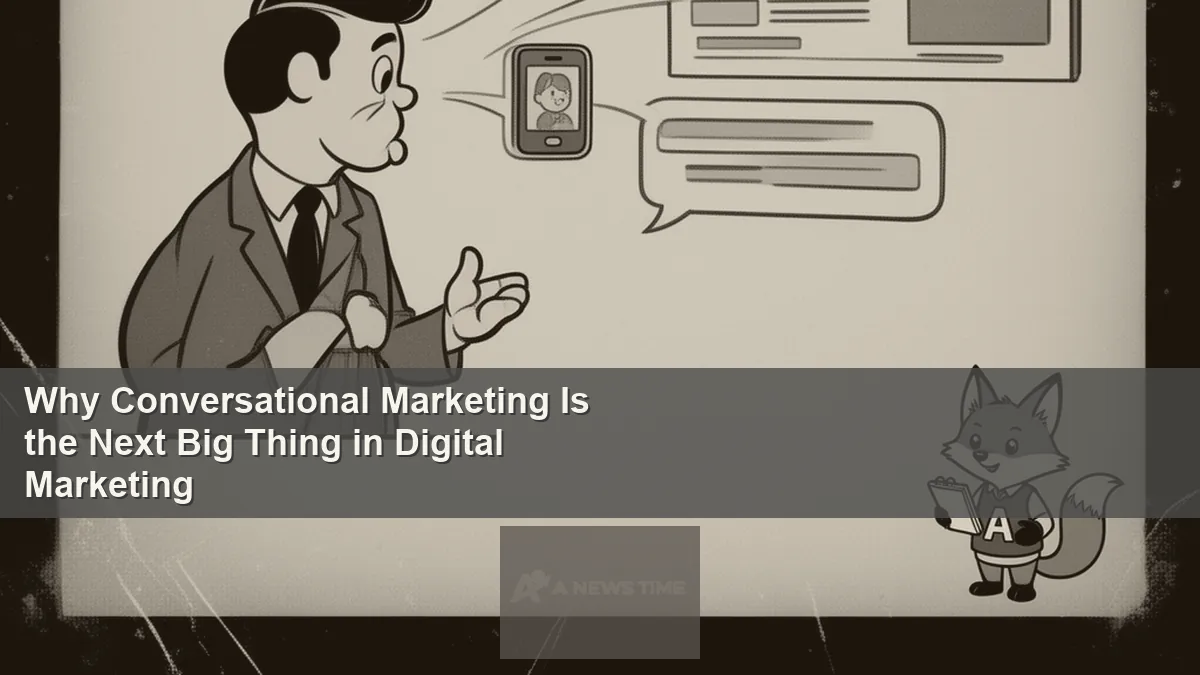
Traditional digital marketing operates on a one-way logic: create content, capture intent signals, route leads into a funnel, then follow up days later with emails that may or may not reach someone who still cares. The time delay built into that model is not a technical limitation. It was a design choice from an era when real-time interaction at scale was operationally impossible. That constraint no longer exists.
Conversational marketing replaces the delay with immediate, context-aware dialogue. A visitor lands on a pricing page and a chat interface engages them within seconds, qualifies their budget and timeline, routes them to the appropriate sales tier, and books a calendar event, all before they would have finished filling out a static lead form. The interaction happens in the moment of highest intent, which is the only moment that reliably converts at a premium.
The technology enabling this shift has reached a deployment maturity point where the relevant question is no longer whether conversational marketing works at scale. The question is which organizations have built the integration infrastructure to make it work well, versus which are running chatbots that frustrate rather than convert.
What Conversational Marketing Actually Covers
Conversational marketing is a category that contains several distinct technologies and deployment patterns, which is worth specifying precisely because the category label is applied loosely in vendor marketing.
The core implementations break into four types. First, AI-powered chatbots deployed on website pages, handling qualification, routing, scheduling, and support for web visitors. These range from rule-based decision tree systems (which handle narrow, predictable query types) to large language model-based systems (which handle open-ended, context-sensitive conversations). Second, live chat with human agents, often augmented by AI to surface relevant responses and customer history, deployed on high-intent pages or triggered when bot confidence thresholds are not met. Third, messaging platform integrations, primarily through API-connected deployments on WhatsApp, Facebook Messenger, SMS, and business messaging channels. Fourth, voice assistants and interactive voice response systems enhanced with natural language processing, deployed by contact centers and increasingly by consumer-facing brands.
The conversational commerce market, which spans all of these deployment types, is growing at substantial rates. MarketsandMarkets research projects the conversational AI market reaching significant scale through 2030, with generative AI agents specifically projected at a compound annual growth rate of 25.5 percent through the decade. North America accounted for 33.62 percent of global conversational AI market share in 2025.
The category matters for B2B and B2C companies in different ways. In B2B, conversational marketing primarily addresses the top-of-funnel qualification problem: getting the right prospects to the right sales resources faster. In B2C and e-commerce, it primarily addresses service efficiency and purchase completion: reducing cart abandonment, answering product questions instantly, and handling post-purchase support without human staffing at scale.
The Data Behind the Adoption Curve
The statistics on conversational marketing adoption and impact have reached a density where the question is less whether the tools work and more which benchmarks are credible versus vendor-influenced. Several consistently reliable data points emerge across multiple independent sources.
Consumer preference for messaging over traditional channels is now well-established. 73 percent of consumers prefer messaging over phone calls for customer service interactions, according to Salesforce customer experience research. A study by Twilio found that 9 out of 10 consumers would prefer to message a business rather than call or email. These preference numbers have shifted dramatically in five years; they were not this lopsided in 2020.
Speed expectation data is equally consistent. 83 percent of consumers expect to be able to initiate a conversation with a brand immediately, and 69 percent cite fast response time as a critical factor in their chatbot satisfaction ratings. The implication for businesses running asynchronous marketing workflows is direct: the segment of your audience that converts at the highest rates has already signaled that delayed follow-up is a dealbreaker.
The operational efficiency data comes largely from enterprise deployments. IBM's published data on its own Watson-based chatbot implementations shows approximately 80 percent of routine customer queries handled without human agent involvement. Chatbots Magazine research places the customer service cost reduction from automation at approximately 30 percent for organizations at sufficient deployment scale. Retailers globally are estimated to save $439 million annually through chatbot deployment, with AI-powered retail sales projected to reach $112 billion.
The brands that are winning with conversational marketing are not the ones with the most sophisticated AI. They are the ones that mapped their buyer's journey carefully enough to know exactly where a real-time conversation changes the outcome, and deployed accordingly. Technology follows strategy, not the other way around.
David Cancel, Co-Founder and CEO, Drift
Loyalty and retention metrics round out the picture. 82 percent of brands using conversational marketing tools report improved customer loyalty metrics, according to research compiled by Electroiq. 68 percent of companies employing conversational sales and marketing report better customer retention rates compared to pre-implementation baselines. These are self-reported figures from brand surveys, which introduces selection bias (companies that implemented conversational tools and saw poor results are less likely to report on them), but the directionality is consistent enough to be credible.
The Platform Landscape: Drift, Intercom, and HubSpot
Three platforms dominate the B2B conversational marketing infrastructure conversation, and their positioning differences are instructive about the market's maturity.
Drift, founded in 2015 and now part of Salesloft, pioneered the revenue-focused chatbot model: the explicit premise that website chatbots should qualify leads and book meetings, not just answer questions. Drift's differentiation was connecting chatbot interactions directly to CRM data, allowing the platform to recognize returning visitors, personalize conversations based on known account data, and route high-intent leads to specific sales reps based on territory, product interest, or account tier. Drift is primarily deployed by mid-market and enterprise B2B companies with defined account-based marketing programs.
Intercom takes a broader platform approach, covering customer support, product tours, and marketing engagement in addition to sales qualification. Its positioning is around the full customer lifecycle: the same platform handles pre-purchase questions, onboarding guidance, and post-purchase support. Intercom's AI layer, Fin, uses large language model technology to answer support questions from a company's documentation without human involvement, which has made it the market leader in AI-assisted customer support for SaaS companies. Intercom's pricing scales with seat count and usage, placing it primarily in the SMB-to-mid-market range.
HubSpot offers conversational tools as part of its integrated CRM platform. HubSpot Conversations combines live chat, chatbots, and email into a shared inbox that connects to the full HubSpot contact database. The strategic advantage is native data integration: HubSpot bots can reference a contact's full history (pages visited, emails opened, forms completed, deal stage) in real time and personalize the conversation accordingly. For companies already running on HubSpot's marketing, sales, and service hubs, adding conversational capabilities means activating a feature rather than integrating a new vendor, which is a meaningful operational advantage.
Conversational marketing is not a chatbot strategy. It is a speed-to-lead strategy. Every minute a prospect waits for a response, the probability of qualifying them drops. Companies that figure that out stop asking whether AI chatbots can do the job and start asking how fast they can deploy them.
Yamini Rangan, CEO, HubSpot
CRM Integration: Why Most Chatbot Deployments Underperform
The clearest predictor of whether a conversational marketing deployment delivers measurable revenue results or becomes a checkbox exercise is the quality of its CRM integration. Chatbots operating without CRM connectivity are answering questions in a vacuum. Chatbots with deep CRM integration are contextually aware agents operating with knowledge of who they are talking to, what that person has done before, where they are in the buying cycle, and what the next appropriate action is.
The operational mechanics of CRM-integrated conversational marketing work as follows. A visitor arrives at a high-intent page, the company's enterprise pricing page or its case study section. The bot detects a known contact (via cookie or email match) and pulls their CRM record: the company they work for, the account tier, the number of prior visits, the last sales activity, and the assigned account executive. The conversation it initiates is not generic. It references prior activity, acknowledges where they are in the decision process, and offers an action (a meeting, a demo, a pricing conversation) that is calibrated to their buyer stage.
For unknown visitors, the bot collects qualification data (company size, role, use case, timeline) and creates a new CRM contact with that data populated, triggering any relevant workflow automation. The lead appears in the sales team's queue with context attached, not as a blank form submission requiring a separate discovery call to gather basic qualification information.
The integration requirement extends beyond CRM into the sales pipeline workflow. High-performing conversational marketing implementations connect directly to calendar scheduling (Calendly, HubSpot Meetings, Outreach), allow real-time routing to the correct sales rep based on round-robin or territory rules, and trigger pipeline stage updates when a meeting is booked. The chatbot becomes a workflow orchestration tool, not just a communication channel.
Measuring What Conversational Marketing Actually Produces
The metrics that matter for evaluating conversational marketing performance are not impressions or chatbot conversations initiated. They are qualification rate, meeting conversion rate, cost-per-qualified-lead versus other channels, and, ultimately, revenue attributed to conversational-sourced pipeline.
Benchmark data from B2B conversational marketing deployments shows response rates varying substantially by implementation quality. Matthew Barby's analysis of chatbot performance data places lower-engagement chatbots at 35 to 40 percent response rates, while well-optimized chatbots with strong personalization and intent-based triggering reach 80 to 90 percent response rates. The gap between those benchmarks is entirely explained by deployment quality, not the underlying technology.
The comparison to traditional digital advertising channels is instructive. Facebook Messenger-based conversational interactions produce 30 percent higher ROI than traditional Facebook retargeting ads, according to Business Insider analysis of advertiser data. Conversational channels generate click-through rates four to five times above standard advertising rates, per industry research aggregated by Zipdo. The reason is structural: the conversational channel is activated at the moment of highest intent (the prospect is already on the website), versus advertising that is interrupting people in a different context.
The customer acquisition cost comparison is the most operationally relevant metric for B2B companies. If a conversational marketing workflow converts 15 percent of website visitors into booked meetings at a cost of $0.10 per conversation (the marginal cost of an AI chatbot interaction), versus a paid search campaign converting 2 percent of clicks at $45 per click, the efficiency advantage is not marginal. It is structural. The conversational channel is not a supplement to paid acquisition; for companies with sufficient organic or direct traffic, it is a lower-cost replacement for a significant portion of it.
B2C and E-Commerce: The Scale Argument
The B2C e-commerce case for conversational marketing rests on scale economics that do not apply to B2B. A mid-market B2B company might have 10,000 website visitors per month. A mid-market e-commerce retailer might have 500,000. The volume of potential customer interactions at that scale makes human-staffed chat operationally impossible. The question is not whether to use automation; it is whether the automation reduces friction or adds it.
The data on consumer e-commerce interactions with AI chatbots shows that product inquiry (33 percent of interactions), order and shipping support (20 percent), and returns (4 percent) are the three dominant use cases. These are not complex interactions. They are high-frequency, pattern-repeating queries that a well-built AI system handles more consistently than a variable human support team. The retail sector accounts for 23.3 percent of the global conversational AI market, the largest single vertical.
Cart abandonment is one of the highest-leverage use cases in e-commerce conversational marketing. The average cart abandonment rate across e-commerce is approximately 70 percent. Even modest conversion improvements in that segment represent meaningful revenue. A chatbot triggered by abandonment behavior, offering to answer product questions, surface relevant reviews, or provide a discount code, addresses the specific friction points causing abandonment in real time rather than hours later via email recovery sequences that most abandoned-cart visitors never open.
The generational data is directional but worth noting. 42 percent of Gen Z consumers report comfort using chatbots to make purchases outright, without human interaction at any stage. That number is lower for older demographic segments but rising across all of them. The pandemic accelerated it: 57 percent of consumers report that COVID-19 changed their openness to AI-powered retail interactions.
Where Conversational Marketing Goes Wrong
The failure modes of conversational marketing are as instructive as the success cases. The most common is the deployment-for-deployment's-sake error: a company installs a chatbot because a competitor has one, assigns it to answer FAQ questions without CRM integration, and measures it on conversations initiated rather than pipeline generated. The result is a customer service overlay that handles some support volume but creates no new revenue signal.
The second common failure is over-automation at the expense of human escalation pathways. 62 percent of consumers are comfortable with automated initial responses, but only when they have a clear path to a human agent if needed. Chatbots that route complex inquiries back to more chatbots, or that bury the "talk to a human" option, generate measurable frustration. 57 percent of consumers report abandoning purchases due to bad customer service interactions, and chatbot failures are an increasing component of that category.
The third failure is mismatched deployment context. Conversational marketing is highest-value on high-intent pages, because that is where real-time intervention meaningfully changes outcomes. Deploying the same chatbot on blog posts and home pages, where visitors are in awareness mode rather than decision mode, generates noise that dilutes the signal and trains your team to discount conversational data.
The companies that extract structural value from conversational marketing are the ones that treat it as a systems integration problem, not a software installation problem. The chatbot is the interface. The value is in what it connects to.
Frequently Asked Questions
What is conversational marketing and how does it differ from traditional digital marketing?
Conversational marketing uses real-time, two-way interaction (via chatbots, live chat, or messaging) to engage prospects at the moment of intent, rather than capturing their information and following up later. Traditional digital marketing is largely asynchronous: a visitor fills out a form, gets added to a sequence, and hears back in hours or days. Conversational marketing eliminates that delay. The structural difference is timing: engaging someone in their moment of highest intent produces materially different conversion rates than re-engaging them after the context has faded.
Which platforms are best for B2B conversational marketing?
Drift (now part of Salesloft) is purpose-built for account-based B2B deployments with deep CRM integration. Intercom is strong for companies prioritizing both sales and customer success conversations on the same platform. HubSpot Conversations is the strongest choice for companies already running on the HubSpot ecosystem, due to native data integration. The right choice depends primarily on your existing tech stack and whether you are optimizing for sales velocity, support deflection, or both.
How much does conversational marketing reduce response times?
AI-powered chatbots respond in under three seconds at any hour. Human-staffed lead follow-up averages four to six hours in organizations without response-time service level agreements, and many organizations take 24 hours or more. For high-intent website visitors, that delay is essentially disqualifying: research consistently shows that lead conversion rates drop by 80 percent or more after five minutes. The chatbot's advantage is not speed as a feature; it is speed as the precondition for conversion.
What ROI should companies expect from conversational marketing?
ROI varies significantly by deployment quality and baseline conversion rates. Companies with strong CRM integration and intent-based triggering report conversational channels generating 4 to 5 times the click-through rates of comparable advertising and 30 percent higher ROI than traditional retargeting. However, these benchmarks are from optimized implementations. A poorly configured chatbot with no CRM integration and generic scripting will not produce those results. The realistic range for a well-implemented B2B deployment is a 20 to 40 percent improvement in qualified lead volume from existing web traffic within the first six months.
Is conversational marketing replacing human sales development representatives?
No, but it is changing what those roles do. AI handles the volume work: initial qualification, data collection, meeting scheduling, FAQ responses. Human SDRs focus on complex discovery, multi-stakeholder navigation, and the relationship-building that AI cannot replicate. Most B2B organizations that have deployed conversational marketing at scale report that their SDR teams shifted from high-volume outbound activity toward higher-quality inbound conversations, not that they eliminated headcount. The economics of that shift are favorable: the human time is directed to the interactions where human judgment creates value.
Sources
- Conversational Marketing Statistics and Facts 2025 - ElectroIQ
- Conversational AI Market Report 2025 - MarketsandMarkets
- Conversational AI Trends and Statistics for 2025 - Itransition
- 40+ Statistics on Conversational AI Agents for 2025 - HelloRep.ai
- 28 AI Marketing Statistics You Need to Know in 2025 - SurveyMonkey
- Conversational Marketing Statistics - Zipdo
- 40 Conversational Marketing Stats You Need to Know - Qualified