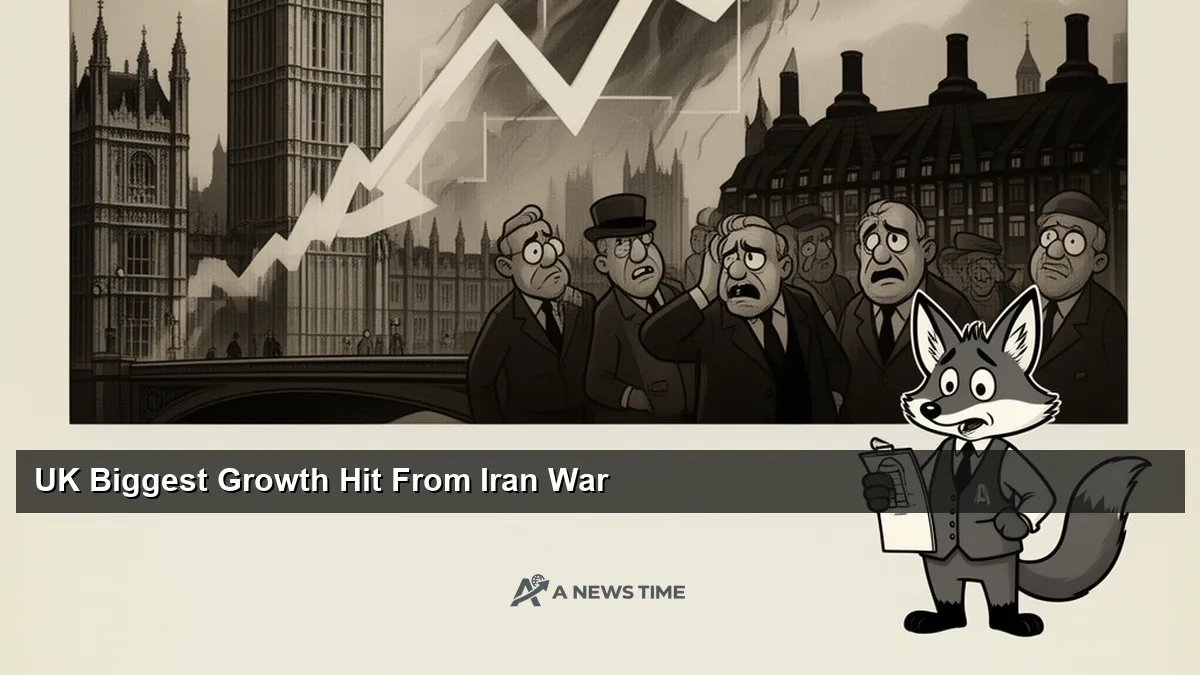
The United Kingdom is forecast to suffer the largest economic growth reduction of any major economy as a result of the U.S.-Iran military conflict, according to the OECD's revised interim outlook published this week. The organization slashed its 2026 UK GDP growth projection from 1.5% to 0.7%, a reduction of 0.8 percentage points that exceeds the downgrades applied to the United States (0.6 points), the eurozone (0.5 points), and Japan (0.4 points). The revision places the UK economy on a trajectory that looks less like recovery and more like the prolonged stagnation that defined the post-Brexit years of 2017 through 2019, but with the added complication of elevated inflation that constrains the policy responses available to the government and the Bank of England.
BBC News reported that the OECD's assessment landed in Westminster like a cold statistical confirmation of what business leaders and economic forecasters had been warning about for weeks: the UK's specific combination of structural vulnerabilities, energy import dependence, post-Brexit trade friction, tight monetary policy, and limited fiscal headroom, makes it disproportionately exposed to the kind of supply-side shock that a Middle East military conflict produces.
Why the UK Gets Hit Hardest
The OECD's analysis identifies four interlocking factors that explain why the UK absorbs more economic damage from the conflict than its peers. Understanding these factors requires looking beyond the immediate oil price spike to the structural characteristics of the British economy that amplify external shocks.
Factor one: energy import dependence. The UK imports approximately 55% of its crude oil and is a substantial net importer of natural gas, with pipeline supplies from Norway supplemented by liquefied natural gas (LNG) shipments from Qatar, the United States, and other producers. The UK's North Sea oil and gas production has been declining steadily since its peak in the late 1990s, and while domestic production still covers a meaningful portion of national energy needs, the gap between production and consumption has widened. When global energy prices rise, the UK feels the increase directly and immediately in its trade balance, its inflation rate, and its household energy bills.
By contrast, the United States is the world's largest oil producer and a net energy exporter. While American consumers still pay global market prices for gasoline and heating fuel, the U.S. economy as a whole captures some of the benefit of higher oil prices through increased revenue for domestic producers, higher tax receipts from the energy sector, and a positive contribution to GDP from expanded drilling and production activity. The UK has no comparable offset.
Factor two: the energy price cap mechanism. The UK's retail energy market operates under Ofgem's price cap, which sets the maximum rate that suppliers can charge households for gas and electricity. The cap is adjusted quarterly based on wholesale energy costs, with a lag of approximately three to six months. This means that the full impact of the current oil and gas price surge will not hit household bills until the July and October 2026 cap adjustments, creating a delayed but inevitable spike in domestic energy costs that will arrive just as other economic headwinds, weaker consumer spending, tighter credit, softer labor demand, are compounding.
The OECD estimates that the average UK household will face annual energy costs of approximately 2,400 pounds under the July price cap adjustment, up from 1,730 pounds in the current period. That 670-pound increase, roughly $850, arrives on top of the real-wage stagnation that British workers have experienced for most of the past five years and represents a meaningful reduction in discretionary spending power for all but the highest-income households.
Factor three: post-Brexit trade friction. Since the UK left the European Union's single market in January 2021, its trade with the EU has been subject to customs checks, regulatory divergence, and administrative costs that did not exist previously. These frictions have already reduced UK-EU trade volumes by an estimated 15% relative to the counterfactual scenario in which Brexit did not occur, according to research by the UK Trade Policy Observatory. The Iran conflict adds a second layer of trade disruption: higher shipping costs through the Persian Gulf, increased insurance premiums for goods transiting the Middle East, and general supply chain uncertainty that makes businesses reluctant to commit to new orders.
The compounding effect matters. A UK manufacturer importing components from East Asia now faces both the post-Brexit customs friction at the UK border and the conflict-driven shipping cost increase through the Suez Canal or around the Cape of Good Hope. The cumulative impact on delivered costs is higher than for a German manufacturer importing the same components through the EU's frictionless internal market. The OECD notes this compounding effect explicitly, observing that "the UK's trade regime amplifies the transmission of global supply chain shocks to the domestic economy in ways that EU membership would have partially mitigated."
Factor four: fiscal and monetary constraints. The UK government's fiscal headroom, defined as the margin by which it meets its self-imposed debt rules, was estimated at approximately 10 billion pounds before the conflict. That is a thin cushion for an economy with annual government spending of roughly 1.2 trillion pounds, and it leaves the Treasury with limited capacity to fund energy subsidies, consumer support programs, or countercyclical spending without either raising taxes, cutting other spending, or breaching its own fiscal rules.
The Bank of England's Dilemma
The Bank of England was expected to begin cutting its base rate from the current 5.25% in August 2026, following a cautious path of quarterly reductions that would bring the rate down to approximately 4.0% by mid-2027. The Iran conflict has disrupted that timeline. With energy prices pushing inflation higher (the CPI is expected to remain above 3% through at least the third quarter of 2026), the Bank faces the same dilemma as the Federal Reserve: cutting rates risks further stoking inflation, while holding rates risks deepening the economic slowdown.
Bank of England Governor Andrew Bailey, speaking at a press conference following the Monetary Policy Committee's March meeting, described the conflict as "a significant external shock that complicates the path of monetary policy." He noted that the Committee voted 6-3 to hold rates, with the three dissenters voting for a 25-basis-point cut, arguing that the growth risks outweighed the inflation risks. The split vote suggests that the internal debate within the Bank is genuine and that a small additional deterioration in economic data could shift the majority toward cutting.
"We are acutely aware that the energy price increase functions as a tax on households and businesses, reducing spending power and slowing economic activity. Our task is to ensure that this temporary price level adjustment does not become embedded in underlying inflationary dynamics through wage-setting behavior and corporate pricing decisions."
Andrew Bailey, Governor, Bank of England
The governor's reference to "temporary price level adjustment" is important. It signals that the Bank views the oil-driven inflation increase as a one-time shift in the price level rather than the beginning of a sustained inflationary spiral. If that assessment is correct, the Bank can afford to "look through" the energy shock and begin cutting rates once underlying inflation shows signs of moderating. If the assessment is wrong, and the energy shock triggers second-round effects in wages and non-energy prices, the Bank will be forced to keep rates higher for longer, deepening the economic damage.
Sector-Level Impact
The OECD's UK-specific analysis identifies several sectors that are disproportionately vulnerable to the current shock. Manufacturing, which accounts for approximately 10% of UK GDP, faces higher input costs from both energy and imported materials. The UK's manufacturing sector is more energy-intensive per unit of output than its French or German equivalents (a legacy of older industrial infrastructure and higher electricity prices even before the conflict), which means the oil price surge translates into a larger competitive disadvantage for British manufacturers relative to their European peers.
Retail and hospitality, which together employ approximately 4.8 million workers in the UK, face a demand-side squeeze as households divert spending from discretionary categories to energy bills. The British Retail Consortium's March survey showed consumer footfall down 3.2% year over year, the weakest reading since the Omicron wave of January 2022. Restaurant bookings data from OpenTable showed a 4.1% decline in March compared to the same period last year.
Financial services, the UK's largest export sector, face a more indirect but potentially significant impact. London's position as a global financial center depends on deal flow (mergers, acquisitions, IPOs, bond issuances), and deal flow has slowed markedly since the conflict began. Thomson Reuters data shows that UK M&A deal value in Q1 2026 is tracking approximately 35% below Q1 2025, as corporate boards defer strategic transactions until the geopolitical outlook clarifies. IPO activity has effectively frozen, with no significant London listings completing since early February.
The housing market is experiencing a separate but related shock. Mortgage rates in the UK, which are more directly linked to the Bank of England's base rate and gilt yields than their U.S. equivalents, have risen to an average of 5.1% for a five-year fixed rate, up from 4.6% in December. The increase has reduced mortgage affordability and cooled demand, with the RICS residential market survey for March showing the weakest buyer enquiries reading since September 2023. The housing market slowdown has a multiplicative effect on the broader economy because housing transactions drive spending on furniture, renovations, legal services, and moving companies.
The Government's Response So Far
The UK government's response to the economic fallout has been measured, constrained by the fiscal limitations that define the current Treasury's operating environment. Chancellor of the Exchequer Rachel Reeves announced three targeted measures in a statement to Parliament on March 21: an extension of the Household Support Fund (providing grants to local authorities for distribution to vulnerable households) at a cost of 500 million pounds, an increase in the Energy Company Obligation (requiring energy suppliers to fund insulation and efficiency improvements for low-income homes) worth approximately 300 million pounds, and a temporary reduction in fuel duty of 3 pence per liter for three months, costing approximately 600 million pounds.
The total fiscal package, approximately 1.4 billion pounds, was described by the opposition as "woefully inadequate." Conservative shadow chancellor Jeremy Hunt called for a more substantial intervention, including a freeze on the energy price cap at current levels and a 10-pence reduction in fuel duty. The government rejected those proposals on fiscal grounds, noting that a price cap freeze would cost approximately 4 billion pounds and would require either borrowing (which would breach the fiscal rules) or cuts to other departments.
The political dynamic around economic policy has shifted noticeably since the conflict began. The Labour government, which came to power in July 2024 promising fiscal responsibility and economic stability, now finds itself managing an external economic shock that it did not cause and cannot control. Polling data from YouGov shows that public confidence in the government's economic management has fallen from 38% approval in January to 29% in March, a decline that tracks closely with the rise in petrol prices and the fall in stock markets.
International Comparisons
Placing the UK's projected 0.7% growth alongside its peers reveals the extent to which British structural vulnerabilities have widened the gap. The United States, at 1.8% projected growth, benefits from domestic energy production, a larger and more diversified economy, and a reserve currency that attracts global capital flows during crises. The eurozone, at 0.9%, benefits from the EU's collective energy purchasing power, its pipeline connections to Norwegian and North African gas, and the European Central Bank's willingness to coordinate with national fiscal authorities. Japan, at 0.9%, benefits from a long history of energy efficiency investments that have reduced its oil intensity per unit of GDP by more than 40% since the 1970s.
The UK, at 0.7%, has none of these specific advantages. It is too small to be self-sufficient in energy, too separated from the EU to benefit from collective purchasing, too fiscally constrained to fund substantial countercyclical spending, and too recently disrupted by Brexit to have fully adjusted its trade relationships. The OECD's numbers quantify what economic geographers have observed for years: the UK economy, after Brexit, is more exposed to global shocks than it was as an EU member, and that exposure becomes most visible precisely when a global shock occurs.
The OECD report notes that even its 0.7% projection contains downside risks. If oil prices remain above $110 per barrel into the summer, if the Strait of Hormuz experiences a more severe disruption, or if consumer confidence deteriorates further, UK growth could fall to zero or even turn negative. A recession in the UK would be the first since the brief pandemic contraction of 2020 and would test the political durability of a government that was elected partly on a promise of economic competence.
What Comes Next for the UK Economy
The immediate outlook for the UK economy depends on three variables that are largely outside British control. The first is the duration and intensity of the Iran conflict, which determines the path of oil prices. The second is the Federal Reserve's policy response, which influences global financial conditions and, through them, the Bank of England's options. The third is the EU's economic performance, since the eurozone remains the UK's largest trading partner despite Brexit.
What the UK government and the Bank of England can control is more limited but not insignificant. Targeted fiscal support for the most vulnerable households can prevent the energy shock from causing a poverty crisis. Monetary policy calibration can balance the competing demands of inflation control and growth support. And regulatory flexibility, for example, relaxing planning restrictions to accelerate renewable energy and insulation projects, can begin to address the structural energy vulnerability that has made this shock so damaging.
The OECD's 0.8 percentage point growth downgrade is the largest single-country revision in the report. It is also a data point in a longer story about the British economy's post-Brexit adjustment: a story in which the theoretical costs of reduced trade integration and reduced policy coordination that economists warned about before the 2016 referendum are, during a period of global crisis, becoming measurably real. The Iran conflict did not create the UK's structural vulnerabilities. It revealed them, and the OECD's numbers put a price tag on what that revelation costs.