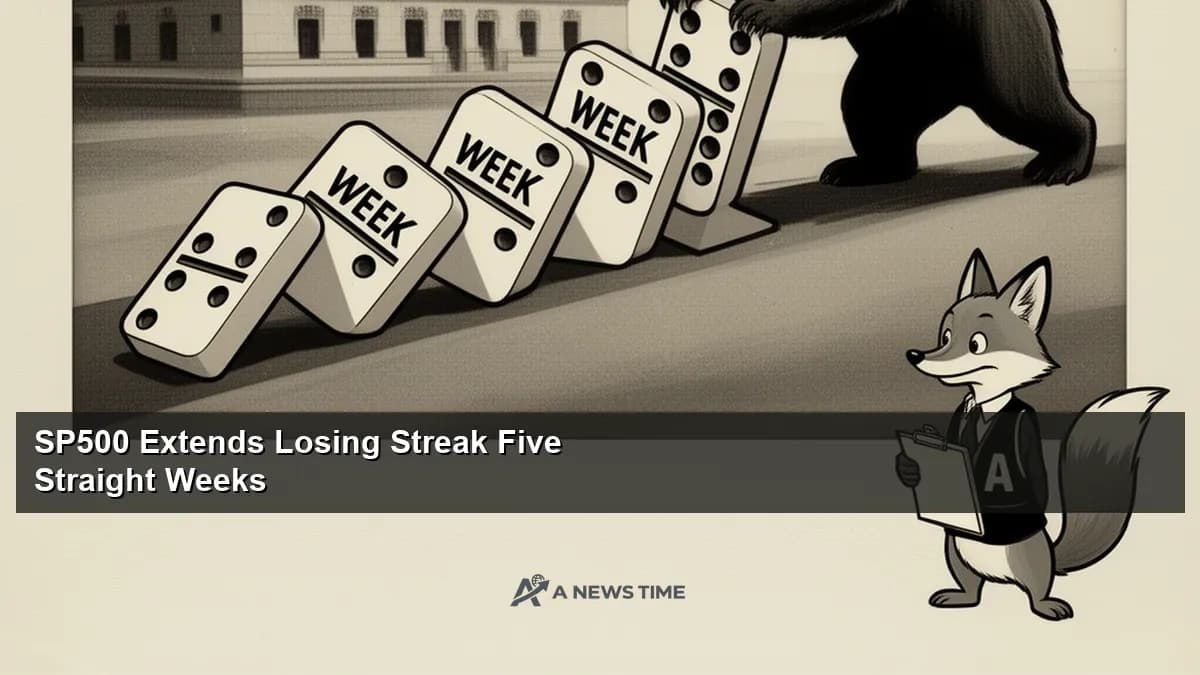
The S&P 500 closed the final week of March 2026 at 4,687, extending its losing streak to five consecutive weeks and marking the longest sustained decline for the benchmark index since the September-October 2022 inflation scare that preceded the Federal Reserve's most aggressive rate hike cycle in four decades. The index has fallen 11.3% from its January 10 all-time high of 5,285, placing it firmly in correction territory and leaving approximately $4.2 trillion in market value on the cutting room floor. For investors who spent the first six weeks of the year optimistic about a soft economic landing and potential Fed rate cuts, March has been a cold, expensive education in how quickly geopolitical risk can rewrite financial narratives.
The week's losses (the S&P fell 2.9% over five sessions) were driven by the same factor that has dominated market psychology since late February: the U.S.-Iran military conflict and its cascading effects on oil prices, inflation expectations, monetary policy, and corporate earnings forecasts. Brent crude settled at $109.60 per barrel on Friday, up from $82 in December 2025. The oil price surge has added what energy economists call a "geopolitical risk premium," essentially a tax on the global economy that gets collected by oil-producing nations and paid by every business and consumer that depends on petroleum-derived energy, transportation, and petrochemicals. Which is to say, by everyone.
Anatomy of a Five-Week Losing Streak
Breaking the five-week decline into its component parts reveals how the market's narrative evolved from cautious concern to active fear. Week one (ending February 28) saw a relatively modest 1.2% decline, driven by the initial naval engagement near the Strait of Hormuz. Week two (ending March 7) brought a sharper 2.1% drop after OPEC declined to increase production. Week three (ending March 14) produced the only interruption in the selling pattern: stocks actually recovered slightly mid-week on diplomatic optimism before giving back those gains by Friday, finishing down 0.8%.
Weeks four and five brought the heaviest damage. The collapse of Swiss-mediated back-channel negotiations on March 17 triggered a 2.4% decline in week four, and week five's 2.9% drop was fueled by an Iranian ballistic missile test, a Pentagon briefing that signaled sustained military operations, and a Goldman Sachs research note that raised the firm's U.S. recession probability to 30%. The progression tells a story of escalation, not just in the conflict itself but in the market's assessment of its economic consequences.
Cumulative breadth data underscores how broad the selling has been. Over the five-week period, declining stocks have outnumbered advancing stocks by a ratio of approximately 2.3 to 1 on the NYSE. The S&P 500's advance-decline line, a measure of how many index components are participating in the market's direction, has fallen to its lowest level since October 2023. When an index decline is accompanied by deteriorating breadth, it suggests that the weakness is not confined to a few heavily weighted names but is spreading across sectors and market capitalizations.
The Oil Price Transmission
Every sustained market decline has a transmission mechanism, the specific channel through which the initial shock propagates into corporate earnings and economic data. In 2022, the transmission mechanism was monetary tightening: the Fed raised rates, borrowing costs rose, asset prices fell. In 2020, it was a biological virus that physically shut down economic activity. In 2026, the transmission mechanism is oil.
Brent crude's journey from $82 in December to $109 in late March represents a 33% increase in the cost of the world's most economically consequential commodity. The effects cascade through the economy in predictable ways. Airlines pay more for jet fuel (Delta Air Lines estimated a $1.2 billion annual earnings impact for every $10 increase in crude prices). Trucking companies pay more for diesel. Chemical companies pay more for feedstocks. Utilities pay more for natural gas (which tends to rise alongside crude). And consumers pay more at the gas pump, leaving less money for restaurants, retail, and entertainment.
Reuters energy analysts estimate that the average American household is now spending approximately $180 more per month on gasoline and home heating compared to December 2025. Annualized, that is $2,160 in additional energy costs per household, money that would otherwise flow into consumer spending, savings, or debt repayment. For a consumer-driven economy where personal consumption accounts for roughly 70% of GDP, the math is not encouraging.
The Meta Rally That Briefly Broke the Pattern
Not every session during the five-week streak was uniformly bleak. On March 12, Meta Platforms surged 6.8% on a single day after reporting that its advertising revenue growth in the first two months of the quarter had exceeded internal projections by a significant margin. The company's AI-driven recommendation algorithms, which have been quietly improving the engagement and monetization of Facebook and Instagram feeds, appeared to be delivering results that were strong enough to offset broader economic headwinds.
The Meta rally briefly pulled the Nasdaq Composite into positive territory for the week and generated a wave of optimistic commentary about AI spending by big tech companies finally translating into measurable revenue growth. For a few hours on March 12, the narrative shifted from "war and recession" to "AI is still working." Nvidia rose 4.2% in sympathy. Microsoft gained 2.8%. The technology sector, which had been the worst-performing major sector for two consecutive weeks, briefly led the market higher.
The rally did not last. By the following Monday, the diplomatic back-channels had collapsed, oil had surged another $4 per barrel, and the technology sector gave back most of its gains. The episode illustrated a dynamic that has repeated throughout the correction: fundamental strength in specific companies or sectors cannot, by itself, overcome a geopolitical overhang that affects the entire economy. Meta's advertising business may be performing well, but even Meta's customers, the businesses that buy advertising, operate in an economy where energy costs are rising and consumer spending power is shrinking.
Volatility Has Become the New Normal
The VIX index, commonly referred to as the "fear gauge," has averaged 28.6 over the past five weeks, compared with 14.2 for the full year 2025. To translate that from options-market jargon into practical terms: the implied daily move for the S&P 500, based on VIX pricing, has roughly doubled. Where the market once expected daily swings of about 0.6%, it now expects swings of approximately 1.3%. In dollar terms, a 1.3% move on the current S&P 500 level represents approximately $540 billion in market value changing hands in a single session.
The elevated volatility has real consequences beyond the abstract. Institutional portfolio managers who use Value at Risk (VaR) models to determine position sizes are forced to reduce their equity allocations when volatility rises, because higher volatility means each dollar of equity exposure carries more risk. This creates a feedback loop: higher volatility leads to forced selling, which pushes prices lower, which can generate even higher volatility. The loop does not continue indefinitely (eventually, buyers step in at prices they consider attractive), but it can persist for weeks or months in the absence of a catalyst to break the cycle.
Options market data reveals the extent of hedging activity. Open interest in S&P 500 put options with strike prices between 4,400 and 4,600 has increased by 340% since early March, according to data from the Options Clearing Corporation. That heavy put buying at levels 3% to 9% below the current index price suggests that institutional investors are preparing for the possibility of further declines while hoping they do not materialize. The cost of that insurance has risen accordingly: the price of a three-month at-the-money put on the SPY ETF has increased by 62% since February.
Where the Smart Money Is Positioning
Beneath the headline selling, meaningful rotations are underway within institutional portfolios. Bank of America's monthly global fund manager survey, released this week, showed that cash allocations rose to 5.8% of portfolio assets, the highest level since March 2023 and well above the long-term average of 4.7%. When professional investors raise cash, they are making a deliberate choice to accept lower returns (cash yields roughly 5.25% in money market funds) in exchange for optionality: the ability to deploy capital quickly if opportunities arise.
"Fund managers are expressing a level of risk aversion we typically see only during active crises. The combination of elevated geopolitical risk, sticky inflation, and Fed policy uncertainty has created a three-headed problem that cash solves better than most asset classes."
Michael Hartnett, Chief Investment Strategist, Bank of America
The survey also showed the largest underweight in technology stocks since September 2022 and the largest overweight in energy stocks since June 2022. Healthcare and utilities allocations rose to their highest levels in 18 months. The pattern is textbook defensive positioning: reduce exposure to sectors that depend on economic growth and increase exposure to sectors that generate revenue regardless of the economic cycle.
Commodity trading advisors (CTAs), the trend-following hedge funds that use systematic models to trade futures, have flipped from net long equities to net short over the past three weeks, according to flow estimates from Deutsche Bank. CTA positioning tends to follow momentum: these funds buy when prices are rising and sell when prices are falling, which means they amplify trends in both directions. Their shift to net short is another mechanical headwind for the equity market and suggests that the trend-following community does not expect the decline to reverse imminently.
Corporate Guidance Season Approaches
First-quarter earnings season begins in mid-April, and the current consensus estimate for S&P 500 earnings growth is 4.2% year over year, according to FactSet. That number has already been revised down from 7.1% at the start of the year, reflecting both the direct impact of higher energy costs on corporate margins and the expected indirect impact of reduced consumer spending power. Analysts at several major firms expect further downward revisions as companies begin reporting and providing forward guidance that accounts for the conflict's full effects.
The most vulnerable sectors for earnings disappointments are airlines (which have already pre-announced significant fuel cost headwinds), consumer discretionary (where higher gas prices are expected to reduce same-store sales), and industrials (where supply chain disruptions from the conflict are beginning to affect production schedules). Technology, the market's largest sector, faces a more nuanced test: the major tech companies have limited direct exposure to oil prices but significant indirect exposure through their advertising and cloud computing customers, many of whom are curtailing spending in response to economic uncertainty.
Companies will also face pointed questions from analysts about their capital allocation plans. Several large-cap companies, including Home Depot, Nike, and Caterpillar, have stock buyback programs that were authorized when share prices were higher. Whether they accelerate those buybacks at current prices (providing a floor for the stock) or pause them to preserve cash (removing a source of demand) will send a signal about management confidence in the economic outlook.
Historical Parallels and Their Limits
Market historians have spent the past several weeks comparing the current decline to previous geopolitically driven selloffs. The most commonly cited parallels are the 1990 Gulf War (which preceded a brief recession and a 20% market decline before a rapid recovery), the 2003 Iraq War (which coincided with the final stages of the dot-com bear market and preceded a multi-year rally), and the 2022 Russia-Ukraine conflict (which contributed to a 25% S&P 500 decline that reversed over the following year).
Each comparison illuminates a different aspect of the current situation, but none is a perfect match. The 1990 Gulf War was a relatively brief, decisive military operation that resolved the immediate oil supply concern within months. The 2003 Iraq War was a protracted conflict that lasted years but occurred when oil prices were relatively low. The 2022 Russia-Ukraine conflict caused a severe energy shock to Europe but had a more limited impact on U.S. energy prices because the U.S. was already the world's largest oil producer.
The current conflict combines elements of all three: it involves a major oil-producing region (like 1990), its duration is uncertain (like 2003), and it has produced a significant energy price shock (like 2022). What makes it potentially more consequential than any of the three is the Strait of Hormuz factor. If the strait were to be closed or severely restricted for an extended period, the resulting supply disruption would exceed anything the oil market has experienced since the 1973 Arab oil embargo.
What to Watch Next
The market enters April with several potential catalysts on the horizon. The March jobs report (April 4) will provide the first major read on labor market health. The CPI report (April 10) will show whether the oil price surge is feeding through into broader consumer inflation. First-quarter earnings season begins with major bank reports (April 11-14). And the United Nations Security Council meeting on April 2 could, depending on its outcome, either reinforce or challenge the market's prevailing pessimism about a diplomatic resolution.
The five-week losing streak will end eventually. All losing streaks do. The question that five weeks of persistent selling has not answered is whether the market is approaching its trough or merely passing through it on the way to something worse. The oil market, the labor market, and the diplomatic channels between Washington and Tehran will provide the next set of clues. Until those clues arrive, the S&P 500's losing streak speaks for itself: investors are selling American equities because the risk of owning them, in this specific geopolitical moment, exceeds the reward. Five straight weeks of that message is not noise. It is a verdict.