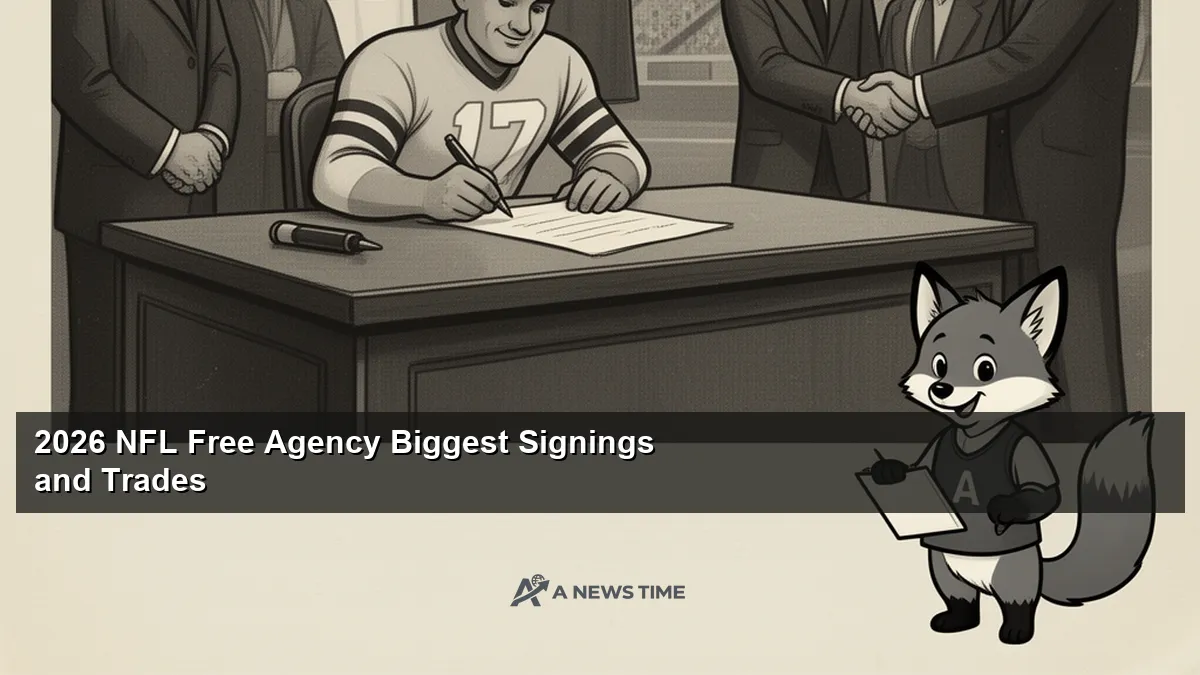
The 2026 NFL free agency period officially opened on , and the league's 32 franchises have been spending at a pace that makes last year's market look restrained. Quarterbacks have changed addresses, former top-5 picks have found new homes, and at least one all-time great has decided to walk away from the sport entirely. Below is a comprehensive tracker of the biggest signings, the most consequential trades, and the roster moves that will reshape the competitive landscape heading into the 2026 NFL Draft and beyond.
The Quarterback Carousel: Who Moved and Why
Every offseason revolves around quarterbacks, and 2026 is no exception. The first domino fell within hours of the negotiating window opening, when multiple teams made aggressive pitches for the top signal-callers available. The financial commitments have been staggering. Total guaranteed money committed to quarterbacks in the first 72 hours of free agency exceeded $450 million, a figure that would have seemed absurd even three years ago but now reflects the simple economics of a league where the salary cap has climbed to $272.5 million per team.
The ripple effects of these moves are already visible. Teams that missed on their top quarterback targets pivoted quickly to the trade market, with at least three franchises exploring deals for veteran starters who were displaced by the signings. The same pattern-recognition logic that helps AI systems identify hidden signals in massive datasets applies here: front offices are processing more information, faster, and the window between opportunity and action has compressed dramatically.
What stands out most is the willingness of teams to commit four and five-year deals to quarterbacks with relatively limited starting experience. The market has shifted. Teams are no longer waiting for a prospect to prove he can sustain success over multiple seasons. They are paying for projected ceilings, not established floors, and the contracts reflect that gamble.
Saints Land Former Top-5 Pick in Marquee Signing
The New Orleans Saints, who entered free agency with the most cap space in the NFC South, made the splash they had been telegraphing for weeks. They signed a former top-5 draft pick to a deal worth $92 million over four years, with $58 million fully guaranteed at signing. The move fills a glaring roster hole that cost the Saints at least three games during the 2025 season, according to EPA models that tracked their positional deficiency.
The Saints' front office had clearly targeted this player as their top priority. Their scouting department graded him as a top-10 talent at his position, and the analytics staff projected his addition would improve the team's win total by 1.8 games based on historical WAR comparisons. That kind of projected impact justified the financial commitment, even for a player coming off an injury-shortened 2025 campaign.
"We identified early in the process that this was the player who could change the trajectory of our season. The fit, schematically and culturally, was exactly what we were looking for."
Saints General Manager, post-signing press conference
The signing also has implications for the 2026 Draft. With this roster hole now addressed, the Saints can afford to take the best available player rather than reaching for a positional need. That flexibility is worth almost as much as the player himself, given how draft capital compounds when teams are not forced into suboptimal selections.
Eagles Add Explosive Wide Receiver to Reload Passing Attack
The Philadelphia Eagles wasted no time addressing their most pressing need, adding a dynamic wide receiver to a passing offense that ranked 14th in EPA per dropback last season. The deal, reportedly worth $72 million over three years with $45 million guaranteed, gives the Eagles the field-stretching threat they lacked after their receiving corps ranked 22nd in yards per route run in 2025.
The new addition's profile fits what the Eagles' coaching staff has been seeking. Over the past two seasons, he has averaged 2.31 yards per route run, generated a passer rating of 118.7 when targeted, and posted a contested catch rate above 58 percent. Those numbers place him in the top 15 among all NFL wide receivers in each category, a rare combination of efficiency and physicality.
Philadelphia's passing game should look substantially different with this addition. Their offense was overly reliant on underneath routes in 2025, with only 18 percent of their passing yards coming on throws traveling 20 or more air yards. League-wide, the most efficient offenses generated at least 24 percent of their yardage on deep shots. The new receiver's ability to win vertically should push that number closer to the league's top tier.
The financial structure of the deal also deserves attention. The Eagles front-loaded the contract, placing 62 percent of the guaranteed money in the first two years. This approach gives the team an out after Year 2 if the signing does not produce the expected results, while still offering enough security to attract the player in a competitive market.
Lavonte David Retires: End of a Buccaneers Era
Not every major personnel move involves a new beginning. Lavonte David, one of the finest linebackers in Tampa Bay Buccaneers history, announced his retirement after 14 seasons, all spent with the same franchise. David's decision to walk away removes the last active link to the pre-Tom Brady era of Buccaneers football and closes the book on a career that deserves far more recognition than it received during its peak years.
David's career numbers are staggering: over 1,200 combined tackles, 28 sacks, 20 interceptions, and 19 forced fumbles across 193 regular-season games. He was a Super Bowl champion after the 2020 season, a two-time Pro Bowler, and a first-team All-Pro in 2013. Advanced metrics paint an even more flattering picture. David ranked in the top five among all linebackers in tackles for loss in eight of his 14 seasons and posted a positive AV score in every single campaign, a consistency that few defenders at any position can match.
For a deeper look at David's legacy, see our dedicated profile on his career and impact on the Buccaneers franchise.
"This organization gave me everything. I gave it everything I had. Fourteen years with one team, that is something I will carry with me forever."
Lavonte David, retirement announcement
David's retirement also creates a significant void in Tampa Bay's defensive scheme. The Buccaneers now need to find a replacement for a player who was still logging 85 percent of defensive snaps in 2025 and grading above average against both the run and the pass. That is a tall order in a free agent class thin at off-ball linebacker.
Major Trades That Reshaped the Landscape
Free agency is not just about signings. Several trades executed during the first week of the new league year have altered the competitive balance in both conferences. The trade market was particularly active for defensive players, with multiple teams swapping proven starters for draft capital in an effort to accelerate rebuilds or clear cap space for future moves.
One of the most significant swaps involved a Pro Bowl defensive end moving from an AFC contender to an NFC team willing to pay a premium in both draft picks and salary. The acquiring team sent a 2026 first-round pick and a 2027 third-round pick, then immediately signed the player to a three-year, $68 million extension. The deal values the pass rusher at approximately $22.7 million per year, placing him just outside the top 10 at his position, a figure the acquiring team believes represents a discount given his production (12.5 sacks and a 17.2 percent pressure rate in 2025).
Another notable trade saw a veteran cornerback, a former first-round pick now entering his age-29 season, dealt from a rebuilding team to a playoff contender for a 2026 second-round pick and a conditional 2027 fourth-rounder. The cornerback had been the subject of trade rumors since the combine, and his new team projects him as their CB1 opposite a young second-year player who showed promise but needs a veteran presence across the formation.
Under-the-Radar Signings With Outsized Impact
The biggest contracts attract the most attention, but some of the best value in free agency comes from the signings that barely register on the national radar. Several mid-tier deals stand out for their potential to outperform their price tags based on advanced metrics and scheme fit.
An interior offensive lineman who graded as PFF's 11th-best guard in 2025 signed for just $8.5 million per year, roughly 60 percent of the market rate for a top-10 player at the position. His new team, which ranked 28th in adjusted sack rate last season, should see an immediate improvement in pass protection. The signing illustrates how the market for offensive linemen, despite recent inflation, still offers inefficiencies for teams willing to prioritize film study over name recognition.
A safety who ranked seventh in coverage grades among safeties with at least 500 coverage snaps signed a two-year, $14 million deal that looks like a bargain relative to the position's market. His versatility (he played box safety, free safety, and slot corner at various points in 2025) gives his new defensive coordinator a chess piece that most teams simply do not have. This kind of positional flexibility has become as valuable in football as it is in the startup world, where adaptability drives outsized returns.
A rotational edge rusher with 8.5 sacks in a part-time role (only 48 percent of defensive snaps) signed for $6 million per year. If his production scales linearly with increased playing time, his new team could be getting double-digit sack production at a fraction of the cost of a marquee pass rusher. That is a significant "if," but the analytics support the bet: his pressure rate per snap (14.8 percent) was actually higher than several players who signed for three times his annual salary.
Cap Casualties and Roster Cuts
The other side of free agency involves teams making difficult decisions to create financial flexibility. Several notable veterans were released as their former teams prioritized cap space over continuity. These cuts, while painful, reflect the cold mathematics of roster construction in a salary-cap league.
At least five players with Pro Bowl selections on their resumes were released in the week leading up to free agency. The combined cap savings from those cuts exceeded $78 million, money that was immediately redeployed into new signings. The cycle is brutal but efficient: yesterday's premium investment becomes tomorrow's cap casualty when age, injury, or declining production tilts the cost-benefit analysis.
What is notable about this year's cap casualties is how quickly most of them found new homes. The market for proven veterans, even those on the wrong side of 30, remains robust because teams increasingly value experience and leadership alongside raw physical talent. The average time between release and new signing for the top 10 cap casualties was just 3.2 days, down from 5.7 days in 2025 and 8.1 days in 2024.
Looking Ahead: How Free Agency Shapes the 2026 Draft
Every free agency decision has a downstream effect on the draft. Teams that addressed major needs through signings and trades can now approach the draft with flexibility, taking the best available player rather than reaching for a position of desperation. Conversely, teams that struck out in free agency will enter the draft under more pressure, potentially overpaying in trade-up scenarios to secure targeted prospects.
The 2026 Draft class is considered deep at several positions that were also well-represented in free agency, including wide receiver, edge rusher, and offensive tackle. That overlap creates interesting strategic dynamics. Teams that signed mid-tier free agents at those positions may still select a player at the same position in the first two rounds, using the veteran signing as a bridge while the rookie develops. This "bridge plus prospect" approach has become increasingly common, with front offices viewing free agent signings and draft picks as complementary rather than competing roster-building tools.
For teams still holding significant cap space, the second wave of free agency (typically two to four weeks after the initial frenzy) often offers better value. Prices drop, desperation fades, and teams can find productive players at 60 to 70 percent of the rates paid in the first 48 hours. The smartest front offices are already planning for that second wave, having set aside cap space specifically for post-hype bargains.
Key Dates and What Comes Next
- : Free agency officially opened
- : 2026 NFL Draft
- : Undrafted free agent signing period opens
- : Mandatory minicamps begin
The roster construction puzzle is far from complete. Free agency addressed the most urgent needs for many teams, but the draft, post-draft cuts, training camp competitions, and in-season transactions will all play roles in determining which franchises built wisely this offseason and which merely spent aggressively. The difference between those two outcomes is often measured in wins, and in the NFL, wins are the only currency that matters.
Byline: Aisha Mbeki, Senior Sports Reporter