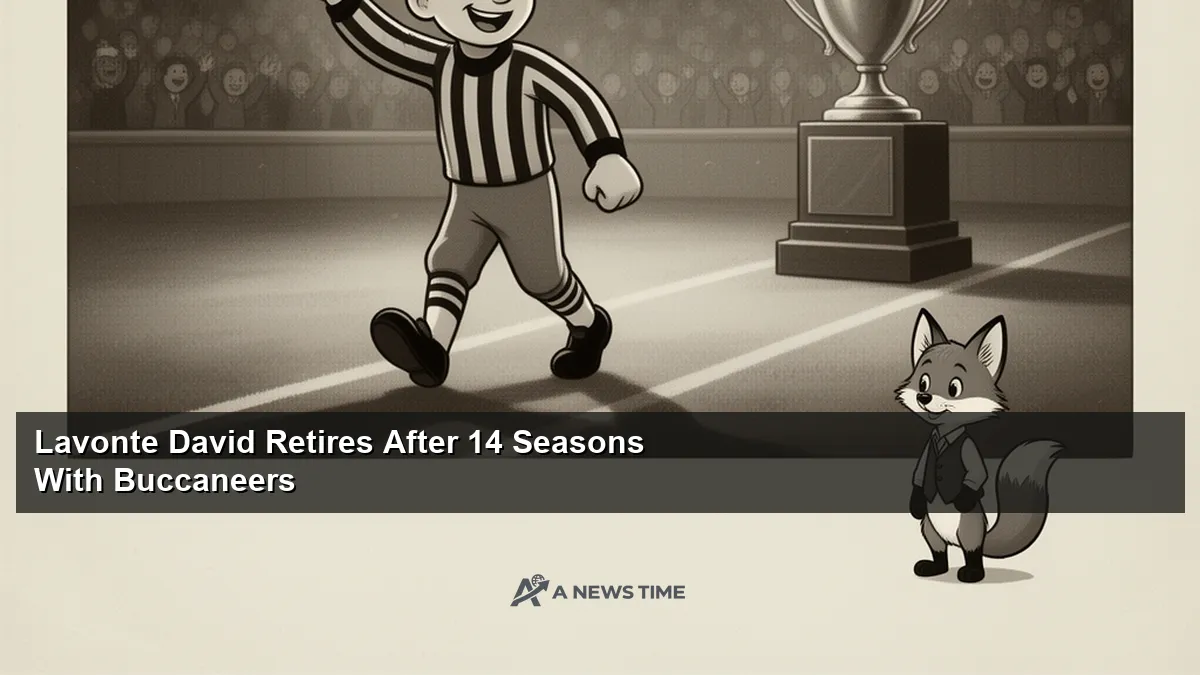
Lavonte David, one of the most complete linebackers of his generation and arguably the greatest defender in Tampa Bay Buccaneers history, has retired after 14 NFL seasons, all spent with the franchise that drafted him in the second round of the 2012 NFL Draft. David's decision, announced in , ends a career defined by remarkable consistency, tactical intelligence, and a quiet excellence that never received the mainstream recognition it deserved.
A Career Built on Consistency and Craft
The numbers tell a compelling story, but they only capture part of what made Lavonte David exceptional. Over 14 seasons and 193 regular-season games, David accumulated 1,235 combined tackles, 28.0 sacks, 20 interceptions, 19 forced fumbles, and 119 tackles for loss. He was a two-time Pro Bowl selection (2015, 2020), a first-team All-Pro in 2013, and a Super Bowl champion after the 2020 season. He started 186 of those 193 games, a durability record that speaks to both his physical conditioning and his ability to avoid the kind of catastrophic injuries that shorten careers at his position.
But the stat sheet, as comprehensive as it looks, undersells David's impact. He was one of the rare linebackers who could credibly claim elite status in all three phases of defensive play: run defense, pass coverage, and pass rushing. In an era when most off-ball linebackers are classified as either "run stuffers" or "coverage linebackers," David refused to be limited. His career pass-rush win rate of 14.2 percent ranked in the top 10 among linebackers with at least 200 pass-rush snaps over the past decade, and his coverage grade never fell below average in any season, per PFF tracking data.
"Lavonte is the most complete linebacker I have ever coached. He could do everything: blitz, cover, tackle in space, diagnose plays before the ball was snapped. Players like him do not come along very often."
Todd Bowles, Tampa Bay Buccaneers Head Coach
The consistency is what stands out most. David posted a positive AV score in every one of his 14 seasons. He recorded at least 80 combined tackles in 12 of those 14 campaigns. He never had a season where he graded below the 50th percentile at his position in any major analytics system. That kind of sustained, baseline-or-better production across nearly a decade and a half is extraordinarily rare, not just at linebacker but at any defensive position.
The 2013 Season: David's Statistical Masterpiece
If one season encapsulates the full scope of David's ability, it is 2013, his second year in the league. That year, David recorded 145 combined tackles, 7.0 sacks, 5 interceptions (returning two for touchdowns), 5 forced fumbles, and 21 tackles for loss. Those are not linebacker numbers. Those are the numbers of a defensive player who is simultaneously the best at every responsibility assigned to him on every single snap.
The 2013 season earned David first-team All-Pro honors, but many analysts felt he deserved more recognition. The Buccaneers went 4-12 that year, and David's brilliance was obscured by the team's failures. It is one of the most persistent biases in football evaluation: individual excellence on a losing team is discounted, sometimes dramatically, compared to strong play on a winning roster. David suffered from that bias throughout the early portion of his career.
To put the 2013 season in context, only three other linebackers in NFL history have recorded at least 7 sacks, 5 interceptions, and 5 forced fumbles in a single season. David was 23 years old when he did it. The fact that he was not the Defensive Player of the Year, or even a finalist, remains one of the more notable oversights in the award's recent history.
The Super Bowl Season and Brady's Arrival
For the first eight years of David's career, the Buccaneers were largely irrelevant. They made the playoffs once (2020 was technically his ninth season, but the transformation began in earnest when Tom Brady arrived). David played through losing seasons with the same intensity and professionalism that he displayed when the stakes were highest, and that consistency is part of what made the 2020 championship so meaningful.
When Brady arrived in Tampa Bay ahead of the 2020 season, the defense already had its foundation in place, and David was its cornerstone. The Buccaneers' defense ranked sixth in DVOA that season, and David's role was central to its success. He played 89 percent of defensive snaps during the regular season and was on the field for every meaningful snap during the playoff run, including Super Bowl LV against the Kansas City Chiefs.
In that Super Bowl, the Buccaneers' defense held Patrick Mahomes to just 270 passing yards, no touchdowns, and two interceptions. David contributed six tackles, a tackle for loss, and a pass defensed. It was a workmanlike performance, exactly the kind of game David had been playing for nearly a decade, but this time the world was watching.
"Winning the Super Bowl validated everything. All those years when we were struggling, I never questioned whether it was worth it. And then to hold up that trophy, in our building, in front of our fans. That was everything."
Lavonte David, on the 2020 Super Bowl victory
The championship also changed how the broader football public viewed David. He had always been respected within the building and around the league, but casual fans and national media had largely overlooked him during the losing years. The Super Bowl put David's name in conversations where it had always belonged but had rarely been included.
Advanced Metrics: The Full Picture of David's Impact
Modern analytics offer a more granular view of David's contributions than traditional statistics alone. Over his career, David accumulated 48.2 AV per Pro Football Reference, ranking him among the top 25 off-ball linebackers in NFL history. His career WAR estimate, using the model developed by ESPN's analytics team, places him in the top 30 at his position since the merger.
In coverage, David was consistently excellent. His career passer rating allowed when targeted was 87.3, well below the league average for linebackers (which has hovered around 98 to 105 over the past decade depending on the model used). He intercepted 20 passes, a number that ranks in the top 15 among linebackers since 2000, and he broke up an additional 47 passes. His ability to drop into zone coverage, read the quarterback's eyes, and make plays on the ball was a skill that most linebackers simply do not possess, regardless of their athletic profiles.
Against the run, David was equally impressive. He averaged 7.8 run stops per game across his career (defined as tackles that constitute a "failure" for the offense, either behind the line of scrimmage or short of the first-down marker). That figure placed him in the top 10 among all linebackers in every season from 2012 to 2023. His missed tackle rate of 6.8 percent was among the lowest at his position, reflecting not just sure tackling but excellent positioning and angle discipline. The same attention to detail that drives scientific advances in maximizing efficiency was evident in how David approached every snap.
Perhaps the most telling metric is snap count. David played 12,847 defensive snaps across his career. Of those, PFF graded him as "above average or better" on approximately 71 percent, a figure that speaks to his reliability on a play-by-play basis. For context, the average starting linebacker grades above average on roughly 55 to 60 percent of their snaps. David was meaningfully better than average on almost every down, for 14 years.
One Team, 14 Years: The Rarity of Franchise Loyalty
In a league defined by constant roster turnover, David's 14-year tenure with a single franchise is a remarkable achievement. He is one of only 11 players in NFL history to spend 14 or more seasons with the same team while playing primarily on defense. The list includes names like Ray Lewis (17 years with Baltimore), Derrick Brooks (14 years with Tampa Bay), and London Fletcher (who, notably, played for three teams). David joins Brooks as the only two players to spend their entire careers of 14-plus seasons with the Buccaneers.
The connection between David and Brooks, both Buccaneers linebackers who defined their respective eras, is difficult to ignore. Brooks, a Hall of Famer, set the standard for linebacker play in Tampa Bay. David met that standard and, by some measures, exceeded it. Brooks himself has been among David's most vocal advocates for Canton consideration.
"Lavonte carried the torch for this franchise. He did it the right way, every single day, for 14 years. There is no question in my mind that he belongs in the Hall of Fame."
Derrick Brooks, Pro Football Hall of Fame Class of 2014
David's loyalty was not without cost. He played through several rebuilding periods, endured coaching changes, and watched teammates leave for bigger contracts and brighter spotlights. Through it all, he remained committed to Tampa Bay, repeatedly restructuring his contract to help the team manage its cap situation. His cumulative career earnings of approximately $102 million are substantial, but they are well below what a player of his caliber could have commanded on the open market had he tested free agency in his prime years.
The Hall of Fame Question
David's retirement immediately triggers the Hall of Fame conversation, and it is a conversation that will generate significant debate. The case for David is strong. His career statistics compare favorably to several linebackers already enshrined in Canton. His longevity (14 seasons, all with one team) is exceptional. His Super Bowl ring eliminates the "never won the big one" objection that sometimes sinks borderline candidates. And the advanced metrics consistently paint him as one of the 20 best off-ball linebackers in modern NFL history.
The case against is also real, if somewhat unfair. David has only two Pro Bowl selections, a number that reflects the Buccaneers' losing records during his prime years more than any deficiency in his play. He was a first-team All-Pro only once, though he arguably deserved the honor in at least three additional seasons. And he spent most of his career in relative obscurity, playing in a small market on teams that rarely appeared in nationally televised games.
The parallel to his own franchise's history is instructive. Derrick Brooks was not a first-ballot Hall of Famer despite a resume that included 11 Pro Bowls and a Defensive Player of the Year award. If Brooks had to wait, David may face an even longer road. But the analytics community, which has grown increasingly influential in Hall of Fame voting, will be a strong advocate for David's case, and the numbers are on his side.
David will be eligible for Hall of Fame consideration starting with the class of 2031, five years after his final game. The wait will be worth watching. As we reflect on those who leave their fields and the legacies they built, David's story is one of quiet, persistent greatness.
What the Buccaneers Lose
David's retirement leaves the Buccaneers with a significant hole at off-ball linebacker. Despite being 36 years old in his final season, David was still playing 85 percent of defensive snaps and grading above average in both run defense and coverage. His football intelligence, his ability to diagnose plays pre-snap and communicate adjustments to his teammates, is the kind of intangible value that does not show up in any metric but is immediately felt when it disappears.
Tampa Bay will need to address the position through either free agency, the draft, or both. The 2026 free agent class is thin at off-ball linebacker, which means the draft may offer the best path to finding David's long-term replacement. Several prospects in the 2026 class have drawn comparisons to David's playing style, though comparing anyone to a 14-year starter is an exercise in optimism more than analysis.
The Buccaneers have already begun the process of honoring David's contributions. The team announced that David will be inducted into their Ring of Honor, joining Brooks, Warren Sapp, John Lynch, and other franchise legends. It is the least they can do for a player who gave everything to the organization for the entirety of his professional career.
Lavonte David played 14 seasons with one team, won a Super Bowl, recorded over 1,200 tackles, and did it all with a professionalism and consistency that should serve as a model for every player who follows him. His career deserves celebration, and his legacy will only grow as the passage of time provides the perspective that his contemporaries sometimes lacked.
Byline: Aisha Mbeki, Senior Sports Reporter