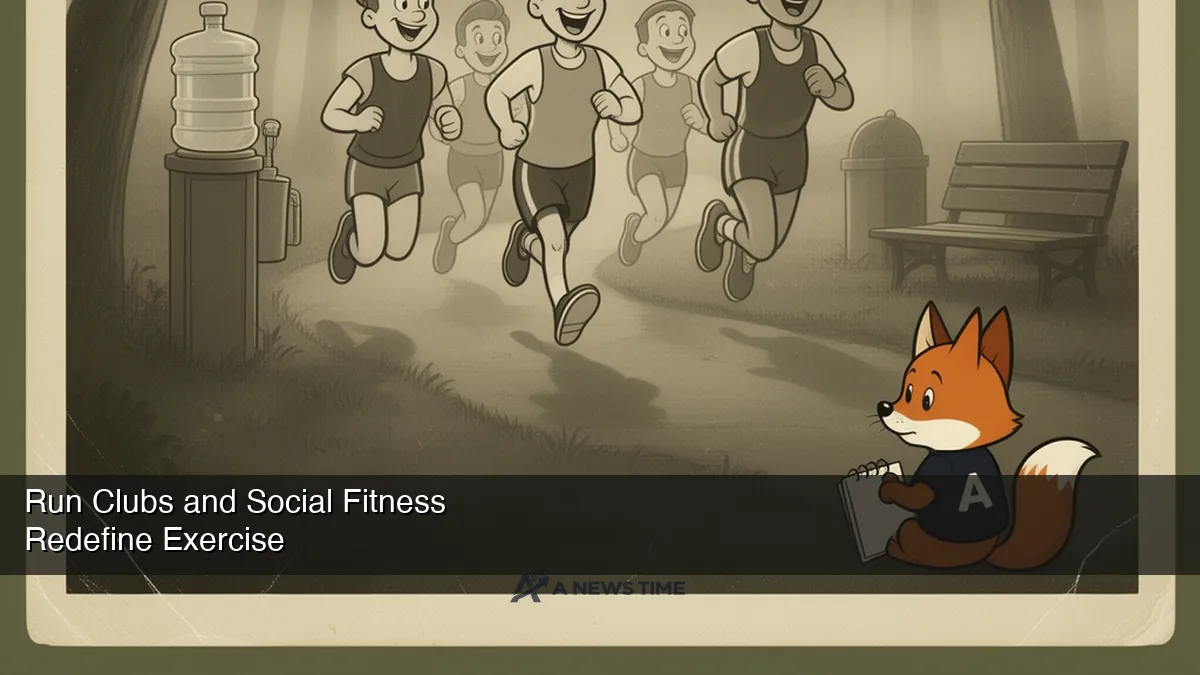
There is a particular kind of Saturday morning that has become recognizable in American cities: a cluster of people in matching technical gear gathering at a coffee shop or park entrance, stretching, checking watches, trading greetings before setting off together at a pace that makes conversation possible. Run clubs have existed for decades, but something has changed about their scale, their cultural resonance, and the need they appear to fill. In 2026, they are everywhere, and the fitness industry is paying close attention.
The American College of Sports Medicine made the observation official this year, adding Adult Recreation and Sport Clubs to its annual Worldwide Survey of Fitness Trends at number nine, the first time the category has appeared in the top 20. The ranking encompasses pickleball leagues, cycling clubs, and recreational sport leagues alongside running, but run clubs in particular have become a cultural phenomenon that extends well beyond the fitness category they ostensibly occupy. Understanding why requires looking at the social forces they are responding to.
The Loneliness Context: Why Now
The timing of run clubs' rise is not coincidental. The years following the pandemic produced a social landscape in which many wellness routines became, by necessity, solitary. Home workouts, solo walks, individual meditation apps, and digital fitness programs replaced the shared physical spaces that had previously structured social exercise. Those individual habits stuck for many people even after gyms and studios reopened, and by 2023 and 2024, social scientists and public health researchers were documenting a loneliness problem in the United States that had structural as well as individual dimensions.
"Many of our wellness routines became increasingly solitary during and after the pandemic. People optimized their individual health habits but lost the connective tissue of shared physical experience. Connection-driven wellness is reversing that, and the demand we are seeing suggests the reversal has real depth."
Justin Gurland, founder of The Maze, New York City's first alcohol-free members club
Gurland's observation from the vantage point of a social fitness and wellness space captures something that researchers have been documenting from different angles. The US Surgeon General's 2023 advisory on the loneliness epidemic established that Americans are spending less time with friends and community than they were two decades ago, with measurable effects on mental and physical health outcomes. Exercise, historically a domain where people could meet the dual need for physical activity and social connection, had been progressively individualized by technology. Run clubs represent, among other things, a correction to that individualization.
Run Clubs as Social Infrastructure
The run clubs that have proliferated in cities like New York, Los Angeles, Chicago, Austin, and Seattle are not simply exercise groups. They have developed the social functions of institutions: regular gathering times, shared identities, cross-generational membership, and community rituals that extend beyond the run itself. Pre-run coffee, post-run brunch, club merchandise, social media communities, guest runner programs, and charity races have all become standard features of the more established clubs. The exercise is the entry point; the community is what keeps people coming back.
This social architecture serves a population that is, by many measures, actively seeking alternatives to the alcohol-centered socializing that has historically dominated adult social life. The rise of sober and sober-curious culture, the popularity of alcohol-free bars and events, and the growth of social spaces like The Maze that explicitly center wellness rather than drinking all reflect a broader shift in how a significant segment of younger adults want to socialize. Run clubs fit this pattern precisely: they offer regular social contact, shared physical challenge, a sense of belonging, and a reason to be outside at seven on a Sunday morning that does not involve a hangover.
The numbers behind run club participation are difficult to pin down precisely because the category is largely informal and fragmented, but the directional data is unambiguous. Strava, the social fitness platform, reported that group running activity on its platform grew substantially year-over-year through 2024 and 2025. Running shoe brands including On, Hoka, and New Balance have invested in run club sponsorships and partnerships as primary marketing channels, recognizing that the social trust built within these communities translates into purchasing influence far more effectively than conventional advertising.
Pickleball and the Recreation Club Surge
While run clubs have captured the most cultural attention, the broader category of adult recreation and sport clubs includes a sport whose growth statistics have surprised virtually everyone who tracks them: pickleball. The sport added millions of players in the United States over the past three years, with recreational leagues appearing in parks, community centers, and dedicated facilities in every major metropolitan area and many rural communities.
What makes pickleball particularly interesting as a social fitness phenomenon is its demographic breadth. Unlike most sports, which tend to cluster within specific age groups, pickleball is genuinely multigenerational: it is equally popular among retirees looking for low-impact social activity and young professionals seeking after-work recreation. That cross-generational appeal is rare in recreational sport, and it may partly explain the sport's unusual cultural staying power in a landscape where fitness trends typically rise and fall quickly. Pickleball courts have been built inside empty retail spaces, converted parking lots, and repurposed gyms, and the associated league and club infrastructure has created social networks that function similarly to run clubs in their community-building dimension.
Recreational soccer leagues, cycling clubs, and adult swim teams are also growing, though less dramatically than pickleball and running. The common thread across all of these formats is that they organize physical activity around social structure rather than treating exercise as a purely individual pursuit. The ACSM's recognition of this category as a top-10 trend reflects a research community's acknowledgment that the social context of exercise may be as important to sustained participation as any individual motivational factor.
Les Mills and the Research Behind Community Fitness
Les Mills International, the New Zealand-based fitness company whose group training programs are used in gyms worldwide, publishes an annual fitness trend report that draws on its own large-scale consumer research. The 2026 edition identified seven key trends, and community connection appeared prominently as both a driver of gym attendance and a defining characteristic of the formats that were showing the strongest participation growth.
The Les Mills research also highlighted a concept that has been circulating in wellness circles under the acronym JOMO: the Joy of Missing Out. Where the earlier FOMO, or Fear of Missing Out, described anxiety about being absent from social events, JOMO describes the deliberate choice of quieter, more intentional social engagement over high-stimulation, alcohol-centered gatherings. Run clubs and other social fitness formats fit the JOMO pattern: they offer genuine social connection without the costs, in every sense, of conventional nightlife. For people navigating the competing demands of health, social life, and economic constraint, a free or low-cost run club represents a genuinely attractive synthesis.
This framing connects social fitness to the broader cultural shift that public health researchers call the "sober curious" movement, though the connection goes deeper than simply replacing bars with run clubs. What the data suggests is that a significant segment of adults, particularly younger adults who came of age during the pandemic, are re-evaluating the role of alcohol in social life and finding that they prefer social contexts organized around shared activity rather than shared consumption. Exercise provides the shared activity, and community structures provide the belonging that bars and clubs once monopolized.
The "Festivalization of Wellness" and Its Complications
The Global Wellness Summit, in its annual trends reporting, has tracked what it calls the "festivalization of wellness": the emergence of large-scale wellness events that blend physical activity with the aesthetic and social energy of festival culture. Wellness raves, which pair electronic music with morning dance events and involve no alcohol, have proliferated in US cities. Hyrox, the fitness competition format that combines running with functional strength stations, has grown from a European concept to a global phenomenon, drawing thousands of participants to events in major cities. Sober morning dance events like Daybreaker, which operates in cities worldwide, have built communities around shared movement in ways that feel more festival than fitness.
| Social Fitness Format | Primary Appeal | Growth Signal |
|---|---|---|
| Run clubs | Community, routine, low cost | All-time high participation; Strava group data |
| Pickleball leagues | Multigenerational, accessible | Fastest single-sport growth in US recreation |
| Hyrox competitions | Challenge, shared achievement | Global expansion from Europe to US cities |
| Wellness raves | Music, movement, sober socializing | Major US city proliferation in 2025-2026 |
| Sober morning dance events | Social connection without alcohol | Daybreaker operating in 25+ global cities |
| Cycling clubs | Outdoor activity, social identity | Steady growth alongside run clubs |
The complications in this picture are real and worth acknowledging. As wellness has become a cultural priority, it has also become a market, and the monetization of social fitness carries risks. Premium run club memberships that charge monthly fees for what was previously free infrastructure represent one end of this spectrum. Wellness festival tickets that price out lower-income participants represent another. Critics of the wellness industry's growth have argued, with considerable evidence, that the commercialization of community can transform what begins as a genuine social good into an exclusive consumption experience.
The Women's Sports Revolution as a Participation Driver
Any account of social fitness trends in 2026 that ignores the influence of the women's sports revolution would be incomplete. The sustained surge in women's sports viewership and participation that has characterized the past several years, driven by the WNBA, the National Women's Soccer League, women's college basketball, and the global rise of women's professional running, has created visible role models and cultural permission for women's athletic participation at all levels.
Run clubs, in particular, have benefited from this cultural moment. The majority of participants in many urban run clubs are women, and the community dimension of these clubs, their emphasis on belonging and shared experience over individual performance metrics, maps well onto motivations that research has found to be especially salient for women's exercise participation. The social structure of run clubs, which tends to de-emphasize competitive pace and emphasize consistent group membership, has proven more effective at retaining women than the competitive gym cultures that have historically dominated fitness marketing.
The broader effect of the women's sports revolution on fitness participation is difficult to isolate statistically, but the directional evidence is strong. Survey data from multiple sources shows that women's reported interest in strength training, competitive sport, and structured group exercise has risen substantially over the past three years. The social fitness trend is not gender-specific, but understanding its growth requires accounting for the cultural shifts that have expanded who sees exercise as part of their identity.
Purpose-Driven Micro-Communities and What They Signal
Researchers studying the social fitness trend have noted the emergence of what they are calling purpose-driven micro-communities: small, cohesive groups organized around specific physical activities, shared values, or both. These are not the large, impersonal fitness communities of commercial gyms but the kind of tight-knit social networks that sociologists describe as high-trust, high-engagement, and capable of generating the sense of belonging that larger social institutions increasingly struggle to provide.
Run clubs are perhaps the most visible example, but the pattern extends to climbing gyms that have become social hubs for young urban professionals, to rowing clubs that combine physical training with community service, to trail running groups organized around environmental stewardship, and to cycling communities that pair rides with local advocacy. In each case, the shared physical activity is the organizing principle, but the community that forms around it serves social functions that extend well beyond fitness. This is not a new phenomenon, organized sport has always served social functions, but its reemergence as a cultural priority in 2026 is notable.
The wearable technology and app-based fitness trends that top the ACSM rankings exist alongside this social fitness movement in a relationship that is more complementary than contradictory. People who track their runs on Strava join run clubs; people who use fitness apps share results with their pickleball league. The data-driven individual practice and the community-based social practice are not competing for the same space. They are, for many people, two dimensions of a single orientation toward physical health that is both personal and communal. For context on how these broader trends are tracked and ranked, see the full ACSM findings in our 2026 fitness trends report.
What Comes Next for Social Fitness
The trajectory of social fitness trends is upward, but the shape of that trajectory is not predetermined. Several forces will determine whether the current surge in run clubs, recreational leagues, and community wellness events translates into durable institutional infrastructure or remains a cultural moment.
The economic pressures on social fitness are real. Free run clubs are only free until someone needs to cover insurance, event coordination, and the administrative work of running a community. As clubs grow, they face choices about how to sustain themselves financially without replicating the exclusionary dynamics of the commercial gym industry. The answers to those questions will determine whether social fitness remains broadly accessible or becomes another wellness luxury.
The public health implications are significant enough to attract policy attention. If organized social fitness can demonstrably reduce loneliness, improve mental health outcomes, and increase exercise adherence in populations that currently underparticipate in physical activity, the case for public investment in the infrastructure that supports it, parks, trails, public courts, and safe streets for running and cycling, becomes considerably stronger. Several cities are already making those investments, and the outcomes will be worth watching. The mental health dimensions of this trend are explored in further depth in our coverage of exercise for mental health as a rising fitness priority.
Frequently Asked Questions
Why are run clubs at an all-time high in 2026?
Run clubs have surged because they fill a gap left by the individualization of wellness during and after the pandemic. They offer social connection, community belonging, and shared physical activity without the costs or downsides of alcohol-centered socializing, appealing to a broad demographic seeking connection-driven wellness experiences.
What is the JOMO trend in fitness?
JOMO stands for Joy of Missing Out and refers to the deliberate choice of quieter, more intentional social engagement over high-stimulation gatherings. In fitness contexts, JOMO describes the preference for morning run clubs and wellness-focused social events over conventional nightlife, a trend identified by Les Mills in its 2026 research.
Is pickleball still growing in 2026?
Yes. Pickleball continues to be one of the fastest-growing recreational sports in the United States, notable for its unusually broad demographic appeal across age groups. New courts and leagues are being developed at a pace that industry analysts describe as unprecedented for a single sport in modern American recreational history.
Are social fitness memberships becoming too expensive?
The commercialization of community wellness is a genuine concern. Premium memberships at alcohol-free social clubs and high-end run club programs can be costly, raising questions about whether connection-driven wellness is accessible to lower-income communities or becoming another exclusive wellness consumption experience.