Byline: Kieran Wolfe, Senior Gaming Reporter
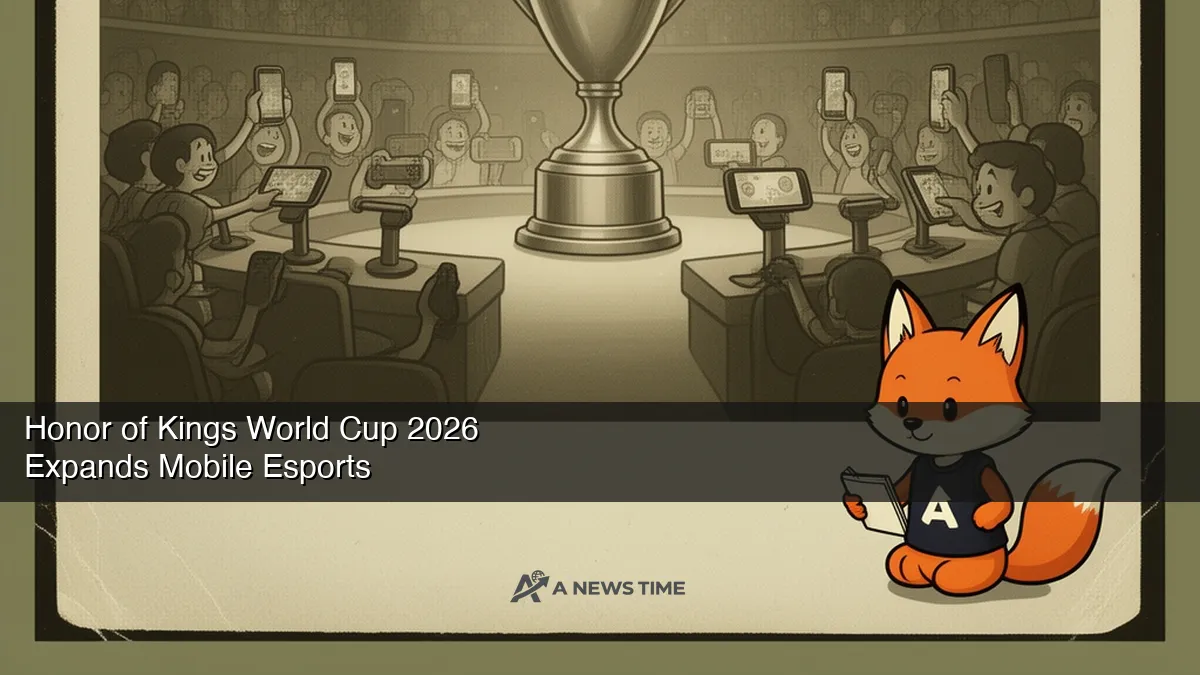
The announcement of the Honor of Kings World Cup 2026 as a confirmed entry in the competitive calendar marks a meaningful moment for mobile esports: the world's highest-grossing mobile game is formally committing to a world championship structure at a time when the broader competitive gaming industry is debating how seriously to take mobile as a tier-one competitive medium. That debate has been shaped for too long by a cultural bias rooted in the gaming industry's PC and console origins, and the Honor of Kings World Cup is one of the clearest arguments for why that bias needs updating. The evidence is not subtle. HoK, developed by Tencent's TiMi Studio Group, operates within a $81.7 billion mobile gaming market that dwarfs the PC and console segments it has historically been compared unfavorably against. The competitive scene that serves this market is not a lesser version of PC esports. It is a parallel industry with its own audience, its own competitive culture, and its own economic logic.
What Honor of Kings Is and Why It Matters
Honor of Kings is a MOBA that launched in China in 2015 and has since become one of the most played games in human history by raw player count. Its domestic dominance in China is well documented: at its peak, the game had over 100 million daily active users in China alone, a figure that most PC titles would consider a lifetime achievement rather than a daily metric. The international version, Arena of Valor, never fully replicated the domestic success, but the franchise's global footprint has expanded meaningfully through targeted market development in Southeast Asia, the Middle East, and parts of Europe.
The game's mechanics are optimized for mobile play in ways that reflect genuine design intelligence rather than compromise. The control system, the session lengths, and the hero roster have all been calibrated for the specific constraints and opportunities of touchscreen interfaces and mobile contexts. This is not a PC game ported to mobile with the rough edges sanded down. It is a game that was designed from its foundations for how mobile players actually interact with games, in shorter sessions, on variable hardware, with asymmetric competitive environments between casual and dedicated players.
For the competitive scene, those design decisions create interesting parameters. The game's skill ceiling is genuinely high, but the skill expression pathways are different from PC MOBAs like Dota 2 or League of Legends. The HoK competitive meta has developed its own sophisticated analytical frameworks, draft theories, and role specializations that reward preparation and execution in ways that are immediately recognizable to any esports observer, regardless of their primary platform background.
The Mobile Esports Ecosystem in 2026
Honor of Kings World Cup 2026 does not exist in isolation. It is part of a mobile esports ecosystem that has expanded substantially across multiple titles and regions. Mobile Legends's MPL Indonesia Season 17 is currently running, continuing the most well-developed regional mobile esports league structure in Southeast Asia. Indonesia has been the mobile esports laboratory for the industry: high smartphone penetration, limited PC gaming infrastructure, and an enormous youth population that grew up with mobile as their primary gaming platform have combined to create a mobile esports culture more mature and financially supported than most Western observers appreciate.
The Esports World Cup 2026 in Saudi Arabia has confirmed the inclusion of mobile titles alongside its PC and console competitive slate. That decision is significant. The EWC's prize pool commitments, tracked by Escharts, extend to mobile titles at levels that give mobile esports organizations comparable financial incentive to the PC competitive structures they have historically operated in the shadow of. When the largest prize pool event in esports history includes mobile games at comparable financial tiers, the industry's internal hierarchy is being explicitly challenged.
According to data cited by Escorenews, mobile esports viewership has grown at a rate that outpaces PC esports year-over-year for the third consecutive year. The growth is concentrated in Southeast Asia, South Asia, the Middle East, and parts of Latin America: precisely the markets where mobile device penetration is highest and where traditional esports infrastructure (gaming cafes, LAN centers, high-speed broadband) is either less developed or less accessible to the broader population. Mobile esports is growing in the markets where esports most needs to grow if it is to achieve the kind of global mainstream recognition that the industry's largest investors are betting on.
Tencent's Strategic Position in Mobile Competitive Gaming
Understanding the Honor of Kings World Cup requires understanding Tencent's strategic position in the global gaming industry. Tencent is not simply a game publisher with a popular title. It is the world's largest gaming company by revenue, with ownership stakes or full ownership of Riot Games, Supercell, Epic Games, and dozens of other studios. Its mobile gaming portfolio, anchored by Honor of Kings domestically and with significant stakes in PUBG Mobile (through Krafton partnership) and Call of Duty: Mobile (through Activision before the Microsoft acquisition), represents a competitive gaming infrastructure spanning multiple titles and hundreds of millions of players.
The decision to invest in a formal World Cup structure for Honor of Kings reflects a calculation that the competitive scene around the game has reached the maturity threshold where organized global competition will generate meaningful return through viewership, sponsorship, and the game's overall brand positioning. Tencent has operated competitive programs for Honor of Kings in China since shortly after launch, with the King Pro League serving as the domestic competitive structure. The international extension through the World Cup format is the next logical step in a long-term competitive development plan.
For Western esports observers, the TiMi Studio's track record is worth noting. TiMi also developed Pokemon Unite and Arena of Valor, and their design team's ability to create competitive games that feel distinct from each other while sharing underlying mobile-optimized principles is a genuine capability that the industry should take more seriously than it typically does. The creative and technical quality of Chinese mobile game development, driven by intense domestic competition and enormous development budgets, has reached a level that renders the "mobile games are simpler" assumption obsolete for any title in Tencent's first-party portfolio.
MPL Indonesia and the Southeast Asian Mobile Esports Model
MPL Indonesia Season 17 offers the clearest working model of what mature mobile esports infrastructure looks like. The league operates with eight franchised teams competing in a double round-robin regular season followed by a playoffs bracket, with production values that include professional broadcast teams, dedicated statistical analysis packages, and live event attendance that regularly fills mid-sized arenas in Jakarta and other major Indonesian cities.
The MPL model has been replicated across multiple Southeast Asian markets, with MPL Philippines, MPL Malaysia, and MPL Thailand all operating as distinct regional competitions that feed into the M-Series World Championship. This tiered structure: domestic leagues, regional events, world championship, mirrors the architecture that PC esports has refined over decades. That mobile esports has built a structurally equivalent competitive hierarchy in roughly a third of the time reflects both the speed of mobile adoption in target markets and the organizational sophistication of Moonton, the MPL publisher, which operates as a subsidiary of ByteDance.
"Mobile esports is not catching up to PC esports. It is running a parallel race on a different track, in markets that PC esports never meaningfully reached."
Mobile Esports Analyst, Escorenews (March 2026)
The financial model for mobile esports also differs from PC in ways that affect sustainability. Mobile games generate revenue through in-game purchases in ways that create a more direct relationship between player engagement and publisher revenue than the PC model, where a separate hardware purchasing decision and a more fragmented purchase pathway (game sales, DLC, battle passes) dilutes the connection. When a mobile game has 100 million daily active users each making in-game purchases, the competitive scene is funded by a financial engine that operates at a scale that PC competitive infrastructure rarely approximates outside of a handful of elite titles.
The Broader Mobile Gaming Market Context
The $81.7 billion mobile gaming market that Honor of Kings inhabits has structural characteristics that give esports in this space different growth dynamics than PC competitive gaming. Mobile device penetration has reached near-saturation in most developed markets and is still growing rapidly in emerging economies where it will eventually reach similar saturation levels. Every additional smartphone owner is a potential mobile gaming audience member in a way that is simply not true of PC gaming, which requires dedicated hardware, upfront cost, and a spatial environment that is not universally accessible.
The esports layer on top of this player base is thinner, proportionally, than in PC gaming, but the absolute numbers are large. Honor of Kings competitive viewership in China regularly exceeds the concurrent viewer counts of comparable PC esports events, and the international audience for mobile esports is growing faster than its PC equivalent. The question for the Honor of Kings World Cup 2026 is not whether a competitive audience exists for the title. It clearly does. The question is how effectively the World Cup format captures and grows that audience through the organizational, production, and competitive quality of the event itself.
For investors and sponsors evaluating mobile esports, the market context is compelling. Reaching younger audiences through esports sponsorship has been a stated objective of consumer brands for years. Mobile esports, with its higher demographic concentration in the 16-to-25 age range and its geographic reach into markets with rapidly growing middle-class consumer populations, offers a sponsorship proposition that is genuinely distinct from PC esports and that complements rather than duplicates existing investment in PC and console competitive events. The brands that recognized this opportunity early in Southeast Asia are now reporting measurable returns; the brands still treating mobile esports as a secondary category are increasingly behind the curve.
The broader 2026 esports calendar, which we analyzed in detail in our overview of 2026 shaping up as a record year for esports prize pools, increasingly includes mobile titles at prize levels that signal genuine industry commitment rather than tokenistic inclusion. The Esports World Cup's decision to distribute $2 million-plus prize pools to mobile titles at equivalent levels to CS2 and VALORANT events is the most unambiguous statement yet that the organizers with the most capital and credibility in the industry see mobile esports as a peer category, not a footnote.
VALORANT and LoL Overlap: How Mobile Esports Fits the Competitive Landscape
One of the arguments against mobile esports' tier-one status has been that the same competitive energy is better directed toward PC titles with more established competitive histories. That argument misunderstands how competitive gaming audiences actually work. The audience that watches Honor of Kings World Cup in Indonesia is not the same audience choosing between HoK and watching IEM Cologne. These are largely distinct audiences shaped by platform access, language, regional culture, and game history. Mobile esports does not compete for PC esports viewers; it reaches entirely different populations.
The LEC 2026 Spring split is currently running simultaneously with MPL Indonesia Season 17, and the evidence suggests that viewer interest in one does not reduce viewer interest in the other. Regional esports audiences have demonstrated a consistent capacity to be deeply engaged with the titles and competitive structures that connect to their gaming culture, while being largely indifferent to those that do not. This is healthy for the overall industry: an esports sector that genuinely serves diverse regional audiences is more resilient than one dependent on universal appeal for a small number of titles.
What the Honor of Kings World Cup 2026 adds to this picture is a formal, globally scoped competitive event for a title that sits at the intersection of the world's largest gaming market (China), the world's fastest-growing esports markets (Southeast Asia, Middle East), and the world's largest single mobile game audience. Getting that event right, delivering production quality, competitive integrity, and accessible viewership experiences, would represent a meaningful expansion of what esports can mean to audiences that current competitive gaming structures have underserved.
Critical Analysis: What Mobile Esports Still Needs to Prove
Enthusiasm for mobile esports' growth should be calibrated by honest acknowledgment of what the space still needs to demonstrate. Live event attendance for mobile esports has generally lagged behind equivalent PC events, and the viewing experience for mobile competitive games on broadcast has not yet achieved the visual clarity and analytical accessibility that makes PC esports watchable for audiences who do not already play the game. These are solvable problems, and they are being worked on, but they represent genuine gaps between current mobile esports quality and the tier-one production standard that the best PC events deliver.
Competitive integrity mechanisms, including anti-cheat infrastructure and fair hardware standardization, are more complex in mobile contexts where the device diversity among competitive participants is enormous. A player competing on a high-end flagship device with the latest processor and screen has measurable technical advantages over a player on a mid-range device, even at elite competitive levels. How organizations standardize hardware for top-tier competition, and how they ensure that the competitive environment is genuinely fair across different device configurations, remains an area where mobile esports lags behind the controlled hardware environments of PC competitive play.
These challenges are real, and they deserve direct acknowledgment rather than hand-waving in service of a growth narrative. The Honor of Kings World Cup 2026's credibility, and the credibility of mobile esports more broadly, will be advanced by addressing them directly rather than by scaling around them. The history of competitive gaming suggests that the titles and organizations willing to prioritize competitive integrity and production quality over rapid expansion are the ones that build durable audiences and sustainable ecosystems. Mobile esports has the player base. What it needs now is the institutional commitment to build competitive infrastructure that matches the ambition of the market it serves.
For context on how the hardware pressures of 2026 affect the competitive ecosystem broadly, including the mobile gaming supply chain, our coverage of MSI's GPU price increases and the challenging 2026 gaming hardware market provides relevant background on how component costs are reshaping the competitive gaming landscape across platforms. The $81.7 billion mobile gaming market's infrastructure, from server farms to device manufacturing, is not immune to these pressures, and understanding the full economic context helps frame why organizations are investing so heavily in competitive programming even as hardware costs rise.
What Comes Next for Honor of Kings Esports
The Honor of Kings World Cup 2026 is a statement of intent as much as it is a specific competitive event. Tencent and TiMi Studio are signaling that they intend to position HoK's competitive scene as a global tier-one esports property, not merely a dominant domestic competitive structure with international exhibition events attached. That ambition will require sustained investment in international development, broadcast localization, regional league infrastructure outside China, and the kind of consistent scheduling that allows competitive communities to develop year-round rather than gearing up for a single annual event.
The mobile esports landscape that surrounds HoK World Cup 2026 is more favorable to that ambition than it has ever been. The Esports World Cup's validation of mobile titles, the maturity of MPL-style regional league structures, the growth of mobile esports audiences in key markets, and the financial scale of the mobile gaming industry collectively create the conditions for Honor of Kings to achieve the global competitive legitimacy that its player numbers have always suggested it deserved.
According to data from Games.gg, mobile esports events in 2026 are projected to reach an aggregate viewership that, for the first time, approaches the equivalent figures for mid-tier PC esports events. That is not yet parity with the top tier of PC competitive gaming, but it is a trajectory that the industry's most forward-looking investors and organizers are taking seriously. The Honor of Kings World Cup 2026 is one of the most significant events on that trajectory, and its success or failure will inform how the broader industry calibrates its mobile esports investment for the years ahead.