When U.S. Census Bureau data revealed that nearly 11 percent of American households were homeschooling their children, up from roughly 3 percent before the pandemic, it raised a question that millions of parents were already living through: how do you actually do this well, especially with a five-year-old who would rather build a fort than sit at a desk?
The numbers have only grown since then. According to the NHERI, approximately 3.408 million students in grades K-12 were homeschooled in 2024-2025, representing about 6.2 percent of the entire school-age population. That is nearly triple the pre-pandemic count of 2.5 million in spring 2019. For families with kindergartners, this raises practical, urgent questions. What do developmentally appropriate homeschool days actually look like? What does the research say about learning at this age? And where do you even begin?
The answers, it turns out, are more accessible than many parents expect.
Why Kindergarten-Age Homeschooling Requires Its Own Framework
Children at age five are not simply small versions of older students. Their brains are in a period of extraordinary plasticity, and the educational science on this point is consistent: play is not a break from learning at this age. It is the primary mechanism through which learning happens. Developmental psychologists have documented for decades that five-year-olds learn language, spatial reasoning, social negotiation, and self-regulation most effectively through child-directed and guided play, not through worksheets or formal instruction.
This creates a genuine tension for new homeschooling parents who feel pressure to "do school" in ways that look like school. The instinct to sit a five-year-old at a table with a reading workbook is understandable, but it often backfires. Attention spans at this age typically run between ten and twenty minutes for structured tasks, and forcing longer sessions can build negative associations with learning that are difficult to reverse.
Five-year-olds are primed to learn everything, but they do it by touching, moving, questioning, and playing. The homeschool parent's job is to be the architect of rich environments, not a lecturer delivering content.
Dr. Peter Gray, research professor of psychology, Boston University
The good news for homeschooling families is that this developmental reality is actually an advantage in the home setting. Unlike a classroom teacher managing twenty-five students, a homeschooling parent can follow the child's lead, extend an activity that has captured genuine interest, and pivot away from something that isn't landing.
Homeschooling Growth in the United States: The Numbers
To understand where homeschooling stands today, it helps to look at how dramatically the landscape has shifted in just a few years. The data below draws from NHERI, the U.S. Census Bureau, and state-level enrollment records.
| School Year | Estimated Homeschool Students | Approximate Share of K-12 Population | Key Driver |
|---|---|---|---|
| 2010-2011 | 2.0 million | 3.4% | Religious and philosophical reasons |
| 2016-2017 | 2.3 million | 3.8% | School safety concerns increasing |
| 2019-2020 | 2.5 million | 4.1% | Steady growth, pre-pandemic |
| 2020-2021 | 5.4 million | 11.1% | COVID-19 school closures |
| 2022-2023 | 3.3 million | 5.7% | Post-pandemic sustained growth |
| 2024-2025 | 3.408 million | 6.26% | Continued preference shift |
What is notable in this data is that homeschooling did not simply spike and retreat after the pandemic. The number settled at roughly double the pre-pandemic baseline. A significant share of families who started homeschooling out of necessity found that it worked for them and chose to continue. Families are also becoming more demographically diverse in this choice. According to NHERI, approximately 41 percent of homeschooling families in recent surveys identified as non-white or non-Hispanic, which challenges the longstanding assumption that homeschooling is primarily a white, religious, or affluent practice.
Tip 1: Center Learning in Play, Not Worksheets
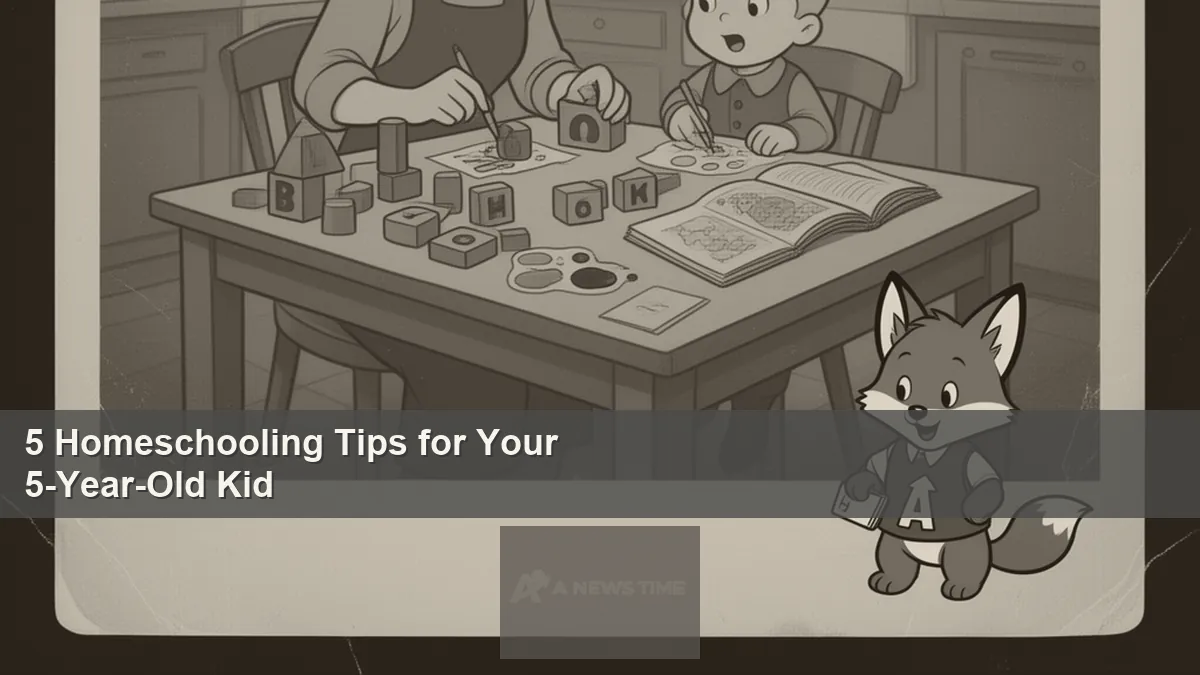
The first and most important shift for parents homeschooling a five-year-old is reframing what "academic activity" looks like. Play-based learning is not a concession to a short attention span. It is the developmentally appropriate vehicle for building the foundational skills that formal academics require later.
Practically, this looks like using counting games instead of number drills, building with blocks to explore shape and spatial relationships, reading aloud together and asking open-ended questions about the story, and incorporating literacy into play by labeling items around the house or writing "grocery lists" together. The research on emergent literacy is unambiguous: children who are read to regularly, who play with language, and who see adults engaging with text develop stronger reading foundations than those exposed primarily to phonics drills in isolation.
Some structured activities do have a place at this age, particularly for letter recognition and basic number sense. But the guideline many developmental educators use is a rough ratio of 80 percent child-directed or play-based activities to 20 percent structured instruction for kindergarten-age children. That ratio can shift gradually as a child moves toward age six and seven and attention spans lengthen.
The families who struggle most in early homeschooling are often the ones trying to recreate a classroom at home. The ones who thrive lean into what homeschooling uniquely offers: flexibility, relationship, and the freedom to follow what genuinely interests the child.
Dr. Sandra Martin-Chang, associate professor of education, Concordia University
Tip 2: Build a Predictable Daily Routine
One of the most consistent findings in early childhood development research is that predictable structure supports self-regulation. Five-year-olds who know what to expect from their day, even when the specific activities vary, show lower anxiety levels and better sustained attention than those in unpredictable environments. This does not mean a rigid schedule with every fifteen minutes planned. It means an arc to the day that the child can anticipate.
A workable homeschool rhythm for a five-year-old might look like this: a morning transition activity such as a picture book or some drawing to ease out of sleep mode, then a short focused learning block of twenty to thirty minutes covering a skill like letter sounds or counting, followed by extended free or guided play, an outdoor period, a read-aloud after lunch, another play block, and a winding-down activity in the late afternoon. Total structured learning time for a kindergartner can often be completed in ninety minutes to two hours. This surprises many new homeschooling parents who assume a full school day is required.
The key is consistency in the sequence rather than the clock. Children this age respond well to "first this, then that" framing. After we read our book, we go outside. After we come in, we have a snack and do our letters. This kind of predictable flow gives children the scaffolding their developing executive function needs without the rigidity that can create resistance.
Tip 3: Prioritize Deliberate Socialization
The socialization question is the one most often raised by skeptics of homeschooling, and it deserves a direct, evidence-based response. The research does not support the idea that homeschooled children are systematically less socialized than their peers. An analysis of 87 peer-reviewed studies on homeschool social development found that the majority showed homeschooled children performing at or above the level of conventionally schooled children on measures of social skills, emotional development, and peer interaction.
However, this positive outcome is not automatic. It requires deliberate effort, particularly for younger children who do not yet have the independence to seek out social opportunities on their own. For five-year-olds, effective socialization strategies include participation in homeschool co-ops, where several families gather for shared activities, classes, or field trips. Many larger metro areas now have robust co-op networks that offer everything from art and music to science labs and physical education.
Other concrete options include neighborhood play groups, library story times, youth sports leagues, community theater programs, and religious education programs. The goal is regular, recurring contact with a consistent peer group, not just occasional outings. Five-year-olds build friendships through repeated exposure and shared activity, and homeschooling parents need to build those recurring touchpoints into the weekly calendar intentionally.
Tip 4: Choose Curriculum Thoughtfully for This Age
The homeschool curriculum market has expanded enormously, which is both helpful and overwhelming for new families. At age five, the curriculum decision is actually less critical than parents often fear. At this developmental stage, the relationship, the environment, and the richness of experiences matter more than the specific workbook series. That said, having some structure can help parents who feel uncertain about where to start.
Several approaches have proven popular and effective for kindergartners. The Charlotte Mason method emphasizes living books (well-written, engaging literature rather than textbooks), nature study, narration, and short lessons. Research-supported early literacy programs like Bob Books or the All About Reading phonics series provide scaffolded, systematic approaches to reading readiness. Unit studies, in which multiple subjects are explored through a single theme such as animals, seasons, or community helpers, work well with five-year-olds because they connect learning to context and story.
One important principle for this age group: literacy and numeracy foundations do not require specialized curriculum if rich reading and mathematical conversation are already present in the home. Children who are regularly read to, who count and sort objects as part of daily life, and who hear a wide vocabulary in conversation are building those foundations continuously. Formal curriculum can supplement these experiences, but it does not replace them.
| Approach | Best For | Typical Annual Cost | Structure Level |
|---|---|---|---|
| Charlotte Mason | Curiosity-driven learners, nature lovers | $100-$300 | Low to medium |
| Classical / Trivium | Structured learners, language focus | $200-$600 | High |
| Eclectic / Unit Studies | Flexible families, varied interests | $50-$250 | Medium |
| Online programs (e.g., Khan Academy Kids) | Tech-comfortable families, supplemental use | Free to $200 | Medium |
| Unschooling / Child-led | Self-directed learners, confident parents | Minimal | Very low |
Tip 5: Know Your State's Legal Requirements
Homeschooling is legal in all 50 states, but the legal landscape varies considerably. Some states, like Alaska and Idaho, require virtually no reporting or oversight. Others, like New York, Pennsylvania, and Massachusetts, have more detailed requirements including annual assessments, curriculum submissions, or proof of instruction hours. Understanding the specific requirements in your state before you begin is essential, both to ensure compliance and to avoid unnecessary stress.
The HSLDA maintains a regularly updated database of state requirements at hslda.org/legal, organized by state. Key variables to research include whether your state requires notification to your local school district, whether a specific number of instruction hours or days per year is mandated, whether certain subjects are required by law, whether annual assessments or portfolio reviews are required, and whether parents need any educational qualifications to homeschool.
For kindergarten specifically, many states do not require formal enrollment in any educational setting until age six or seven. This means that some families homeschooling a five-year-old may not yet be subject to the state's homeschooling oversight requirements, which apply to compulsory school age. Checking the compulsory attendance age in your state is therefore the first legal step for parents of kindergartners.
Most experienced homeschooling families recommend connecting with a local homeschool group before getting too deep into curriculum choices. These groups often have members who have navigated the local legal requirements for years and can provide practical guidance that goes well beyond what any website can offer.
What the Research Says About Outcomes
The data on long-term outcomes for homeschooled students is encouraging. According to NHERI's analysis of multiple peer-reviewed studies, home-educated students typically score 15 to 25 percentile points above public school students on standardized academic achievement tests. This finding holds regardless of the parents' level of formal education or the family's income level, which is a particularly important detail. It suggests that the educational advantage of homeschooling is not simply a proxy for socioeconomic privilege.
On social and civic outcomes, adults who were homeschooled show higher rates of community volunteer work and civic participation than the general population in several studies. They attend college at similar rates and succeed academically at equal or higher rates compared to students who attended conventional schools.
For parents starting this journey with a five-year-old, these long-range outcome data provide useful reassurance. But the more immediate measure of success is simpler: Is your child curious? Is learning associated with positive emotions in your home? Is the relationship between parent and child healthy and warm? At age five, those questions matter more than any curriculum or achievement score.
Frequently Asked Questions
Do I need a teaching degree to homeschool my five-year-old?
No. No state in the United States requires homeschooling parents to hold a teaching certificate or college degree to legally homeschool their children. Research by the NHERI has found that the level of the parent's formal education is not significantly correlated with the academic outcomes of homeschooled children. That said, parents who are intentional about their approach and who take advantage of available resources and co-op networks tend to report better outcomes than those who are more passive.
How many hours a day should I spend on formal instruction with a five-year-old?
Most developmental educators and experienced homeschooling families find that 60 to 90 minutes of structured, focused activity is sufficient for kindergarten-age children. Total engaged learning time, including play-based activities, reading, and exploration, can be much longer. The key distinction is between time spent in formal instruction and time spent in learning more broadly. For five-year-olds, a great deal of valuable learning happens informally throughout the day.
How do I address the socialization concern from family members?
Point them to the research: 87 percent of peer-reviewed studies on the social development of homeschooled children show outcomes at or above the level of conventionally schooled peers. More practically, be specific about the social structures you have in place, whether that is a co-op, a sports team, a regular play group, or a religious education program. Concrete examples are more persuasive than abstract data for most concerned relatives.
Can a five-year-old who is behind academically catch up through homeschooling?
Yes. One of the documented advantages of homeschooling is the ability to individualize the pace and approach to match where a child actually is, rather than where age-based grade norms say they should be. Children who are struggling in conventional school settings because the pace is too fast, the environment is overstimulating, or they have a specific learning difference often make significant gains in a homeschool environment where instruction can be tailored to their specific needs.
What if I start homeschooling and it doesn't work out?
Returning to conventional school is straightforward in most states. Most public schools will assess the child and place them at an appropriate grade level. Many families also experiment with hybrid approaches, enrolling part-time in a public school enrichment program or a homeschool co-op while conducting primary instruction at home. Homeschooling is not an irreversible commitment, and starting with a trial period can reduce the pressure on both parent and child.
Sources
- Fast Facts on Homeschooling - National Home Education Research Institute
- How Many Homeschool Students Are There in the United States - NHERI
- Homeschool Growth 2024-2025 - Johns Hopkins School of Education
- A Look at Homeschooling in the U.S. - Pew Research Center
- Homeschooling in the United States: Results from the 2016 Parent Survey - National Center for Education Statistics
- Homeschooling and the Question of Socialization Revisited - Peabody Journal of Education