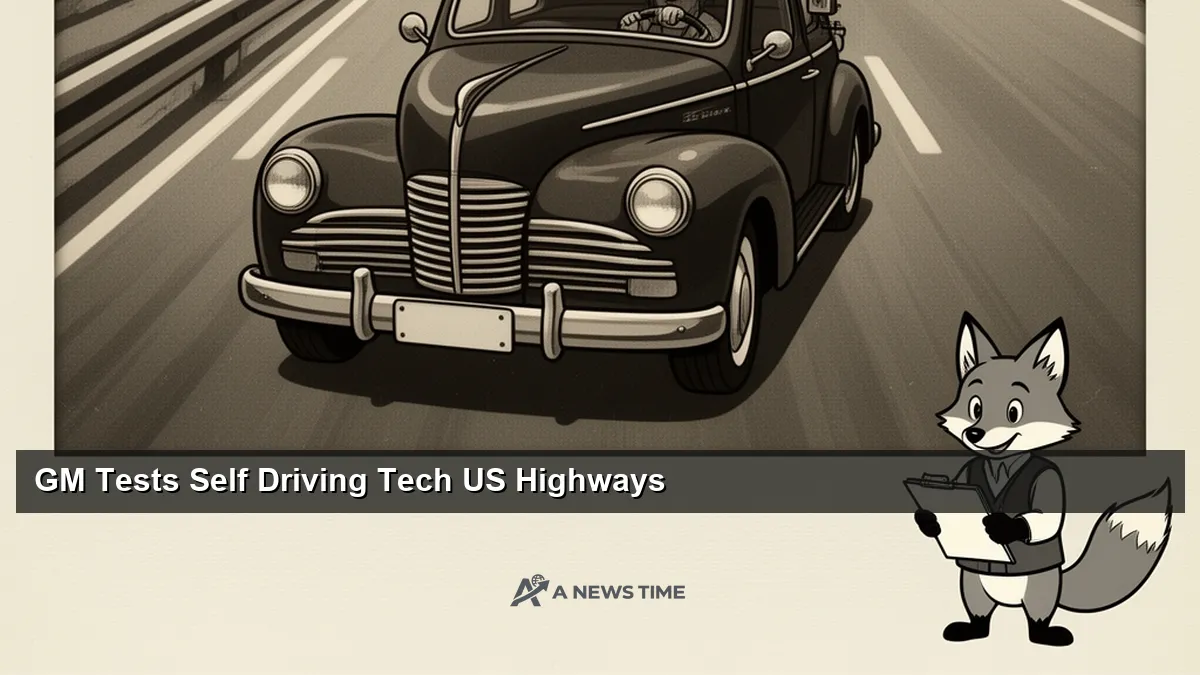
General Motors began testing its latest generation of mostly self-driving technology on public highways in Michigan and California on March 25, 2026, marking the first time the Detroit automaker has deployed highway-capable automated driving systems outside of controlled test environments. The vehicles, a fleet of approximately 20 modified Cadillac Escalade IQ electric SUVs equipped with GM's Ultra Cruise system, are operating on designated highway corridors with safety drivers behind the wheel, collecting data that GM says will form the foundation of a commercial highway automation feature available to customers by late 2027.
The testing represents a strategic pivot for General Motors, which invested more than $10 billion in its Cruise autonomous vehicle subsidiary between 2016 and 2024 before scaling back Cruise's robotaxi operations following a series of high-profile incidents, including a pedestrian dragging accident in San Francisco in October 2023 that led to the suspension of Cruise's California operating permits. The highway testing program is technically separate from Cruise (it is managed by GM's Advanced Driver Assistance Systems division rather than the Cruise subsidiary), but it clearly draws on the sensor, software, and mapping technology that Cruise developed over nearly a decade of autonomous vehicle research.
What the Vehicles Can Do
GM describes the test vehicles as operating at SAE Level 3 capability on designated highway segments, meaning the automated system handles all aspects of the driving task (steering, acceleration, braking, lane changes, and merging) while the human driver monitors the system and must be prepared to take over when the system requests it. This is a step above the Level 2 systems currently available in production vehicles (including GM's own Super Cruise and Tesla's Autopilot), which require the driver to remain continuously engaged with the driving task, and a step below Level 4, which would allow the vehicle to operate without any human intervention in defined conditions.
The distinction matters more than it might seem. Level 2 systems are driver-assistance features: the car helps you drive, but you are still the driver. Level 3 systems shift the legal and operational responsibility to the vehicle during automated operation: the car drives, and you supervise. That shift in responsibility has profound implications for liability, insurance, regulation, and the driver's attention requirements. Mercedes-Benz is currently the only automaker selling a Level 3 system in the United States (its DRIVE PILOT feature, available on the S-Class and EQS), and it is limited to speeds below 40 mph on approved highway segments in California and Nevada. GM's test program appears to target Level 3 operation at highway speeds up to 70 mph, which would be a significant expansion of the operational envelope if it reaches production.
| SAE Level | Name | Who Drives | Who Monitors | Production Examples |
|---|---|---|---|---|
| Level 0 | No Automation | Human | Human | Most vehicles pre-2015 |
| Level 1 | Driver Assistance | Human + system | Human | Adaptive cruise, lane keep |
| Level 2 | Partial Automation | System (limited) | Human (continuous) | Tesla Autopilot, GM Super Cruise |
| Level 3 | Conditional Automation | System | Human (on request) | Mercedes DRIVE PILOT (limited) |
| Level 4 | High Automation | System | System | Waymo (robotaxi, geo-fenced) |
| Level 5 | Full Automation | System | System | None in production |
The test vehicles are equipped with a sensor suite that includes 22 cameras, five lidar units (light detection and ranging sensors that create three-dimensional maps of the vehicle's surroundings), six radar units, and 12 ultrasonic sensors. The total sensor count is significantly higher than what is available on production Super Cruise vehicles (which rely on cameras, radar, and a single forward-facing lidar unit for driver attention monitoring) and reflects the more demanding requirements of a system that must handle highway driving without continuous human oversight.
GM has not disclosed the specific computing hardware running the test vehicles' automated driving software, but industry sources familiar with the program indicate it is based on a next-generation compute platform with substantially more processing power than the current Ultifi architecture used in production GM vehicles. The compute requirements for Level 3 and above are roughly five to ten times greater than Level 2, because the system must not only perceive and react to the driving environment but also predict the behavior of surrounding vehicles, plan complex maneuvers (like multi-lane highway merges), and do all of this with a reliability standard that approaches or exceeds human performance.
The Michigan and California Test Routes
The testing is concentrated on two highway corridors. In Michigan, the vehicles are operating on a 95-mile stretch of Interstate 96 between Detroit and Lansing, a route that includes urban highway segments (with merging traffic, construction zones, and variable speed limits near Detroit), suburban stretches, and rural highway sections. In California, the vehicles are operating on a 78-mile section of Interstate 280 and U.S. Route 101 between San Jose and San Francisco, a corridor that includes steep grades, tight curves, dense traffic, and frequent fog.
The route selection is deliberate. GM's engineering team chose corridors that present a representative sample of the highway driving challenges found across the United States, including varying road geometries, traffic densities, weather conditions, and infrastructure quality. Michigan provides winter weather testing capability (though March conditions were mild during the initial deployment), while California provides the dense traffic and complex interchange patterns that are characteristic of West Coast highway driving.
Each test vehicle carries two occupants: a trained safety driver in the driver's seat and a data engineer in the passenger seat who monitors the system's real-time decision-making and logs any interventions, anomalies, or unexpected behaviors. The safety drivers are required to have completed a 160-hour training program that includes simulator time, closed-course exercises, and supervised highway driving. GM emphasized that the safety drivers are instructed to take over at any sign of system uncertainty, a protocol designed to ensure that the test program prioritizes safety over data collection.
The Cruise Legacy: Lessons Learned and Applied
General Motors' self-driving ambitions cannot be discussed without addressing the Cruise experience. Cruise, which GM acquired in 2016 for approximately $1 billion and subsequently invested more than $10 billion in, was at one point valued at $30 billion and considered a front-runner in the autonomous vehicle race. The company operated a robotaxi service in San Francisco using modified Chevrolet Bolt EVs and was expanding to additional cities when the October 2023 incident changed everything.
In that incident, a Cruise robotaxi struck a pedestrian who had been knocked into its path by a hit-and-run driver. The initial collision was not the Cruise vehicle's fault. What followed was: the vehicle's software, attempting to pull over after detecting the collision, dragged the pedestrian approximately 20 feet along the roadside. Cruise's subsequent handling of the incident, including incomplete initial disclosures to regulators, led to the suspension of its California permits, the resignation of CEO Kyle Vogt, and a comprehensive review of the subsidiary's operations, culture, and safety practices.
GM subsequently scaled back Cruise's operations, laid off approximately 25 percent of Cruise's workforce, and refocused the subsidiary on technology development rather than commercial robotaxi service. The company also began integrating Cruise's technology more directly into GM's production vehicle programs, which is the lineage that the current highway testing program descends from.
"What we learned from the Cruise experience is that technology readiness and operational readiness are two different things. You can have a vehicle that drives well 99.9 percent of the time, but if your organization is not prepared to handle the 0.1 percent competently and transparently, you are not ready to operate on public roads. This program applies those lessons from day one."
Doug Parks, Executive Vice President, Global Product Development, General Motors
The organizational changes GM has made in response to the Cruise experience are visible in the highway testing program's structure. The program operates under GM's existing vehicle safety and regulatory compliance framework rather than as an independent entity. Test data is shared in real time with the National Highway Traffic Safety Administration (NHTSA) under a voluntary data-sharing agreement. And the program has a dedicated safety review board, composed of external safety experts and former NHTSA officials, that has authority to pause testing if safety metrics fall below defined thresholds.
The Competitive Landscape
GM's highway testing program enters a competitive field that is both crowded and stratified. At the top of the autonomy stack, Waymo (the Alphabet subsidiary) operates Level 4 robotaxis in San Francisco, Phoenix, Los Angeles, and Austin, carrying paying passengers without human safety drivers. Waymo's system is the most advanced commercially deployed autonomous driving technology in the world, but it operates exclusively in geo-fenced urban environments and at relatively low speeds. Waymo has not announced plans for highway automation, though its vehicles do use highways for short stretches within their operating areas. For more on the operational realities of Waymo's service, see our coverage of first responder interactions with Waymo robotaxis.
Tesla occupies a unique and controversial position. Its Full Self-Driving (FSD) system is classified as Level 2 (meaning the driver must remain engaged at all times) but operates on virtually any road in the United States, including highways, city streets, and rural roads. Tesla CEO Elon Musk has repeatedly predicted that FSD would achieve Level 4 or Level 5 capability "next year" for several consecutive years, predictions that have not materialized. The technology has improved substantially, with the vision-only approach (Tesla removed radar and ultrasonic sensors from its vehicles in 2022 and 2023, relying solely on cameras) producing progressively smoother and more confident driving behavior. But the absence of lidar and the continued requirement for driver supervision place Tesla's current system below what GM is targeting with its highway testing program.
Mercedes-Benz's DRIVE PILOT, as noted earlier, is the only production Level 3 system available in the U.S. but is limited to speeds below 40 mph, which restricts its utility to congested highway traffic rather than open-road driving. BMW has announced a Level 3 system for highway use that is expected to launch in 2027. And in the commercial vehicle space, companies like Aurora Innovation and Torc Robotics (a Daimler Truck subsidiary) are testing Level 4 autonomous trucking systems on highway corridors in Texas, New Mexico, and Virginia.
The NVIDIA DRIVE Hyperion platform, recently adopted by several major automakers for Level 4-ready vehicle development, represents another dimension of the competitive landscape: the computing infrastructure that underlies autonomous driving systems. GM's use of a proprietary compute platform rather than an off-the-shelf solution from NVIDIA or Qualcomm reflects its preference for vertical control over the software and hardware stack, a choice that gives it more customization flexibility but also requires it to bear the full cost of development and validation.
Regulatory and Legal Framework
The regulatory landscape for automated driving in the United States remains fragmented. There is no federal law specifically governing Level 3 or higher automated vehicles. NHTSA has issued voluntary guidelines but has not promulgated binding regulations that define the performance standards a Level 3 system must meet, the testing requirements it must pass, or the liability framework that applies when it is operating.
In the absence of federal regulation, individual states have taken the lead. Michigan, which has historically been the most accommodating state for automotive testing (reflecting the industry's economic importance to the state), enacted legislation in 2024 that explicitly authorizes the testing and deployment of Level 3 and Level 4 vehicles on public roads, subject to registration with the Michigan Department of State and submission of periodic safety reports. California's framework, administered by the Department of Motor Vehicles, is more restrictive, requiring specific testing permits, public disclosure of disengagement reports (instances where the human safety driver takes over from the automated system), and post-incident reporting.
GM has obtained the necessary permits in both states and has emphasized its commitment to operating within the regulatory frameworks rather than seeking exemptions or pushing against regulatory boundaries. That posture reflects both the lessons of the Cruise experience and a strategic calculation that earning regulator trust during the testing phase will smooth the path to commercial deployment when the technology is ready.
Timeline to Commercial Deployment
GM has stated that it intends to offer a commercial highway automation feature, based on the technology being tested in this program, as an option on Cadillac vehicles beginning in late 2027. The feature would likely be offered as a subscription service, similar to the current Super Cruise system (which is available for $25 per month or $2,500 for three years), but at a higher price point reflecting the more advanced capability.
The timeline is aggressive but not unrealistic, given that GM already has the Super Cruise hardware installed in approximately 750,000 vehicles on U.S. roads and can leverage that fleet's data (with appropriate privacy protections) to train and validate the more advanced system. The challenge will be demonstrating to regulators, insurers, and consumers that a Level 3 system operating at 70 mph is safe enough to deploy at scale. The safety bar for a Level 3 system is, by definition, higher than for Level 2, because the legal and moral responsibility for driving errors shifts from the human to the manufacturer.
For General Motors, the highway testing program represents something beyond a technology demonstration. It is an attempt to rehabilitate the company's autonomous driving credibility after the Cruise setbacks, to demonstrate that the billions invested in self-driving technology were not wasted, and to position GM's production vehicles as the most technologically advanced in the domestic market. Whether the technology delivers on that ambition will be measured not in press releases but in miles driven, interventions logged, and the confidence of the regulators and consumers who will ultimately decide whether the system reaches the road.