More than half of the American workforce has now participated in some form of AI training. Employers spent billions last year rolling out courses, certifications, and internally built learning modules. And yet, heading into , the AI skills gap is not closing. It is widening. The central problem companies thought they could solve with a training budget has turned out to be far more complicated than any single line item can address, and the data is beginning to reflect the cost of that miscalculation.
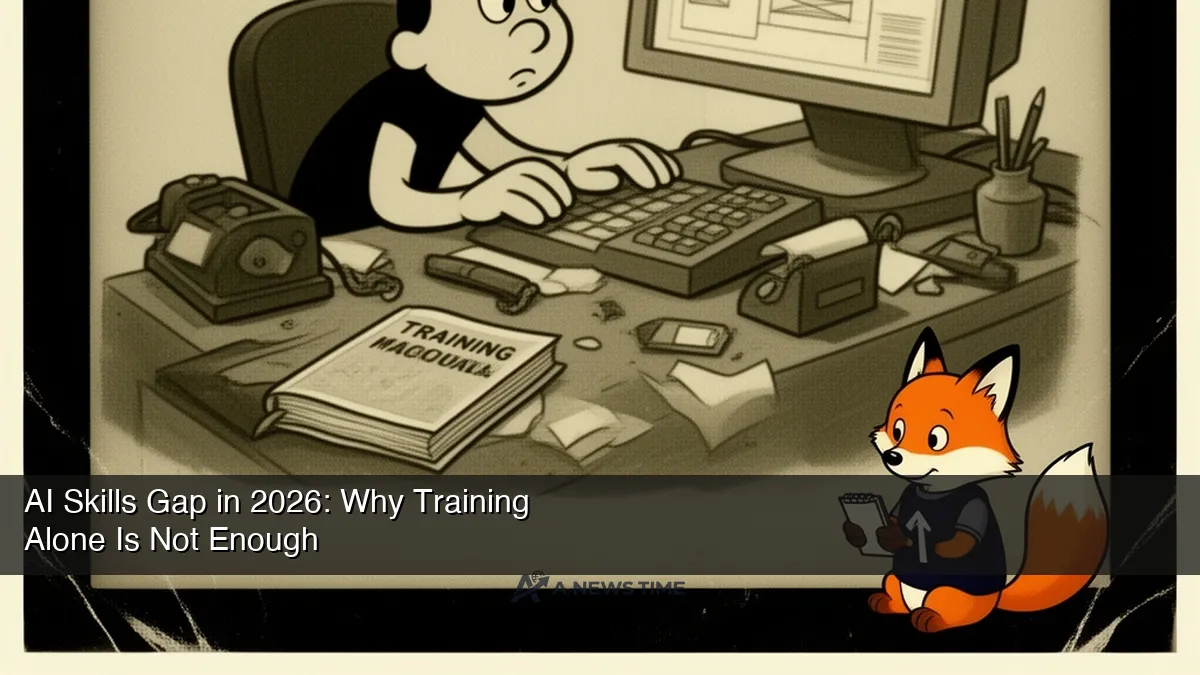
DataCamp's enterprise training report, one of the most comprehensive surveys of corporate AI readiness conducted this year, found that widespread access to training has not translated into workforce capability at any meaningful scale. Organizations report that employees complete assigned courses and pass required assessments, then return to their desks and continue working exactly as they did before. The knowledge is present in the abstract. The application is not. This is the core distinction that most corporate learning-and-development programs have failed to address: the difference between knowing what a tool does and knowing how to integrate it into the specific decisions, processes, and constraints of a real job.
What the Numbers Actually Show
The scale of employer concern is reflected in hiring data as much as in training reports. HR Dive's 2026 workforce survey found that more than half of managers plan to hire specifically to close AI skills gaps within their organizations. That is a striking figure. It suggests that the dominant employer response to persistent capability deficits is not to redouble internal training efforts but to look for workers who already possess the skills externally. Sixty-two percent of those same managers said they plan to bring in contract workers to cover AI-specific needs.
The Paycom and PSB Insights survey of 1,250 HR and finance professionals, released in early , confirmed that skills training remains the top organizational focus for employers this year, ahead of benefits redesign, compensation restructuring, and compliance priorities. That level of stated commitment is real. The gap between commitment and execution, however, is where the difficulty lives.
Consider what the data shows in aggregate. Employers say training matters. They are spending on it. They are making it mandatory in many cases. And then, when capability assessments come back, the gaps remain. The question worth asking is not whether organizations are investing in training but whether the training they are buying is designed to produce the outcomes they need.
The Implementation Gap: Where Training Falls Short
The most useful framing for understanding why training alone is insufficient comes from organizational learning research, not technology research. Learning transfer, the process by which knowledge acquired in one context gets applied in another, is notoriously difficult to engineer. Studies in organizational psychology have consistently shown that between 10 and 20 percent of what is learned in formal training programs is applied on the job in a sustained way. The remaining 80 to 90 percent fades, gets crowded out by existing habits, or never finds a moment of application because the learner's day-to-day workflow was not redesigned to accommodate new behaviors.
Dr. Amanda Singh, a learning-and-development researcher who consults for Fortune 500 companies on capability transformation, put the problem plainly in a recent industry brief: "We have confused access to information with skill development. Giving someone a 20-hour course on prompt engineering does not make them an AI-capable employee any more than giving them a cookbook makes them a chef. The application has to happen inside the work itself, under real conditions, with real consequences."
"We have confused access to information with skill development. Giving someone a 20-hour course on prompt engineering does not make them an AI-capable employee any more than giving them a cookbook makes them a chef. The application has to happen inside the work itself, under real conditions, with real consequences."
Dr. Amanda Singh, organizational learning researcher
This insight points toward a structural problem with how most corporate AI training is currently designed. The dominant format, asynchronous video modules with multiple-choice assessments, measures recall rather than application. It tells the HR department that a learner watched the video and retained the main points. It says nothing about whether that person can now use the tool to do their actual job faster, better, or differently.
What Employers Are Missing: The Real-World Application Layer
The emerging consensus among workforce development specialists is that the problem is not the volume of training but the absence of what practitioners call the "application layer." This refers to structured opportunities to use newly acquired skills inside real work contexts, with a support structure (coaching, peer feedback, manager reinforcement) that helps the learner navigate the inevitable friction of changing established workflows.
AICerts, a skills certification organization focused on enterprise AI readiness, has identified what it describes as "Employee Skill Gap Intelligence Engines" as one of the defining reskilling tools of . These are systems that go beyond tracking course completions and instead map individual capability profiles against role-specific skill requirements, flagging not just where employees lack knowledge but where their workflows most urgently need AI integration. The distinction is important: a knowledge gap and a workflow integration gap require entirely different interventions.
The practical implication is that organizations need to rethink what they are asking their learning-and-development budgets to accomplish. A course library, however comprehensive, does not constitute an AI upskilling strategy. A genuine strategy requires identifying which specific roles have the highest potential for AI-driven productivity gains, redesigning those workflows to include AI tools at natural decision points, and then providing training that is explicitly tied to those redesigned workflows rather than to abstract concepts.
This approach is more expensive and more organizationally demanding than buying course licenses. It requires collaboration between HR, technology, and line-of-business leadership that most organizations have not historically been good at. But the evidence is increasingly clear that the alternative, training in isolation from work redesign, is producing the exact outcome we are seeing: a workforce that has been trained but has not been transformed. For more on how the broader economy is absorbing the costs of this gap, see our coverage of Q4 GDP revisions and the productivity question.
Who Bears the Cost of the Gap
The consequences of a persistent AI skills gap are not evenly distributed. For individual workers, the risk is straightforward: those who cannot demonstrate applied AI capability in their specific field will increasingly find themselves at a competitive disadvantage in hiring, promotion, and compensation decisions. The gap is not an abstraction. It is the difference between two candidates with identical credentials where one can show that they have integrated AI tools into their daily output and one cannot.
For organizations, the cost is showing up in the hiring data. When more than half of managers say they intend to hire externally to fill AI capability gaps, and 62 percent plan to use contract workers, they are implicitly acknowledging that their internal training programs have not worked as intended. They are paying twice: once for the training that did not produce the needed capability, and again for the external talent or contractors who will. The compounding cost is organizational disruption, because knowledge brought in through contract arrangements rarely embeds deeply enough to outlast the contract.
Smaller employers face a different version of the same problem. Large enterprises with dedicated learning-and-development functions and vendor relationships can at least experiment with more sophisticated approaches. Small and mid-sized organizations often lack the infrastructure to do anything more than purchase a course subscription and call it a strategy. Their workers complete the same modules as those at larger firms but have even less structural support for applying what they have learned. The skills gap, in this sense, is also a size gap.
The Path Forward: What Actually Works
The research literature on effective workforce capability development, synthesized across decades of organizational learning studies, points toward several practices that consistently produce better real-world application outcomes than standard training programs alone.
First, learning embedded in work outperforms learning separated from work. When employees are asked to complete a course and then apply it to a real project within their current role, transfer rates improve substantially. "Just-in-time" learning, where workers access training at the moment of need rather than completing a course in advance of any specific application, has shown particularly strong results in technology skill contexts.
Second, manager reinforcement is not optional. Studies consistently show that manager behavior in the 90 days following a training experience is one of the strongest predictors of whether the learning gets applied. When managers actively create opportunities for employees to use new skills, ask about application in regular check-ins, and reward early attempts even when imperfect, transfer rates improve significantly. Training programs that do not include a manager activation component are statistically less likely to produce sustained behavior change.
Third, cohort-based and peer-learning approaches, where workers in similar roles learn together and share application experiences, produce better outcomes than solo, self-paced formats. The social dimension of learning matters because it creates accountability, surfaces shared obstacles, and generates role-specific application ideas that no course designer could anticipate. For a deeper look at how these workforce changes connect to technology industry dynamics, our technology desk's coverage of Colorado's AI Act policy overhaul offers useful regulatory context on how governments are beginning to address workforce readiness as a policy issue.
None of these approaches is cheap or easy to scale. But they represent the honest answer to a question the corporate training industry has been reluctant to ask loudly: if the training is not producing the capability, what is the training actually for? The answer, in too many organizations, has been compliance and optics rather than genuine skill development. That answer is becoming harder to sustain as the cost of the capability gap becomes increasingly visible in both the labor market and the business results.
What Individuals Can Do Right Now
For workers navigating an environment where employer training programs are producing uneven results, the practical advice is more specific than "take more courses." The evidence suggests that the most effective individual strategy combines three elements: targeted tool selection, deliberate workflow integration, and documented output.
Targeted tool selection means identifying which specific AI tools are most relevant to your particular role and the decisions you make most frequently, rather than pursuing broad familiarity with the full landscape. A marketing analyst who becomes genuinely proficient with AI-assisted data interpretation tools will have a more marketable skill profile than one who has passing familiarity with a dozen different platforms.
Deliberate workflow integration means finding one or two recurring tasks in your current role, ideally tasks that are time-consuming and repetitive, and systematically experimenting with AI assistance on those specific tasks over a defined period. The goal is not to explore the technology in the abstract but to develop a documented record of what the tool does and does not do well in your specific context.
Documented output means keeping a record of the before-and-after: how long a task took without AI assistance versus with it, what the quality difference was, and what you learned about effective prompting or tool configuration in your domain. This documentation is what separates workers who have genuinely integrated AI into their practice from those who have merely attended the training. In a job market where AI capability claims are increasingly common, the ability to show specific, measurable examples of applied competency is the differentiator that matters. This connects directly to the broader upskilling landscape our next piece addresses: 80% of Workers Need AI Upskilling by 2027.
The AI skills gap is real, it is persistent, and it is not going to be closed by training budgets alone. Organizations that recognize this and invest in the harder work of workflow redesign and application support will develop a genuine competitive advantage. Those that continue to confuse course completions with capability will continue to find themselves hiring to fill gaps that their training programs were supposed to close.