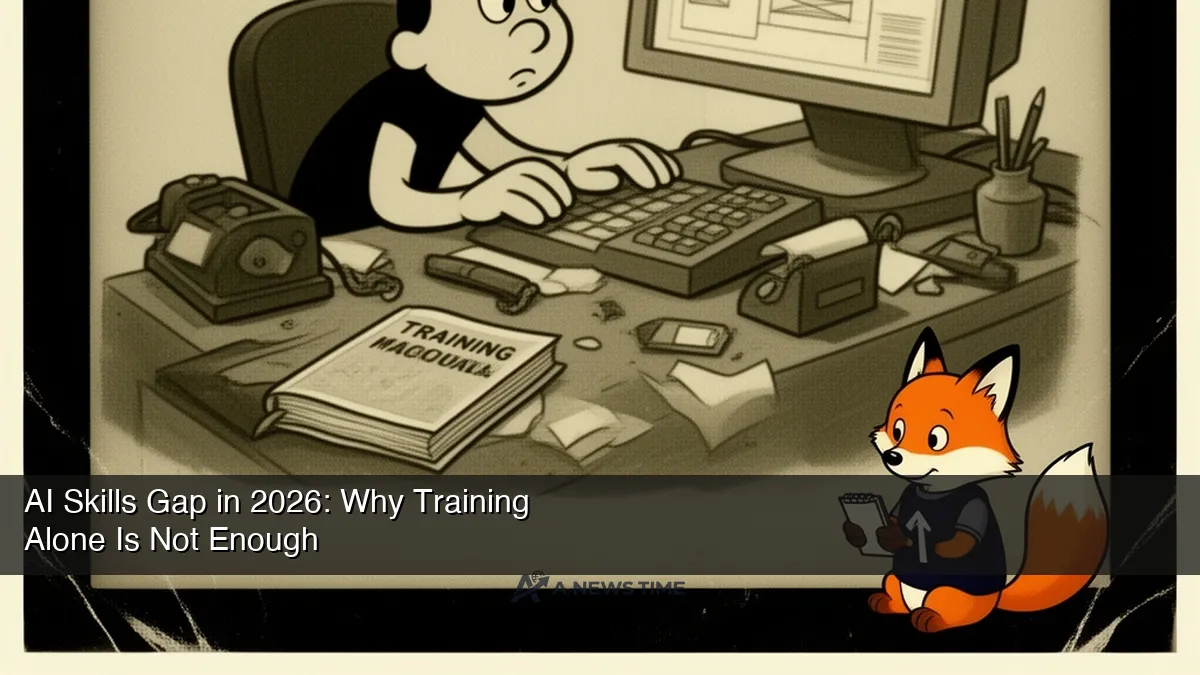
By , 80 percent of the global workforce will need to acquire meaningful AI skills to remain competitive in their roles. That figure, drawn from a DigitalApplied analysis of labor market data and employer hiring patterns, is not a projection about what might happen if AI adoption continues at its current pace. It is a description of what the data already shows is underway. One in ten job postings now explicitly requires AI-related skills, a number that has been rising steadily for three years and is accelerating. The workers who understand what upskilling actually demands, as distinct from what employers say it demands, will be the ones who navigate this transition effectively.
The distinction between upskilling and reskilling matters here, and most coverage of this topic uses the terms interchangeably in ways that obscure important practical differences. Upskilling refers to adding new capabilities to an existing skill set within the same general career domain. A financial analyst who learns to use AI-assisted forecasting tools is upskilling. Reskilling refers to acquiring an entirely new set of capabilities sufficient to move into a different career domain. A manufacturing worker who learns data science to transition into a technical operations role is reskilling. Both are real and necessary, but they require different timelines, different resources, and different support structures. Conflating them produces advice that fits neither situation well.
The Scale of the Transition
The World Economic Forum's Future of Jobs report provides the most comprehensive global picture of the transition currently underway. The report projects that roughly 85 million jobs will be displaced by automation and AI systems by , while approximately 97 million new roles will emerge that require human-machine collaboration skills. The net number, 12 million new roles, sounds encouraging in isolation. The practical challenge is that the displaced roles and the emerging roles are not occupied by the same people in the same places. The workers most at risk of displacement, those in repetitive, predictable, rules-based roles, are often not positioned to move immediately into roles requiring complex judgment, technical fluency, or interpersonal skills that AI cannot replicate.
Monster's labor market data adds a specific dimension to the picture: mentions of AI skills on resumes have tripled over the past two years. That is a meaningful signal both about what workers believe employers want and about what employers are actually beginning to screen for. The tripling of resume mentions does not, however, mean that three times as many workers have genuine, applied AI competency. Much of the increase reflects workers adding familiar tool names to their profiles in response to perceived demand, without the underlying capability that would make those additions meaningful in a real job context.
This gap between claimed and actual capability is one of the defining features of the current labor market moment, and it creates a challenge for employers and workers alike. Employers who rely on keyword screening are selecting for workers who know what to put on a resume, not necessarily for workers who can deliver on those claims. Workers who pad their profiles risk being placed in roles where the gap between claimed and actual skill becomes quickly visible.
The Performance Gap Between AI Power Users and Everyone Else
Perhaps the most consequential data point in the current landscape comes from the Anthropic Economic Index, which tracks how different worker populations are using AI tools in real work contexts. The index has documented a 10 percent performance gap between workers who have genuinely integrated AI into their core workflows, what researchers are calling "power users," and those who are new to or occasional users of the same tools.
Ten percent may sound modest, but in competitive labor markets, performance gaps of this size are economically significant. Over a year of work, a 10 percent productivity difference compounds. A manager choosing between two candidates with similar credentials will notice which one consistently delivers faster, better-documented, more thoroughly researched output. Over time, the performance gap becomes a compensation gap, a promotion gap, and ultimately a career trajectory gap.
Dr. Marcus Osei, a workforce economist at Georgetown University's Center on Education and the Workforce, has tracked the long-term earnings effects of technology transitions across four decades of labor market data. "Every major technology transition in the past 50 years has created a significant and persistent earnings premium for early adopters," he noted in a recent interview with an industry publication. "The workers who adapted quickly to personal computers in the 1980s, the internet in the 1990s, mobile platforms in the 2000s, all of them saw earnings growth that diverged substantially from late adopters within five to seven years. There is no reason to believe the AI transition will be different."
"Every major technology transition in the past 50 years has created a significant and persistent earnings premium for early adopters. There is no reason to believe the AI transition will be different."
Dr. Marcus Osei, workforce economist, Georgetown University's Center on Education and the Workforce
What Upskilling Actually Requires: A Practical Framework
The framework most workforce development specialists now recommend is built around three levels of AI competency, with different workers needing different levels depending on their role and industry.
The first level is AI literacy: a basic understanding of what AI systems can and cannot do, how large language models work at a conceptual level, what the common failure modes and limitations are, and how to evaluate AI-generated output critically rather than accepting it uncritically. This level is relevant to virtually every white-collar worker regardless of specialization. It is not about using specific tools; it is about understanding the technology well enough to make informed decisions about when and how to apply it.
The second level is tool proficiency: hands-on competency with the specific AI tools most relevant to a given role or industry. For a marketing professional, this might mean effective prompting for content generation, using AI-assisted analytics platforms, and understanding how algorithmic content distribution affects strategy. For a software developer, it might mean integrating code-completion tools into the development workflow, using AI for debugging and documentation, and understanding when automated suggestions need human review. The specific tools matter less than the depth of applied competency within the relevant context.
The third level is workflow integration: redesigning existing work processes to take systematic advantage of AI capabilities rather than using AI as an ad-hoc supplement to existing workflows. This is the level at which the Anthropic Economic Index's power user premium emerges. Workers at this level have not just learned a tool. They have restructured how they approach their work so that AI assistance is embedded at the points where it delivers the most value.
Human-Centric Skills as the Primary Differentiator
One of the more counterintuitive findings from the World Economic Forum's Future of Jobs analysis is that as AI systems become more capable at cognitive tasks, the relative premium on distinctly human capabilities is increasing rather than decreasing. Critical thinking, ethical judgment, complex communication, creative problem-solving, and interpersonal skills that require genuine understanding of human context and emotion, all of these are commanding higher relative value in the labor market precisely because they are the capabilities that AI systems are least able to replicate at scale.
The implication for upskilling strategy is that the most durable investment a worker can make is not in any particular AI tool or platform. Those change rapidly. The most durable investment is in the combination of domain expertise and human judgment that allows a worker to direct, evaluate, and take responsibility for AI-assisted output. A journalist who deeply understands their beat and can evaluate source credibility, ethical implications, and audience needs is more valuable with AI assistance than a worker who can use AI tools fluently but lacks that domain foundation.
This framing has practical implications for how workers should prioritize their learning investments. Rather than chasing each new tool release, the more sustainable strategy is to deepen domain expertise while developing a general capacity to integrate new tools as they emerge. The specific skills required to use today's leading AI tools will be partially obsolete within three years. The judgment to use any AI tool effectively within a specific domain will not be. For related context on how big technology companies are investing in the infrastructure underlying these tools, our technology reporting on Big Tech's 2026 AI spending is worth reviewing alongside this workforce picture.
The Upskilling vs. Reskilling Decision
The question of whether a given worker needs to upskill or reskill is worth addressing directly because the answer determines what kind of support and time investment is realistic. Research from Upside Learning and other workforce development organizations suggests that most workers, perhaps 70 percent, are in roles where upskilling is the appropriate response: adding AI-related capabilities to an existing career trajectory rather than rebuilding from a different foundation.
For these workers, the primary challenge is not reorienting their career but integrating new capabilities into an existing professional identity and workflow. The psychological dimension of this is real and underappreciated. Workers who have spent years developing expertise in a field can feel that AI assistance diminishes or devalues that expertise, particularly when the tools perform well on tasks that previously required years of practice to do well. Managing this dynamic is part of effective upskilling, not a separate issue from it.
For the remaining 30 percent, those in roles where AI automation poses a genuine displacement risk rather than a productivity enhancement opportunity, reskilling is the more honest framing. This is a harder conversation to have, and most employer-funded training programs avoid it because it implies the company may not be the destination for the reskilled worker. But workers who need to reskill and are told they merely need to upskill will find themselves under-prepared for the transition that is actually coming.
A Practical Guide for Workers Starting Now
For workers who recognize the urgency but are uncertain where to start, the following sequence reflects what the evidence actually supports rather than what the marketing materials for training platforms tend to emphasize.
Start with an honest assessment of where your role is on the automation risk spectrum. Not all jobs are equally exposed, and the workers most prone to unnecessary anxiety are often those in roles with significant interpersonal, judgment-intensive, or creative components that are genuinely difficult to automate. The workers who should be most concerned are those in roles characterized by high volume, repetitive decision-making against established rules, where AI pattern-matching is most powerful.
If your role has meaningful upskilling potential, identify the two or three tasks you spend the most time on and experiment systematically with AI assistance on those specific tasks. Do not attempt to overhaul your entire workflow at once. The evidence suggests that workers who try to integrate AI into everything simultaneously often find the experience overwhelming and revert to previous habits. Focused, deliberate experimentation on high-value tasks produces better outcomes.
Invest in AI literacy before tool proficiency. Understanding how these systems work, what they are optimized for, and where they characteristically fail will make you a better user of any specific tool than any amount of platform-specific training. This foundation is also more durable: when the tools change, the underlying literacy transfers.
Document your results. The workers who will demonstrate the most credible AI capability in job searches, performance reviews, and promotion conversations are those who can point to specific, measurable examples of how they used AI tools to improve their output. "I used AI tools" is not a competitive differentiator. "I reduced the time to produce our weekly client reports by 40 percent and improved their analytical depth by integrating AI-assisted data processing, and here is how I verified the output" is. For further context on the training infrastructure questions underlying this transition, see our analysis of why AI training alone is not enough to close the current skills gap.
The 80 percent figure is large enough to be alarming and real enough to be actionable. The workers who treat it as a call to deliberate, evidence-based preparation rather than a reason to purchase the next available course will be the ones who emerge from this transition with a stronger position than they entered it with.