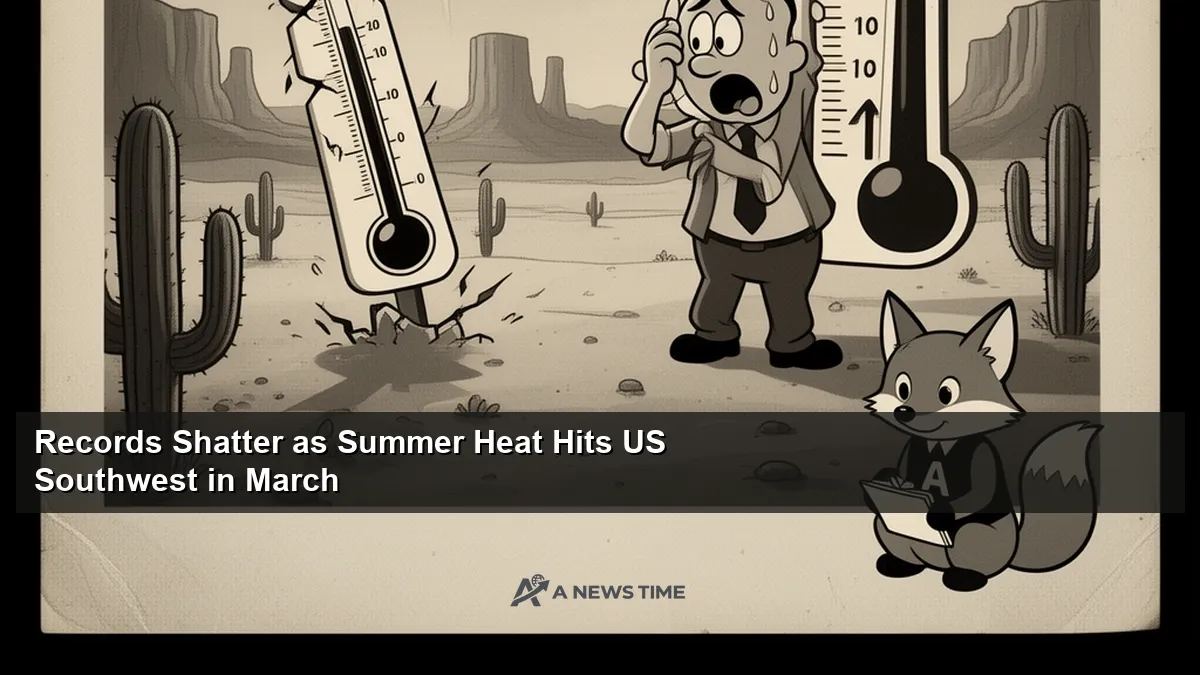
It is still March, and the US Southwest is already experiencing temperatures that belong in June. A record-shattering heat wave swept across Arizona, Nevada, Southern California, and parts of New Mexico in , pushing thermometers to levels never previously recorded for the month and raising urgent questions about what summer itself will bring to a region already defined by extreme heat. Multiple cities broke daily, monthly, and in some cases all-time March temperature records, with readings running 15 to 25 degrees Fahrenheit above seasonal norms for days on end.
The Numbers Behind the Heat
Temperature records exist because they provide context. When a city that has been keeping weather records for over a century breaks a record by a degree or two, it is noteworthy. When it breaks a record by ten or fifteen degrees, it is extraordinary. The March 2026 heat wave in the US Southwest falls into the latter category.
Phoenix, Arizona, which maintains one of the longest and most complete temperature records in the region, recorded multiple days with high temperatures exceeding 100 degrees Fahrenheit during the third week of March. The city's previous March record was in the low 90s. Las Vegas, Nevada, experienced similar anomalies, with afternoon highs reaching well into the upper 90s during a month when typical highs hover in the low 70s. Tucson, Palm Springs, and Death Valley all reported comparable departures from normal.
The scale of the departure matters for a specific reason: it pushes the event outside the range of what historical climate variability can comfortably explain. Weather is inherently variable, and warm spells in March are not unprecedented in the Southwest. But warm spells that exceed the previous record by double-digit margins occupy a different statistical category. They sit in the extreme tail of the historical distribution, the region where natural variability alone becomes an increasingly inadequate explanation and where the influence of long-term climate change becomes increasingly difficult to dismiss.
Meteorologists tracking the event noted that the heat wave was driven by a persistent high-pressure ridge that parked over the region for several days, creating what is sometimes called a "heat dome," a column of sinking, compressing air that warms as it descends and suppresses cloud formation. Heat domes are a normal feature of Southwest summer weather, but their appearance in March, at this intensity, is not.
What Climate Change Has to Do With It
No single weather event can be attributed entirely to climate change. The atmosphere is a chaotic system, and individual heat waves, storms, and cold snaps occur for reasons that include natural variability, regional weather patterns, and ocean temperature cycles. What climate change does is shift the baseline, raising the floor from which extreme events launch and making the most extreme outcomes more probable.
Think of it this way. Imagine rolling a pair of dice that have been slightly loaded. Most of the time, the results look normal. But over many rolls, you notice that high numbers come up more often than they should, and the very highest rolls (double sixes) appear with a frequency that the unloaded dice would never produce. Climate change is the loading. The March 2026 heat wave is one of those improbable rolls, an event that could theoretically occur in an unwarmed climate but that becomes significantly more likely in a warmed one.
The scientific framework for making this connection is called attribution science, and it has matured significantly over the past decade. Researchers can now estimate, often within days of an extreme event, how much more likely or intense it was made by human-caused climate change. While formal attribution analysis for the March 2026 event has not yet been published, the characteristics of the heat wave (its intensity, duration, geographic extent, and timing relative to seasonal norms) are consistent with the patterns that attribution studies have repeatedly linked to anthropogenic warming in the Southwest. The broader pattern of accelerating climate indicators, as documented in the WMO's 2026 State of the Global Climate report, provides essential context.
A Region Already on the Edge
The US Southwest is not a place with a comfortable margin for additional heat. Phoenix already holds the distinction of being the hottest large city in the United States, with average summer highs exceeding 105 degrees Fahrenheit and nighttime lows frequently remaining above 90. The city has experienced a rapid increase in heat-related deaths over the past decade, with hundreds of fatalities in recent summers, disproportionately affecting homeless individuals, outdoor workers, and elderly residents without adequate cooling.
The infrastructure of the region is built around the assumption of extreme summer heat but moderate spring temperatures. Air conditioning systems are designed to handle peak loads in July and August, not March. Electrical grids are stress-tested for summer demand, not late-winter demand. Agricultural operations plan irrigation schedules around historical temperature patterns. When March suddenly delivers summer-like conditions, all of these systems are caught partially unprepared.
- Energy demand: Air conditioning usage surged across the region during the heat wave, straining power grids that were not yet operating at summer capacity. Some utilities had scheduled maintenance outages for what should have been a mild period, reducing available generation capacity at precisely the wrong moment.
- Water supply: The Colorado River system, which provides water to roughly 40 million people across seven states, is already operating at historically low levels following two decades of drought. Early-season heat accelerates evaporation from reservoirs and increases agricultural water demand, compounding an already precarious supply situation.
- Public health: Emergency rooms in Phoenix and Las Vegas reported increased heat-related admissions during the event, including heat exhaustion, heat stroke, and dehydration cases. The timing in March caught some vulnerable populations without the heat awareness and preparedness that public health campaigns typically build by the start of summer.
- Agriculture: Fruit trees and crops in Arizona and Southern California that had begun their spring growth cycles were stressed by the sudden heat, with some orchards reporting blossom damage that could reduce yields later in the season.
The Urban Heat Island Amplifier
Cities like Phoenix and Las Vegas do not merely experience regional heat waves: they amplify them. The urban heat island effect, caused by the absorption and re-radiation of solar energy by dark surfaces (asphalt, concrete, rooftops), reduced vegetation, and waste heat from buildings and vehicles, can add 10 to 15 degrees Fahrenheit to urban temperatures compared to surrounding rural areas. During a heat wave, this amplification becomes dangerous.
The effect is most pronounced at night. Rural areas cool relatively efficiently after sunset as the ground radiates absorbed heat into the sky. Urban areas, with their massive thermal inertia stored in concrete and asphalt, continue radiating heat well into the night, preventing temperatures from dropping to levels that allow the human body to recover from daytime heat stress. This lack of nighttime cooling is what makes extended heat waves most dangerous: it is not the peak daytime temperature alone that kills, but the cumulative inability to recover overnight.
During the March 2026 event, nighttime low temperatures in central Phoenix remained above 70 degrees Fahrenheit, roughly 15 to 20 degrees above normal for late March nights. In a typical March, overnight lows in the low 50s provide comfortable sleeping conditions without air conditioning. The elevated nighttime temperatures during the heat wave eliminated that natural cooling period, effectively extending the heat stress to a 24-hour cycle.
Phoenix and other Southwest cities have been implementing heat mitigation strategies, including cool roof ordinances, urban tree planting programs, and the designation of cooling centers for vulnerable populations. These measures were designed primarily with summer heat waves in mind. The March 2026 event raises the question of whether the heat season itself needs to be redefined, with preparedness measures activated earlier and maintained later than current protocols assume.
Historical Context and the Shifting Baseline
To appreciate how unusual the March 2026 heat wave is, it helps to look at the longer record. Phoenix has maintained continuous weather observations since 1896. Over that 130-year period, March temperatures have shown a gradual warming trend consistent with both the urban heat island effect and broader regional climate change. But the rate of warming has accelerated markedly in recent decades, with the warmest March days in the record concentrated almost entirely in the past 20 years.
This pattern, where the rate of change accelerates rather than remaining constant, is a hallmark of climate change impacts in the Southwest. The region has warmed by approximately 2 degrees Fahrenheit since the mid-twentieth century, with most of that warming occurring since the 1980s. This may sound modest, but in a region where temperatures already push biological and infrastructure limits during summer, even a small shift in the baseline can push extreme events into uncharted territory.
The concept of a "shifting baseline" is important for public communication. When people evaluate whether current weather is unusual, they tend to compare it to their personal experience, typically the last 20 to 30 years. If those years were themselves anomalously warm compared to the longer historical record, the baseline is already shifted upward, and genuinely extreme events may not register as dramatically as they should. A resident who moved to Phoenix in 2010 has a very different sense of "normal" March weather than one who arrived in 1970. Both are wrong relative to the full historical record, but in opposite directions. Understanding these shifting baselines is a challenge shared by researchers studying ancient astronomical observations against modern data.
What This Means for the Coming Summer
One heat wave does not predict a summer. Weather systems are sufficiently chaotic that a record-hot March can be followed by a relatively mild summer, or vice versa. Seasonal forecasts from the NOAA Climate Prediction Center issued in late March 2026 indicate above-average temperatures for the Southwest through the summer months, but with considerable uncertainty about the magnitude and persistence of the anomaly.
What the March event does provide is a stress test. It reveals which systems are prepared for extreme heat and which are not. It identifies vulnerable populations before the more dangerous summer months arrive. And it demonstrates, in tangible terms, that the heat season in the Southwest is expanding, starting earlier and potentially lasting longer than the historical patterns on which infrastructure, public health systems, and daily life have been built.
The implications extend beyond the Southwest. Climate models consistently project that extreme heat events will become more frequent, more intense, and longer-lasting across much of the United States as global temperatures continue to rise. The Southwest, because it starts from a higher baseline, is the leading edge of this trend, but cities in the Southeast, Midwest, and even the Northeast face increasing heat risks as well. What happens in Phoenix and Las Vegas in March 2026 is a preview, not an exception.
Adaptation and the Limits of Resilience
The Southwest has adapted to heat more extensively than any other region of the United States. Universal air conditioning, heat-aware building codes, public cooling infrastructure, and cultural norms around hydration and sun protection are all well established. These adaptations have allowed tens of millions of people to live productively in an environment that would have been marginally habitable without modern technology.
But adaptation has limits. Air conditioning requires electricity, and power systems can fail during precisely the extreme events that make cooling most critical. Water supply requires precipitation and snowpack, both of which are declining in the region. Outdoor work, from construction to agriculture to landscaping, cannot be fully air-conditioned, leaving millions of workers exposed to heat that exceeds safe physiological limits during extreme events. Research into how natural systems cope with extreme conditions spans disciplines, from the EU's efforts to future-proof ecosystems to biomedical investigations into how the human body responds to chronic environmental stress.
The March 2026 heat wave underscores the importance of treating heat as a public health emergency on par with hurricanes, floods, and wildfires. Heat is already the deadliest weather-related hazard in the United States, killing more people annually than all other weather hazards combined. Unlike hurricanes, which are visible on satellite imagery days in advance and trigger mandatory evacuations, heat waves kill quietly, behind closed doors, often affecting individuals who lack the resources or awareness to protect themselves.
Building resilience to this threat requires investment at multiple scales: individual (access to cooling, hydration, awareness), community (cooling centers, neighborhood check-in programs, shade infrastructure), municipal (cool roofs, urban forestry, heat action plans), and regional (grid reliability, water supply management, emergency coordination). The March event is a reminder that these investments are needed not just for the peak of summer but increasingly for the shoulder seasons as well.
Caveats
Several important caveats apply to the interpretation of this event. First, the record-keeping period for Southwest cities, while long by US standards, is short by climatological standards. Records spanning 100 to 130 years capture only a small slice of the region's climate history, and paleoclimate evidence suggests that the Southwest has experienced extreme heat events in the pre-instrumental past as well. Second, the urban heat island effect contributes to temperature records in cities like Phoenix, meaning that part of the warming trend reflects urbanization rather than regional climate change. Third, the connection between individual heat waves and long-term climate change, while scientifically well-supported in a statistical sense, cannot be expressed as a simple causal chain for any single event. Attribution science quantifies the increased probability, not a direct cause-and-effect relationship.
These caveats do not diminish the significance of the event. They contextualize it. The March 2026 heat wave is one data point in a trend that is consistent, well-documented, and aligned with the physical mechanisms of greenhouse-gas-driven warming. Whether this particular event was "caused" by climate change is the wrong question. The right question is whether the climate in which it occurred is meaningfully different from the one that existed a century ago. The answer, supported by every major temperature dataset and every major scientific organization, is unambiguously yes.