Byline: Sophia Winters, Senior Entertainment Reporter
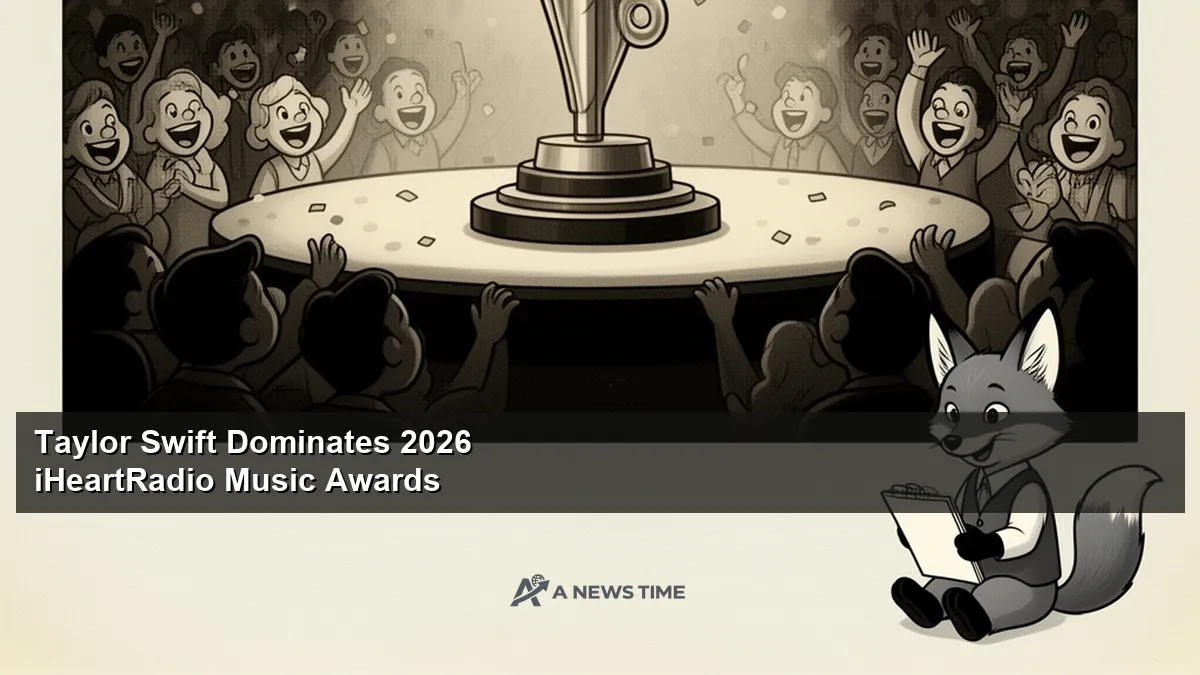
Taylor Swift dominated the 2026 iHeartRadio Music Awards in a way that has become almost routine for the pop superstar, collecting multiple trophies across several categories while making her awards show debut as a couple with Kansas City Chiefs tight end Travis Kelce. The ceremony, which also saw singer-songwriter Alex Warren top the winners list alongside Swift, was a spectacle that blended pop music's biggest names with the kind of celebrity relationship content that drives social media engagement for days afterward.
If the evening had a thesis statement, it was this: Taylor Swift's cultural dominance shows no signs of fading, and the entertainment industry's fascination with her personal life has become as much a part of the show as the music itself.
Swift's Winning Night
Swift's haul at the 2026 iHeartRadio Music Awards continued a pattern of awards show dominance that has defined her career for the better part of a decade. While the specific categories and number of wins fluctuate from ceremony to ceremony, the consistency of her presence at the top of every major winners list is remarkable. It speaks to a combination of commercial success, critical recognition, and fan engagement that no other artist in contemporary pop music can match.
The iHeartRadio Music Awards, which are determined by a combination of fan voting and radio performance metrics, tend to reward artists who have both massive mainstream appeal and dedicated, mobilized fanbases. Swift excels on both counts. Her albums generate the kind of radio play that moves the commercial needle, and her fanbase, the Swifties, are among the most organized and motivated voting blocs in entertainment.
What distinguishes Swift's continued success from the typical trajectory of a pop star is the longevity and the artistic evolution. Most pop artists experience a peak period of dominance lasting three to five years before fading from the cultural center. Swift has maintained her position for well over a decade, reinventing her sound and her public persona with each album cycle in ways that keep both critics and audiences engaged.
Her acceptance speeches at the ceremony were characteristically gracious, thanking fans, collaborators, and the radio professionals who continue to champion her music. Swift has always understood the importance of the relationship between artist and audience, and her public expressions of gratitude, whether genuine or strategic (and they can be both), reinforce the emotional connection that drives her commercial machine.
"Every time I stand on a stage like this, I'm reminded that none of it happens without the people who listen to the music, share the music, and make it part of their lives. Thank you for that. Always."
Taylor Swift, 2026 iHeartRadio Music Awards acceptance speech
The Travis Kelce Factor
The evening's most discussed moment was not a musical performance or an award presentation. It was the red carpet arrival of Taylor Swift and Travis Kelce as a couple, marking their first joint appearance at a major awards show. The pair, whose relationship has been one of the most scrutinized celebrity romances since they went public in 2023, arrived together to a frenzy of camera flashes and social media posts that immediately dominated every entertainment news platform.
The Swift-Kelce relationship occupies a unique space in the celebrity landscape. It bridges two of America's most popular cultural domains, pop music and professional football, creating a crossover audience that neither industry could generate independently. When Swift attended Chiefs games during the 2023 NFL season, viewership spiked. When Kelce appeared at Swift's concerts, the footage went viral. Their relationship has become a content engine that benefits both of their brands while generating the kind of organic media coverage that publicists dream about.
At the iHeartRadio Awards, the couple's interactions were carefully observed and exhaustively analyzed by fans and media commentators. Every whispered exchange, every supportive glance during an acceptance speech, every coordinated outfit choice was dissected on social media in real time. The level of attention paid to their body language and interactions reflects a broader cultural fascination with celebrity relationships that shows no signs of abating.
For Swift, the relationship has added a new dimension to her public narrative. Her music has always been deeply informed by her personal life, and the stability and happiness she has projected since dating Kelce stands in contrast to the turbulent relationships that informed some of her earlier albums. Whether and how this relationship will influence her future music is a question that Swifties have debated endlessly, with many hoping that happiness will produce a different kind of creative output rather than a diminished one.
Kelce, for his part, has navigated the transition from sports celebrity to entertainment-world fixture with surprising ease. His comfort on camera, his willingness to participate in Swift's world without appearing overshadowed, and his own growing media presence (including hosting and acting opportunities) suggest a genuine enthusiasm for the spotlight that extends beyond his relationship.
Alex Warren's Breakout Night
While Swift's dominance was expected, the other major story of the evening was the performance of Alex Warren, who emerged as one of the night's top winners. Warren, who first gained prominence through social media and content creation before transitioning to music, represents a new model of artist development that the traditional music industry is still learning to accommodate.
Warren's path to the iHeartRadio Awards stage did not follow the conventional route of demo tapes, label showcases, and radio promotion. His fanbase was built on platforms like TikTok and YouTube, where his personality and storytelling ability attracted millions of followers who then followed him into music. The transition from influencer to musician is one that many have attempted and few have executed convincingly, but Warren's songwriting has demonstrated a sincerity and emotional depth that has won over listeners who might otherwise be skeptical of content-creator-turned-musician projects.
His wins at the iHeartRadio Awards validate an approach to career building that prioritizes direct audience connection over industry gatekeeping. Warren did not need a major label to identify him as a talent, develop his image, or introduce him to an audience. He built that audience himself, and the awards are a recognition that the audience he built is large enough, engaged enough, and commercially significant enough to compete with the industry's most established acts.
The implications for the broader music industry are significant. If artists can build careers of this magnitude through social media and independent distribution, the traditional label model's value proposition becomes harder to justify. Labels will argue, correctly, that they provide resources and infrastructure that independent artists cannot easily replicate. But Warren's success suggests that those resources are not always necessary, or at least not necessary from the beginning.
For more context on how digital platforms are reshaping creative careers, see our analysis of how algorithms influence content discovery and audience building.
The iHeartRadio Awards in Context
The iHeartRadio Music Awards occupy a specific niche in the awards show landscape. Unlike the Grammys, which are voted on by Recording Academy members and carry an air of industry credibility (deserved or otherwise), the iHeartRadio Awards blend fan voting with radio performance data, producing results that more closely reflect commercial popularity than critical consensus.
This methodology has both advantages and limitations. On the positive side, the fan-voting component ensures that the awards reflect genuine audience engagement rather than industry politics. The radio performance data grounds the results in measurable commercial success, preventing the awards from becoming purely a popularity contest driven by the most organized online fanbases.
The limitation is that the awards tend to favor a narrow slice of the musical spectrum. Artists who dominate mainstream pop radio and have large, active online fanbases will always be overrepresented. Genres that thrive outside the mainstream radio ecosystem, including most forms of independent rock, electronic music, jazz, classical, and much of hip-hop, are structurally disadvantaged by the methodology.
This is not a criticism unique to the iHeartRadio Awards. Every awards show reflects the biases of its methodology and its voting body. The Grammys have their own well-documented blind spots. The MTV VMAs prioritize visual spectacle. The Country Music Association Awards reward Nashville's internal politics as much as artistic merit. The iHeartRadio Awards are simply more transparent about what they are measuring: mainstream commercial impact and fan engagement.
The Awards Show Dilemma
The 2026 iHeartRadio Awards also illustrated the ongoing tension in the entertainment industry between awards shows as celebrations of artistic achievement and awards shows as television events designed to generate ratings and social media engagement. The prominence of the Swift-Kelce appearance, which generated more media coverage than any of the musical performances, is a case study in this tension.
Awards show producers have learned, sometimes painfully, that the performances and the trophies are no longer sufficient to drive viewership on their own. Modern awards shows need moments, whether those moments are surprise appearances, celebrity interactions, or viral exchanges that generate clips for social media. The Swift-Kelce debut provided exactly that kind of moment, and its prominence in the evening's coverage was entirely predictable.
Whether this evolution is good or bad for music depends on your perspective. Purists lament the reduction of musical achievement to a backdrop for celebrity content. Pragmatists argue that anything that drives attention to music and musicians is ultimately beneficial, even if the attention is initially directed at who is dating whom rather than who is making the best records.
The truth, as usual, lies somewhere in between. The iHeartRadio Awards are both a legitimate recognition of commercial achievement and a celebrity spectacle designed for maximum social media impact. The two functions are not mutually exclusive, and the artists who succeed in this environment are those who understand that modern pop stardom requires excellence in both domains.
- Taylor Swift: Multiple wins across major categories, continuing her decade-long dominance
- Travis Kelce: Awards show couple debut with Swift, generating massive social media engagement
- Alex Warren: Breakout winner, validating the social-media-to-music pipeline
- Ceremony format: Fan voting plus radio performance data determines winners
What This Means for the Rest of 2026
Swift's dominance at the iHeartRadio Awards sets the stage for what promises to be another major year for the pop star. While details of her 2026 plans have not been officially announced, the speculation around a potential new album, continued touring, and expanded business ventures suggests that her cultural footprint will only grow in the months ahead.
For Warren, the awards represent a launching pad. The visibility and credibility that come with iHeartRadio wins will open doors to collaborations, touring opportunities, and media appearances that can accelerate his transition from viral success to sustained career. The challenge will be building on the momentum without losing the authenticity that attracted his audience in the first place.
For the broader music industry, the 2026 iHeartRadio Awards reinforce several ongoing trends. The power of dedicated fanbases to drive commercial outcomes. The increasing importance of cross-platform presence (music plus social media plus personal brand). And the enduring appeal of awards shows as cultural events, even as their format and purpose continue to evolve.
The evening was, by any measure, a success for Swift, for Warren, for iHeartRadio, and for the fans who voted, watched, and posted their way through the ceremony. Whether it was also a success for music depends on what you think music awards are for. If they are about celebrating the artists who connect with the largest audiences, then yes, unequivocally. If they are about something more, well, that is a conversation that has been going on for as long as awards shows have existed, and it is not going to be resolved by any single ceremony.
For more entertainment coverage, check out our guide to how technology is reshaping the creative landscape.